Look, I’m going to skip the part where I tell you “it’s never too late!” and throw a bunch of inspirational quotes at you. You’ve heard them. They didn’t get you off the couch.
What might get you off the couch is this: I’ve trained a lot of people in Los Angeles. A lot. Men and women who hadn’t exercised in 10, 20, sometimes 30 years. People who walked into Focus Camp terrified. People who were sure their body was done. People who cried in the first session — not from pain, but from the realization that they could still do things they thought were gone forever.
A woman named Doris started with us at 67. She hadn’t exercised since college. Her doctor told her she was pre-diabetic, her knees hurt every morning, and she couldn’t carry her grandchild up a flight of stairs without stopping to breathe. She was embarrassed. She almost didn’t come to her first session.
Eight months later, she did the Baldwin Hills stairs — all 282 of them — without stopping. She texted me a photo from the top. Caption: “My grandchild rode on my back.”
That’s not motivation porn. That’s what happens when a 67-year-old woman follows a smart program, shows up consistently, and lets her body do what it was designed to do.
This article is everything Doris wished she’d known before she started. Everything I wish every new client knew before they walked through our door. It’s long because you deserve long. You deserve real answers to real questions — not a 500-word blog post with five generic tips and a “consult your doctor.”
Let’s get into it.
What’s Actually Happening in Your Body Right Now
I’m not going to sugarcoat this. If you’re over 50 and you haven’t been exercising regularly, your body has changed. Not because you’re broken. Because biology is biology. And the first step to fixing something is understanding what’s actually going on.
You’ve Lost Muscle – More Than You Think
Starting around age 30, your body begins losing muscle mass. The medical term is sarcopenia, and it’s one of the most well-documented aspects of aging. Here’s the timeline most people don’t know:
| Age Range | Muscle Mass Lost | What It Means in Real Life |
|---|---|---|
| 30–40 | ~3–5% per decade | You start noticing you’re “not as strong as you used to be” |
| 40–50 | ~3–5% per decade | Carrying groceries gets harder. Stairs leave you winded |
| 50–60 | ~5–8% per decade | Opening jars becomes difficult. Getting up from low chairs is harder |
| 60–70 | ~8–12% per decade | Falls become more likely. Daily tasks require real effort |
| 70+ | ~10–15% per decade | Loss of independence becomes a real risk |
That’s not a typo. By the time you’re 70, if you’ve done nothing to counteract it, you may have lost 30 – 50% of the muscle you had at 30.
Here’s the part that matters: this is reversible. A 2024 study published in JMIR Aging found that older adults with sarcopenia who followed a combined strength training and tai chi program showed measurable improvements in skeletal muscle area. A 2025 study in Frontiers in Network Physiology documented reversal of age-related muscle decline through consistent exercise.
The Cleveland Clinic’s 2026 update on sarcopenia states it plainly: “Resistance exercise is the most effective intervention for preventing and treating sarcopenia.” Not supplements. Not medication. Exercise.
Your Bones Have Gotten Thinner
After 30, your body breaks down old bone faster than it builds new bone. This is especially dramatic in women after menopause. By age 65, many women have lost 20–25% of their bone density.
Why does this matter? Because thinner bones break more easily. And a broken hip at 65 is a completely different event than a broken arm at 25. Hip fractures in older adults carry a mortality rate of 20–30% within one year.
The fix: weight-bearing exercise. Walking, gentle squats, standing exercises — anything where your bones have to support your body weight — mechanically stimulates your bones to rebuild.
Your Joints Have Stiffened
Cartilage thins with age. The fluid that lubricates your joints becomes less viscous. Tendons and ligaments lose elasticity. This is why you feel stiff in the morning.
Here’s the counterintuitive truth: movement is the best medicine for stiff joints. Sitting still makes arthritis worse. Gentle movement pumps synovial fluid through your joints, nourishing the cartilage.
Your Balance Has Declined
Three systems keep you upright: your inner ear, your proprioceptors, and your nervous system. All three degrade with age. The result? You’re more likely to trip. More likely to fall. And falls are the leading cause of injury-related death in adults over 65, according to the World Health Organization.
Your Heart and Lungs Have Deconditioned
Without regular aerobic activity, your heart becomes less efficient. Your VO2 max declines by about 10% per decade after age 30. This is why you get winded climbing stairs.
Your Recovery Has Slowed
At 25, you could destroy yourself in a workout and feel fine the next day. At 60, that same workout might leave you sore for four days. This means you need to be smarter about how you train.
| What’s Changed | Why It Happens | What Fixes It | Results Timeline |
|---|---|---|---|
| Muscle loss | Aging, inactivity | Resistance training | 4–8 weeks |
| Bone density decline | Aging, hormonal changes | Weight-bearing exercise | 3–6 months |
| Joint stiffness | Cartilage thinning | Consistent gentle movement | 2–4 weeks |
| Balance decline | Neural degradation | Balance-specific exercises | 2–4 weeks |
| Cardiovascular decline | Inactivity | Walking, light cardio | 2–4 weeks |
| Slower recovery | Reduced hormonal response | Smart programming, sleep | Immediate |
The Five Fears That Keep You Stuck
Fear #1: “I’m Too Old to Start.”
No, you’re not. A BMJ study found that people who started exercising in their 60s and 70s experienced significant improvements in cardiovascular health, muscle strength, and mental well-being.
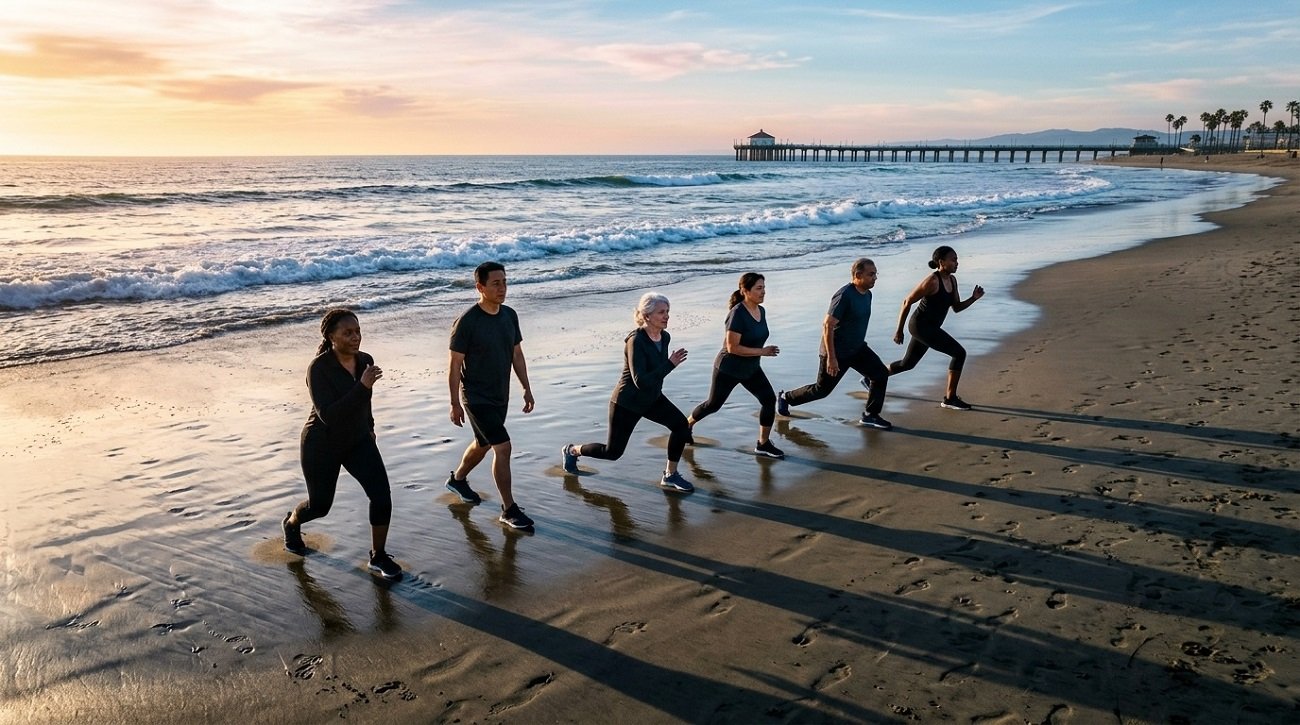
A man named Robert started at Focus Camp at 72. He had two knee replacements, a shoulder surgery, and hadn’t done anything more physical than walking to his car in over 15 years. Four months later, he did walking lunges on the sand at Venice Beach.
Fear #2: “I’ll Hurt Myself.”
The risk of NOT exercising after 50 is far greater than the risk of exercising properly. Sedentary older adults have 2–3x higher risk of heart disease, 2x higher risk of diabetes, and 3x higher risk of falls.
Fear #3: “I’ll Look Foolish.”
Nobody is watching you. Everyone in a fitness session is focused on their own workout. And if a gym environment genuinely makes you uncomfortable? Train outdoors. No mirrors. No audience. Just you and the ocean.
Fear #4: “My Body Can’t Handle It.”
Your body can handle more than you think. We start with walking on sand for 10 minutes. That’s it.
Fear #5: “I Don’t Know Where to Start.”
That’s what the rest of this article is for.
What Happens When You Start Moving
Days 1–7: Your Brain Changes First
Exercise triggers endorphins, serotonin, and BDNF. Most clients sleep better within the first three sessions. Anxiety drops. These are neurological effects that happen before any visible physical change.
Weeks 2–4: Your Muscles Wake Up
Your nervous system is learning to activate muscle fibers more efficiently. You’ll notice stairs feel easier, getting up from chairs requires less effort, and you have more energy.
Weeks 4–8: Real Physical Changes Start
Muscle tone improves. Body fat starts to decrease. Blood pressure drops. Balance improves. Joint stiffness decreases.
Months 2–3: People Around You Notice
Measurable increases in muscle mass. Significant fat reduction. Dramatically improved endurance. Sharper cognitive function.
Months 3–6: The Transformation
10–20+ pounds of fat loss. Visible muscle definition. Dramatically improved balance. Reduced medication needs. A complete shift in how you feel about your body.
The Doctor Conversation You Need to Have
Before you start any exercise program after 50, go to your doctor. Here’s exactly what to ask for:
| What to Ask | Why It Matters |
|---|---|
| Exercise clearance | Ensures no contraindications for physical activity |
| Cardiovascular screening | Establishes safe heart rate range, especially if on medication |
| Joint assessment | Identifies which movements to prioritize or avoid |
| Bone density check (DEXA scan) | Determines if you have osteopenia or osteoporosis |
| Medication review | Some meds affect heart rate, blood sugar, or recovery |
| Blood work (Vitamin D, glucose, lipids, thyroid) | Provides baseline to measure progress |
| Age | Target HR Zone (50–70%) | Max Heart Rate (Est.) |
|---|---|---|
| 50 | 85–119 bpm | 170 bpm |
| 55 | 83–116 bpm | 165 bpm |
| 60 | 80–112 bpm | 160 bpm |
| 65 | 78–109 bpm | 155 bpm |
| 70 | 75–105 bpm | 150 bpm |
| 75 | 73–102 bpm | 145 bpm |
Your First 30 Days: Week-by-Week Plan
Week 1: Just Show Up (10–15 Min, 3 Days)
| Exercise | Duration/Reps | Notes |
|---|---|---|
| Walk | 10 minutes | Flat surface, comfortable pace. You should be able to talk easily |
| Gentle stretching | 5 minutes | Neck rolls, shoulder circles, hamstring stretch, calf stretch |
Week 2: Add Structure (15–20 Min, 3 Days)
| Exercise | Sets × Reps | Notes |
|---|---|---|
| Walk | 10 minutes | Slightly faster — can talk, feel warmth in chest |
| Chair squats | 2 × 5 | Sit down on chair, stand up. Use hands if needed |
| Wall push-ups | 2 × 5 | Hands at shoulder height, lean in, push back |
| Balance stand | 2 × 10 sec/leg | Hold wall for support. Let go if stable |
| Stretching | 5 minutes | Focus on whatever feels tight |
Week 3: Build Confidence (20–25 Min, 3–4 Days)
| Exercise | Sets × Reps | Notes |
|---|---|---|
| Walk | 12 minutes | Include one gentle incline if available |
| Chair squats | 3 × 8 | Try without using hands on the way down |
| Wall push-ups | 3 × 8 | Slow: 2 sec down, 1 sec pause, 2 sec up |
| Calf raises | 2 × 10 | Hold wall. Rise on toes, hold 1 sec, lower slowly |
| Balance stand | 2 × 15 sec/leg | Try letting go of wall |
| Cool-down stretch | 5 minutes | Hamstrings, calves, hip flexors, shoulders |
Week 4: You’re Exercising Now (25-30 Min, 4 Days)
| Exercise | Sets × Reps | Notes |
|---|---|---|
| Walk | 15 minutes | Mix flat and gentle incline |
| Bodyweight squats | 3 × 10 | No chair. Feet shoulder-width. Go as low as comfortable |
| Incline push-ups | 3 × 10 | Hands on bench, step, or sturdy table |
| Calf raises | 3 × 12 | Full range of motion |
| Glute bridges | 3 × 10 | Lie on back, push hips up, squeeze glutes |
| Balance stand | 2 × 20 sec/leg | Try closing eyes for 5 sec if stable |
| Breathing cool-down | 5 minutes | 4-count inhale, 4-count hold, 6-count exhale |
The 10 Best Exercises for Beginners Over 50
1. Walking
A study in the New England Journal of Medicine found that 30 minutes of brisk walking five days a week reduced cardiovascular disease risk by up to 35% and dementia risk by up to 40%.
Proper form: Stand tall, shoulders back. Bend elbows to 90°. Land softly — heel first, roll through foot, push off toes. Breathe in through nose (3-4 counts), out through mouth (3-4 counts).
| Week | Duration | Pace | Frequency |
|---|---|---|---|
| 1–2 | 10 min | Comfortable conversation | 3 days/week |
| 3–4 | 15 min | Slightly brisker | 3–4 days/week |
| 5–6 | 20–25 min | Brisk — talking requires effort | 4–5 days/week |
| 7–8 | 30 min | Brisk | 5 days/week |
| 9+ | 30–45 min | Brisk to fast | 5+ days/week |
Walking on sand requires 2.1–2.7x more mechanical work than pavement, reduces joint impact by up to 50%, and engages stabilizer muscles with every step.
2. Chair-Supported Squats
The most functional exercise in existence. Every time you sit, stand, get out of a car, or climb stairs — you’re squatting.
How: Stand in front of a sturdy chair. Push hips back. Lower yourself slowly (3 seconds). Pause 1 second at bottom. Stand up by driving through heels.
| Level | Exercise | Sets × Reps |
|---|---|---|
| Week 1–2 | Chair squat (sit fully) | 2 × 5 |
| Week 3–4 | Chair squat (sit fully) | 3 × 8 |
| Week 5–6 | Chair squat (hover above seat) | 3 × 10 |
| Week 7–8 | Bodyweight squat (no chair) | 3 × 10 |
| Week 9+ | Bodyweight squat (deeper) | 3 × 12–15 |
3. Wall Push-Ups
Strengthens chest, shoulders, triceps, and core. Counters forward-hunched posture.
How: Stand arm’s length from wall. Hands at shoulder height. Slowly lean in (2 sec), push back (2 sec).
| Level | Exercise | Sets × Reps |
|---|---|---|
| Week 1–2 | Wall push-ups | 2 × 5 |
| Week 3–4 | Wall push-ups | 3 × 8 |
| Week 5–6 | Incline push-ups (bench) | 3 × 8 |
| Week 7–8 | Incline push-ups | 3 × 10 |
| Week 9+ | Knee or full push-ups | 3 × 8–10 |
4. Glute Bridges
Strengthens glutes, hamstrings, and lower back. Zero impact, very safe.
How: Lie on back, knees bent, feet flat. Push hips up through heels. Squeeze glutes at top (2 sec hold). Lower slowly (3 sec).
| Level | Exercise | Sets × Reps |
|---|---|---|
| Week 1–2 | Two-leg glute bridge | 2 × 8 |
| Week 3–4 | Two-leg (2 sec hold) | 3 × 10 |
| Week 5–6 | Two-leg (3 sec hold) | 3 × 12 |
| Week 7–8 | Single-leg | 2 × 8/leg |
| Week 9+ | Single-leg (3 sec hold) | 3 × 10/leg |
5. Standing Balance Exercises
Falls are the leading cause of injury-related death in adults over 65. Balance training prevents them.
| Level | Exercise | Duration |
|---|---|---|
| Week 1–2 | One-leg stand, eyes open, hand on wall | 10 sec/leg |
| Week 3–4 | One-leg, eyes open, fingertip on wall | 15 sec/leg |
| Week 5–6 | One-leg, eyes open, no support | 20 sec/leg |
| Week 7–8 | One-leg, eyes closed, fingertip on wall | 10 sec/leg |
| Week 9+ | One-leg, eyes closed, no support | 15+ sec/leg |
6. Seated Calf Raises
Calf strength directly correlates with fall risk. Strong calves = stable ankles.
| Level | Exercise | Sets × Reps |
|---|---|---|
| Week 1–2 | Seated calf raises | 2 × 10 |
| Week 3–4 | Seated calf raises | 3 × 15 |
| Week 5–6 | Standing (holding wall) | 3 × 12 |
| Week 7–8 | Standing (no support) | 3 × 15 |
| Week 9+ | Standing on step (full range) | 3 × 15 |
7. Resistance Band Pull-Aparts
Strengthens upper back and rear shoulders. Directly counters “forward syndrome” — the hunched posture from decades of sitting.
8. Dead Bugs (Core Stability)
Trains deep core muscles that protect your lower back. Far safer than crunches for older adults.
| Level | Exercise | Sets × Reps |
|---|---|---|
| Week 1–2 | Dead bug – just arms | 2 × 6/side |
| Week 3–4 | Dead bug – just legs | 2 × 6/side |
| Week 5–6 | Opposite arm and leg | 3 × 8/side |
| Week 7–8 | 3 sec hold at extension | 3 × 8/side |
| Week 9+ | Slow tempo (4 sec out, 4 sec back) | 3 × 10/side |
9. Gentle Yoga or Chair Yoga
You don’t need to be flexible to start yoga. That’s like saying you need to be clean before you shower. Yoga improves flexibility, balance, strength, breathing, stress reduction, and body awareness.
10. Deep Breathing Exercises
The 4-7-8 technique: Breathe in through nose for 4 counts. Hold for 7 counts. Exhale through mouth for 8 counts. Repeat 4-6 times. Do this every morning, before/after workouts, and before bed.
The 7 Mistakes That Hurt Older Beginners
| # | Mistake | Why It’s Dangerous | The Fix |
|---|---|---|---|
| 1 | Going too hard on day one | Extreme soreness → quitting | Start at 50% of what you think you can do |
| 2 | Skipping warm-up/cool-down | Cold muscles = injury-prone muscles | 5-8 min warm-up, 5 min cool-down every session |
| 3 | Ignoring pain | Pain = injury signal. Ignoring it = worse injury | Stop immediately if sharp/joint pain. Modify or skip |
| 4 | Copying younger people’s workouts | 25-year-old programs don’t fit 60-year-old bodies | Follow age-appropriate programs |
| 5 | Only doing cardio | Doesn’t prevent muscle loss or build bone density | Combine cardio + resistance + balance |
| 6 | Comparing yourself to others | Kills motivation, creates unrealistic expectations | Compare only to yesterday’s you |
| 7 | Going alone without guidance | Bad form → injury. No accountability → quitting | Invest in 4-6 private coaching sessions |
Strength Training After 50: Not Optional
If you’re over 50 and not doing resistance training, you’re losing muscle mass right now. The American Heart Association recommends resistance training at least 2 days per week for all adults.
| Resistance Source | Examples | Cost |
|---|---|---|
| Body weight | Squats, push-ups, lunges, glute bridges | Free |
| Resistance bands | Pull-aparts, rows, presses | $10–$25 |
| Household items | Water bottles, backpack with books | Free |
| Sandbags | Carries, cleans, squats | $20–$50 |
| Outdoor terrain | Sand, hills, stairs | Free |
Nutrition: What Actually Matters
| Age Group | Protein Intake | Source |
|---|---|---|
| Adults 19–50 | 0.8 g/kg (0.36 g/lb) | RDA (minimum) |
| Adults 50–65 | 1.0–1.2 g/kg (0.45–0.55 g/lb) | Harvard Health |
| Adults 65+ | 1.2–2.0 g/kg (0.55–0.9 g/lb) | NIH, ACL.gov |
| Food | Protein per Serving | Notes |
|---|---|---|
| Chicken breast (4 oz) | ~35g | Lean, versatile |
| Salmon (4 oz) | ~25g | Also omega-3s |
| Eggs (2 large) | ~12g | Cheap, easy, complete |
| Greek yogurt (1 cup) | ~15–20g | Great for breakfast |
| Cottage cheese (1 cup) | ~25g | Slow-digesting, good before bed |
| Lentils (1 cup cooked) | ~18g | Plant-based, high fiber |
| Protein powder (1 scoop) | ~20–30g | Convenient supplement |
Hydration: Drink half your body weight in ounces per day. Add 16–20 oz per hour of exercise.
LA’s Outdoor Advantage
| Location | Surface | Best For | Joint Impact |
|---|---|---|---|
| Venice Beach | Soft sand | Fat-loss circuits, conditioning | Very low |
| Manhattan Beach | Packed sand | Walking, jogging, sprints | Low |
| Baldwin Hills | Paved stairs (282) | Lower-body power, cardio | Moderate |
| Griffith Park | Grass, dirt trails | Trail running, endurance | Low-moderate |
| Kenneth Hahn | Paved paths + grass | Walking, hiking, yoga | Low |
| Santa Monica | Flat grass + beach | Walking, circuits, yoga | Very low |
| Time | Temp | Crowds | Air Quality | Best For |
|---|---|---|---|---|
| 6–8 AM | Cool | Low | Best | Beach, stairs, trails |
| 8–10 AM | Comfortable | Moderate | Good | All outdoor activities |
| 10 AM–2 PM | Warm/hot | High | Moderate | Shaded parks only |
| 4–6 PM | Cooling | Moderate | Good | Beach, park circuits |
| 6–8 PM | Cool | Low | Good | Evening walks |
Self-Directed vs. With a Coach
| Factor | Self-Directed | With a Coach |
|---|---|---|
| Form correction | You can’t see yourself | Real-time correction |
| Program design | Generic (YouTube) | Personalized to your body |
| Progression | Guesswork | Calculated, safe |
| Accountability | Easy to skip | Someone waiting for you |
| Injury risk | Higher | Lower (professional oversight) |
| Motivation | Depends on willpower | Built into the relationship |
Realistic Results Timeline
| Timeframe | What You’ll Experience |
|---|---|
| Days 1–7 | Better sleep, reduced anxiety, more energy |
| Weeks 2–4 | Stairs easier, less stiffness, more energy, 2–4 lb fat loss |
| Weeks 4–8 | Muscle tone visible, blood pressure dropping, balance improving |
| Months 2–3 | 5–10 lb fat loss, people noticing, dramatically better endurance |
| Months 3–6 | 10–20+ lb fat loss, visible definition, reduced meds, complete transformation |
Frequently Asked Questions
Am I too old to start? No. A BMJ study found significant improvements in people who started in their 60s and 70s.
How much exercise per week? 150 min moderate cardio + 2 days resistance training + 3 days balance exercises + 2–3 days flexibility. Build toward this over 8–12 weeks.
Best exercise for a 60-year-old beginner? Walking. Then add bodyweight squats and wall push-ups. Then balance exercises.
Safe to lift weights after 50? Yes — and strongly recommended. Start with bodyweight, progress to bands, then light weights.
How long until results? Mental benefits: 1–2 weeks. Strength: 2–4 weeks. Visible changes: 4–8 weeks. Body composition: 8–12 weeks.
Arthritis / bad knees? Exercise is one of the most effective treatments. Low-impact movement improves joint health.
Exercise on medication? Usually yes — and it often helps. Get doctor’s clearance first.
How to stay motivated? Make it social, make it enjoyable, track your progress.
Your Next Step
Start with Week 1. Walk for 10 minutes, three times this week. Build the habit. Everything else follows.
Ready for guidance?
Our private coaching is designed for people exactly where you are right now.
Your body has been waiting for you. It’s time to answer.
By François & Tina — Focus Camp, Los Angeles. Learn more about our programs.
3 Responses