The Walk That Changed Everything
Linda was 54 when she sat in my office at Focus Camp and said something I’ve never forgotten:
“I don’t want to be an athlete. I just want to walk to the grocery store without my knees hurting and my back aching. That’s it. That’s my whole fitness goal.”— Linda, 54, Mar Vista
She wasn’t asking for a six-pack. She wasn’t training for a marathon. She wanted to walk. Three blocks to the store, pick up a few things, and walk back. Without pain. Without needing to sit down on a bench halfway. Without arriving home exhausted and wondering what happened to her body.
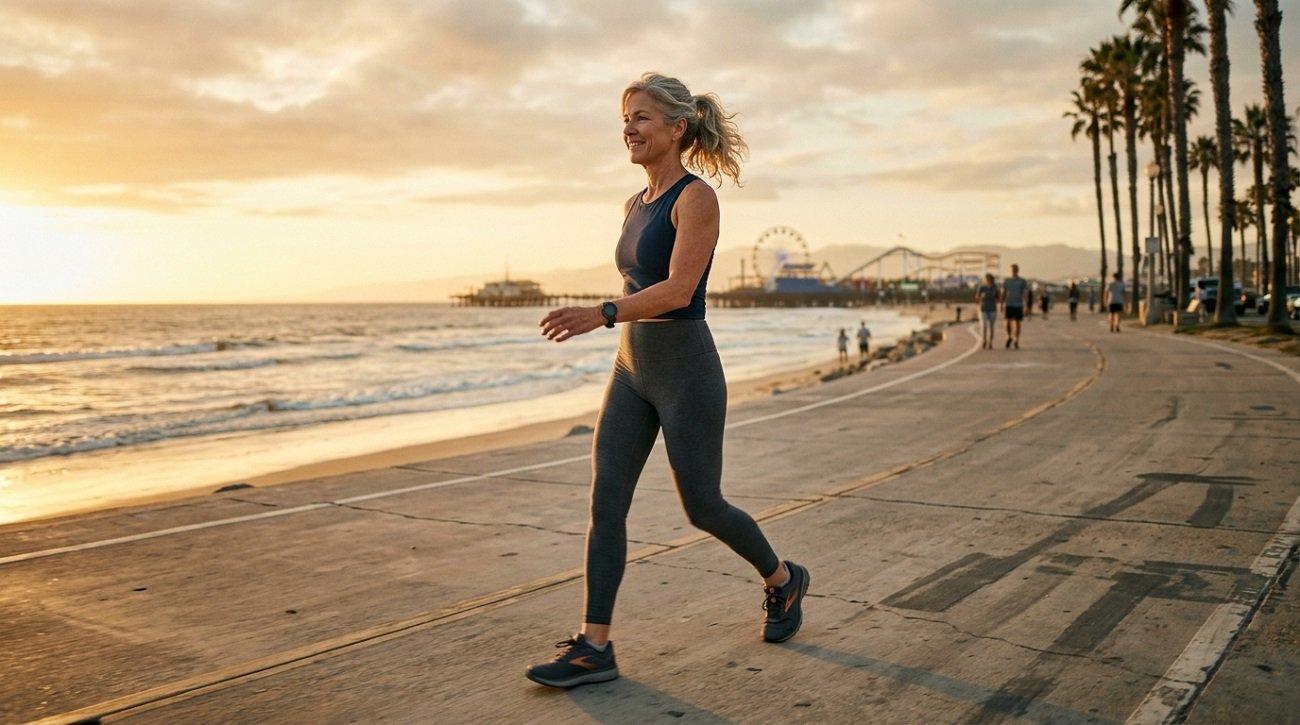
That was fourteen months ago. Linda now walks five miles on the Strand in Santa Monica every Saturday morning. She’s lost 28 pounds. Her doctor took her off blood pressure medication. She did a 5K charity walk in March — her first ever — and finished with a smile on her face.
She didn’t join a gym. She didn’t do CrossFit. She didn’t buy a Peloton. She walked.
That’s what this article is about. Walking — the simplest, most accessible, and most underrated form of exercise that exists — and how to use it strategically to lose weight, reduce belly fat, and completely change how your body feels after 50.
And because I live and train people in Los Angeles, I’m going to give you specific routes, specific programs, and specific details that work for this city. The flat beach paths. The hidden neighborhood loops. The trails that won’t destroy your knees. All of it.
Let’s get into it.
Why Walking Is the Best Exercise for Weight Loss After 50
I need to say something that might sound controversial coming from a fitness trainer: walking is the single best exercise you can do for weight loss after 50.
Not running. Not HIIT. Not spin class. Walking.
Here’s why.
1. It Doesn’t Destroy Your Joints
Every time your foot hits the ground while running, your joints absorb roughly 2.5 times your body weight in impact force. For a 180-pound person, that’s 450 pounds of force per step, thousands of times per mile. After 50, when cartilage is thinner and joints are stiffer, that impact adds up fast. Knee pain. Hip pain. Shin splints. Plantar fasciitis.
Walking? The impact force is roughly 1.2 times your body weight. Less than half of running. You can walk every single day without the cumulative joint damage that running causes.
A 2026 comparison study published by GoodRx confirmed what physical therapists have been saying for decades: for adults over 50, those carrying excess weight, or anyone with chronic joint issues, walking provides the fat-burning benefits of cardio with a fraction of the injury risk.
2. You Can Actually Do It Every Day
The best exercise for weight loss isn’t the one that burns the most calories in a single session. It’s the one you’ll actually do consistently, day after day, week after week. And here’s the thing about running or high-intensity workouts after 50: they beat you up. You need recovery days. Your knees ache. Your back is stiff. You skip sessions because your body needs rest.
Walking doesn’t need recovery days. You can walk today, tomorrow, and the next day. Your body recovers while you’re doing it. That consistency — that ability to show up every single day without punishment — is what drives real, lasting weight loss.
3. It Burns More Calories Than You Think
Most people dramatically underestimate how many calories walking burns. A 160-pound person walking at a brisk pace (3.5 mph) for 60 minutes burns approximately 280-320 calories. Do that five days a week, and you’re burning an extra 1,400-1,600 calories per week. Over a month, that’s 5,600-6,400 calories — enough to lose roughly 1.5 to 2 pounds of fat without changing anything else.
Add a modest dietary change (cutting 200-300 calories per day), and you’re looking at 3-4 pounds of fat loss per month. That’s 36-48 pounds in a year. From walking.
4. It Preserves Muscle While Burning Fat
This is a big one that most people miss. High-intensity cardio (running, cycling, HIIT) can actually break down muscle tissue, especially in adults over 50 who aren’t eating enough protein. You lose weight, but a chunk of that weight is muscle — which is exactly what you don’t want.
Walking, especially brisk walking and incline walking, preserves muscle mass while primarily burning fat. A study published in the PMC found that regular walking exercise reduced abdominal fat while maintaining lean muscle mass in middle-aged adults. That means the weight you lose is mostly the weight you want to lose.
Walking vs. Running: The Real Comparison
Running burns roughly 2x more calories per minute than walking. But because walking is low-impact, you can do it longer, more often, and without injury breaks. Over a month, a consistent walker often burns more total calories than an inconsistent runner who’s nursing a sore knee every other week.
The Science: What Walking Actually Does to Your Body After 50
Walking isn’t just “better than nothing.” It triggers specific physiological changes in your body that directly combat the effects of aging. Here’s what happens when you walk regularly, backed by real research:
| Body System | What Walking Does | Timeline | Research Source |
|---|---|---|---|
| Body Fat | Reduces total body fat, especially visceral (belly) fat | 4-8 weeks | PMC, Journal of Obesity |
| Insulin Sensitivity | Improves how your body processes sugar, reducing diabetes risk | 2-4 weeks | PMC, Diabetes Care |
| Blood Pressure | Lowers systolic and diastolic blood pressure | 3-6 weeks | American Heart Association |
| Heart Health | Strengthens the heart, improves circulation, lowers resting heart rate | 4-8 weeks | CDC Physical Activity Guidelines |
| Joint Health | Lubricates joints, reduces stiffness, strengthens supporting muscles | 2-4 weeks | Arthritis Foundation |
| Bone Density | Weight-bearing nature slows bone loss | 3-6 months | NIH Osteoporosis Research |
| Mental Health | Reduces anxiety, depression, and cortisol (stress hormone) | 1-2 weeks | Harvard Health, 2026 |
| Sleep Quality | Improves sleep duration and quality | 1-3 weeks | Sleep Medicine Reviews |
| Metabolism | Boosts metabolic rate, especially with interval walking | 4-6 weeks | Journal of Sports Medicine |
| Cognitive Function | Improves memory, focus, and reduces dementia risk | 6-12 weeks | Harvard Health, 2026 |
The Visceral Fat Connection
This deserves special attention because it’s the number one reason people over 50 struggle with their weight.
There are two types of body fat: subcutaneous fat (the stuff you can pinch under your skin) and visceral fat (the deep fat that wraps around your organs in your abdomen). Visceral fat is the dangerous one. It’s linked to heart disease, type 2 diabetes, inflammation, and even certain cancers.
After 50, hormonal changes — especially the drop in estrogen during menopause for women and the gradual testosterone decline in men — cause your body to store more fat viscerally. That’s why many people notice their belly getting bigger even though their overall weight hasn’t changed much.
Here’s the good news: walking is particularly effective at reducing visceral fat. A study published in the Journal of Obesity found that regular moderate-intensity walking significantly reduced visceral fat in adults over 50, even when total body weight didn’t change dramatically. Your body can get healthier and your belly can get smaller even if the scale doesn’t move as fast as you’d like.
The Metabolism Question
Your metabolism slows down as you age. After 50, you burn roughly 1-2% fewer calories per decade. That sounds small, but it adds up — it can mean 100-200 fewer calories per day by the time you’re 60.
Walking helps in two ways. First, it burns calories directly. Second, it helps maintain and build lean muscle mass (especially in your legs and core), which is the primary driver of your resting metabolic rate. More muscle = higher metabolism = more calories burned even when you’re sitting on the couch.
And if you want to give your metabolism an extra kick, interval walking — alternating between fast and slow paces — has been shown to boost metabolic rate for hours after your walk is over. More on that in the next section.
Calorie Burn: How Much You Actually Burn Walking
Let me give you real numbers. Not estimates from some random calculator — actual data based on walking research at different paces and body weights.
Calories Burned in 60 Minutes of Walking
| Walking Pace | Speed | 130 lbs | 155 lbs | 180 lbs | 205 lbs |
|---|---|---|---|---|---|
| Slow Stroll | 2.0 mph | 148 cal | 176 cal | 204 cal | 233 cal |
| Casual Walk | 2.5 mph | 177 cal | 211 cal | 245 cal | 279 cal |
| Moderate Walk | 3.0 mph | 195 cal | 232 cal | 270 cal | 307 cal |
| Brisk Walk | 3.5 mph | 224 cal | 267 cal | 311 cal | 354 cal |
| Power Walk | 4.0 mph | 265 cal | 316 cal | 366 cal | 417 cal |
| Brisk + Incline (5%) | 3.5 mph | 295 cal | 352 cal | 408 cal | 465 cal |
| Interval Walk (fast/slow) | 3.5-4.0 mph | 310 cal | 370 cal | 430 cal | 490 cal |
Look at that bottom row. Interval walking — alternating between fast and slow paces — burns nearly 40% more calories than a casual stroll at the same total time. That’s because the faster intervals push your heart rate up, and your body continues burning extra calories for hours after the walk is over (a phenomenon called EPOC, or excess post-exercise oxygen consumption).
The Key Insight
Pace matters more than distance. A 160-pound person walking 3 miles at 3.5 mph (51 minutes) burns about 280 calories. The same person walking 3 miles at 2.5 mph (72 minutes) burns about 250 calories — and took 21 minutes longer. Walk faster, not just farther.
Weekly Calorie Burn at Different Frequencies
| Frequency | Duration | Pace | Weekly Burn (155 lbs) | Monthly Fat Loss |
|---|---|---|---|---|
| 3 days/week | 30 min | Moderate (3.0) | 348 cal | ~0.4 lbs |
| 4 days/week | 45 min | Brisk (3.5) | 801 cal | ~0.9 lbs |
| 5 days/week | 45 min | Brisk (3.5) | 1,001 cal | ~1.1 lbs |
| 5 days/week | 60 min | Brisk (3.5) | 1,335 cal | ~1.5 lbs |
| 5 days/week | 60 min | Interval | 1,850 cal | ~2.1 lbs |
| 6 days/week | 60 min | Interval | 2,220 cal | ~2.5 lbs |
That last row — six days a week, 60 minutes, interval walking — burns over 2,200 extra calories per week. That’s nearly two-thirds of a pound of pure fat, every week, from walking alone. Combine it with modest dietary changes, and you’re looking at 3-4 pounds of fat loss per month.
The Japanese Interval Walking Method (The Biggest Walking Trend of 2026)
If you’ve been hearing about “Japanese Walking” or “Japanese Interval Walking” lately, there’s a good reason. It’s one of the most researched and effective walking methods for fat loss in adults over 50 — and it’s incredibly simple.
What Is It?
Japanese Interval Walking Training (IWT) was developed by researchers at Shinshu University in Japan. The protocol is straightforward:
- Walk fast for 3 minutes — at a pace where talking is difficult (about 70% of your max effort)
- Walk slow for 3 minutes — at a comfortable recovery pace (about 40% of your max effort)
- Repeat for 30 minutes total (5 rounds of fast/slow)
- Do this at least 4 days per week
That’s it. No complicated choreography. No sprinting. No equipment. Just alternating between “I can feel my heart rate going up” and “this feels easy” every three minutes.
What Does the Research Say?
This is where it gets interesting. A landmark study published in the journal Hypertension Research followed over 700 adults aged 60-85 who practiced Japanese Interval Walking for several months. The results were striking:
| Outcome | Interval Walking Group | Continuous Moderate Walking Group |
|---|---|---|
| Abdominal visceral fat reduction | Significant decrease | Moderate decrease |
| Leg strength increase | +13% | +5% |
| Blood pressure improvement | Significant reduction | Moderate reduction |
| Peak aerobic capacity (VO2) | +10% | +4% |
| Waist circumference reduction | -2.1 cm average | -0.8 cm average |
| Overall body fat percentage | Significant decrease | Slight decrease |
The interval walkers lost more than twice the visceral fat and gained more than twice the leg strength compared to the continuous moderate walkers. And both groups spent the same total time walking — the only difference was the pace variation.
A 2026 TIME magazine feature on the trend confirmed that researchers believe the alternating intensity pushes your body into a higher metabolic state that persists even after the walk is over — something steady-pace walking doesn’t do as effectively.
How to Start Japanese Interval Walking
| Week | Fast Interval | Slow Interval | Rounds | Total Time |
|---|---|---|---|---|
| 1-2 | 2 min fast | 3 min slow | 4 rounds | 20 min |
| 3-4 | 3 min fast | 3 min slow | 4 rounds | 24 min |
| 5-6 | 3 min fast | 3 min slow | 5 rounds | 30 min |
| 7-8 | 3 min fast | 2 min slow | 5 rounds | 25 min |
| 9-10 | 3 min fast | 2 min slow | 6 rounds | 30 min |
| 11-12 | 4 min fast | 2 min slow | 5 rounds | 30 min |
What “Fast” Actually Means
Fast doesn’t mean running. It means walking at a pace where you’re breathing noticeably harder, your heart rate is up, and talking in full sentences becomes difficult. For most people over 50, that’s around 3.5-4.5 mph. If you can’t talk at all, you’re going too fast. If you can sing, you’re going too slow.
The 12-Week Walking Program for Weight Loss After 50
Here’s a complete, progressive walking program designed specifically for adults over 50 who want to lose weight. It starts easy and builds gradually — because the fastest way to fail is to do too much too soon.
1
Phase 1: Foundation (Weeks 1-4)
Goal: Build the habit. Get your body used to daily movement. Don’t worry about speed.
| Week | Days | Duration | Pace | Focus |
|---|---|---|---|---|
| 1 | 4 days | 15-20 min | Comfortable (2.5 mph) | Just show up. Walk the same route each time so you don’t have to think. |
| 2 | 4 days | 20-25 min | Comfortable (2.5-3.0 mph) | Add 5 minutes. Notice how your body feels during and after. |
| 3 | 5 days | 25-30 min | Moderate (3.0 mph) | Add one more walking day. Pick up the pace slightly. |
| 4 | 5 days | 30 min | Moderate (3.0 mph) | 30 minutes should feel comfortable now. You’ve built the foundation. |
Daily step goal: 4,000-5,000 steps (including your walking session + normal daily movement)
2
Phase 2: Building (Weeks 5-8)
Goal: Increase intensity. Introduce brisk walking and gentle hills. Start burning serious calories.
| Week | Days | Duration | Pace | Focus |
|---|---|---|---|---|
| 5 | 5 days | 35 min | Brisk (3.5 mph) | Increase pace. You should be breathing harder but still able to talk. |
| 6 | 5 days | 40 min | Brisk (3.5 mph) | Add 5 minutes. Try a route with gentle inclines once this week. |
| 7 | 5 days | 40 min | Brisk + 1 hill | Include one moderate hill or incline in your route. Walk it at a steady pace. |
| 8 | 5 days | 45 min | Brisk + hills | 45 minutes is your new normal. Hills should feel manageable. |
Daily step goal: 6,000-7,500 steps
3
Phase 3: Fat Burning (Weeks 9-12)
Goal: Introduce interval walking. Maximize calorie burn. This is where the real transformation happens.
| Week | Days | Duration | Method | Focus |
|---|---|---|---|---|
| 9 | 5 days | 40 min | 3 fast / 3 slow × 5 rounds + warm-up | First interval week. Keep “fast” at brisk walk pace, not a jog. |
| 10 | 5 days | 45 min | 3 fast / 3 slow × 5 rounds + warm-up | Increase fast pace slightly. You should be breathing noticeably harder. |
| 11 | 5-6 days | 45 min | 3 fast / 2 slow × 6 rounds + warm-up | Shorter recovery. Your body is adapting. Add a 6th day if you feel good. |
| 12 | 5-6 days | 50 min | 4 fast / 2 slow × 5 rounds + warm-up | Longer fast intervals. By now, your body is a fat-burning machine. |
Daily step goal: 8,000-10,000 steps
Important Note
Always start each session with 5 minutes of easy walking to warm up, and end with 5 minutes of easy walking to cool down. The warm-up and cool-down are included in the total duration times above. Don’t skip them — they protect your joints and help your heart rate transition smoothly.
10 Best Walking Routes in Los Angeles for Weight Loss
Los Angeles is one of the best cities in the country for walking — if you know where to go. Here are my top picks, organized by difficulty level, that I recommend to our Focus Camp members. Each one has been walked hundreds of times by people in our program.
🏖️ Santa Monica Beach Bike PathEasy
This is the gold standard for flat, easy walking in LA. A paved path that runs along the ocean from Pacific Palisades down through Santa Monica, past the pier, and all the way to Venice. The ocean breeze keeps you cool, the views keep you motivated, and the flat terrain is perfect for beginners or anyone with knee issues.
Distance
3-5 miles one way
Terrain
Flat, paved
Elevation
~0 ft gain
Best Time
Before 10 AM
Parking: Lot 4 (Broadway/Ocean) or metered parking on Ocean Ave. Weekend mornings fill up fast — arrive by 8 AM.
🌊 Venice Boardwalk to Marina del ReyEasy
Start at the Venice Boardwalk and head south along the Strand through Marina del Rey. Less crowded than the Santa Monica section, with a wider path and more breathing room. You’ll pass the marina, watch the boats, and finish near Dockweiler Beach.
Distance
4-6 miles
Terrain
Flat, paved/concrete
Elevation
~0 ft gain
Best Time
Morning or sunset
Parking: Free lot at Venice Beach (2100 Ocean Front Walk) or metered on Washington Blvd.
🌳 Lake Hollywood TrailEasy
A hidden gem that most tourists don’t know about. A flat, paved loop around the Hollywood Reservoir with stunning views of the Hollywood Sign and the Hollywood Hills. Quiet, shaded in parts, and perfect for interval walking because the flat terrain lets you control your pace precisely.
Distance
3.3-mile loop
Terrain
Flat, paved
Elevation
~50 ft gain
Best Time
Early morning
Parking: Free street parking on Lake Hollywood Dr. Limited spots — go early on weekends.
🏟️ Rose Bowl Loop (Pasadena)Easy
A flat, 3-mile loop around the iconic Rose Bowl stadium. Popular with walkers, joggers, and families. The path is wide, well-maintained, and completely flat. There’s something motivating about walking alongside dozens of other people who are all there to move their bodies.
Distance
3-mile loop
Terrain
Flat, paved
Elevation
~20 ft gain
Best Time
Anytime (lit at night)
Parking: Free in Lot I or Lot H (off Seco St). Very accessible.
🌿 Elysian Park LoopModerate
LA’s oldest park and one of its most underrated walking spots. The West Loop is a gentle 2.5-mile trail with rolling hills, shaded paths, and views of downtown LA. The terrain is dirt and gravel in places, which is actually better for your joints than concrete — the slight give absorbs impact.
Distance
2.5-mile loop
Terrain
Dirt, gravel, some pavement
Elevation
~200 ft gain
Best Time
Morning (cooler)
Parking: Free parking along Stadium Way or in the park lots.
🌺 The Strand: Manhattan Beach to Hermosa BeachEasy
South Bay’s answer to the Santa Monica path, but without the tourist crowds. A flat, paved path that runs along the beach from the Manhattan Beach Pier to the Hermosa Beach Pier and back. The round trip is about 4 miles — perfect for a 60-minute brisk walk.
Distance
4-mile round trip
Terrain
Flat, paved
Elevation
~0 ft gain
Best Time
Weekday mornings
Parking: Metered near Manhattan Beach Pier or free residential streets a few blocks inland.
🔭 Griffith Park: Observatory to Greek Theatre LoopModerate
For when you want something more challenging but still manageable. This loop starts at the Griffith Observatory parking area, follows the paved service road, and loops down to the Greek Theatre and back. Moderate inclines, incredible views of LA, and enough elevation to really feel it in your legs.
Distance
2.5-3 miles
Terrain
Paved road + dirt paths
Elevation
~300 ft gain
Best Time
Sunset (amazing views)
Parking: Free lot at the Observatory (fills fast on weekends) or Greek Theatre lot.
🌳 Kenneth Hahn State Recreation AreaModerate
A 400-acre park in the Baldwin Hills with multiple walking loops ranging from flat to moderately hilly. The Baldwin Hills Scenic Overlook trail is the challenging option (steep stairs), but the lower loop trails are perfect for brisk walking with gentle elevation changes.
Distance
1.5-4 miles (multiple loops)
Terrain
Paved + dirt trails
Elevation
100-400 ft gain
Best Time
Morning
Parking: $6 parking fee on weekends. Free on weekdays.
🚶 Runyon Canyon (Lower Loop Only)Moderate
Famous for celebrity sightings, but the full hike is too intense for most walkers. The lower loop, however — starting from the Fuller Ave entrance and taking the paved fire road — is a manageable 1.8-mile walk with moderate inclines and great views. Skip the steep upper trails unless you’re feeling strong.
Distance
1.8-mile loop
Terrain
Fire road (dirt/gravel)
Elevation
~200 ft gain
Best Time
Weekday mornings
Parking: Very limited. Street parking on Fuller Ave. Arrive before 8 AM on weekends.
🌹 Exposition Park to USC LoopEasy
A flat, urban walking route that takes you through Exposition Park (home of the Natural History Museum, the Coliseum, and the California Science Center), through the USC campus, and back. Paved sidewalks the entire way, with plenty of shade and interesting things to look at.
Distance
3-4 mile loop
Terrain
Flat, paved sidewalks
Elevation
~0 ft gain
Best Time
Morning or late afternoon
Parking: $15 at Exposition Park lots. Free metered parking on some surrounding streets on weekends.
Want Company on Your Walk?
Walking alone is great. Walking with a group is even better — the accountability and social connection make it much easier to stick with. At Focus Camp, we organize outdoor walking and training sessions across Los Angeles where you’ll walk with a small group led by a trainer who adjusts the pace to your level. Book a session if you’d like to try it.
What to Wear and Bring on Your Walking Workouts
You don’t need much to walk. But the right gear makes the difference between a walk you enjoy and a walk that gives you blisters, knee pain, or a sore back.
Shoes: The One Thing You Shouldn’t Cheap Out On
| Feature | Why It Matters | What to Look For |
|---|---|---|
| Arch Support | Prevents plantar fasciitis and knee pain | Matched to your foot type (flat, normal, high arch) |
| Cushioning | Absorbs impact, protects joints | At least 25mm stack height for walking |
| Wide Toe Box | Prevents bunions, blisters, and toe cramping | Toes should splay naturally, not be squeezed together |
| Heel Drop | Affects how your foot strikes the ground | 8-12mm drop for walking (higher = easier on calves) |
| Weight | Heavy shoes fatigue your legs faster | Under 10 oz per shoe for walking |
Recommended shoes for adults over 50: Brooks Ghost, New Balance 990, Hoka Clifton, ASICS Gel-Nimbus, Saucony Triumph. Go to a running store (not a department store) and get fitted. Most specialty stores in LA will analyze your gait for free.
Replace your shoes every 300-500 miles. If you walk 15 miles per week, that’s roughly every 5-7 months. Worn-out shoes lose their cushioning and support, and that’s when injuries happen.
Everything Else
| Item | Why You Need It | Notes |
|---|---|---|
| Moisture-wicking socks | Prevents blisters | Merino wool or synthetic blend. No cotton. |
| Sunscreen (SPF 50) | LA sun is strong year-round | Apply 15 min before you go out. Reapply every 2 hours. |
| Sunglasses | Protects eyes, reduces squinting headaches | UV400 protection minimum. |
| Water bottle | Hydration prevents fatigue and muscle cramps | Drink 8 oz before you start, 4-8 oz every 20 minutes. |
| Hat or visor | Shade for your face and head | Wide-brimmed for sun protection. Breathable material. |
| Phone (charged) | Safety, GPS tracking, music/podcasts | Use a walking app to track distance and pace. |
| Light layers | LA mornings can be cool, midday is warm | Wear a zip-up you can tie around your waist. |
What to Wear for LA Beach Walks
If you’re walking on the Santa Monica or Venice paths, the ocean breeze can be deceptive — you can still get badly sunburned. Wear sunscreen, sunglasses, and a hat even on overcast days. The UV index in LA is often high even when it’s cloudy.
Nutrition for Walking Weight Loss: What to Eat and When
Walking burns calories. But if you eat back everything you burn, you won’t lose weight. Here’s how to eat in a way that supports your walking program without starving yourself or feeling deprived.
The Simple Math
To lose one pound of fat, you need to burn roughly 3,500 more calories than you eat. If your walking program burns an extra 1,500 calories per week and you cut 200 calories per day from your diet (that’s roughly one sugary drink or a large handful of chips), you’re creating a weekly deficit of 2,900 calories. That’s nearly a pound of fat per week.
You don’t need a complicated diet. You need a modest, consistent calorie deficit.
What to Eat
| Nutrient | Why It Matters for Walkers Over 50 | Best Sources |
|---|---|---|
| Protein | Preserves muscle mass during weight loss. Repairs walking-related muscle micro-tears. | Chicken, fish, eggs, Greek yogurt, lentils, tofu |
| Complex Carbs | Fuels your walks. Prevents fatigue and muscle cramps. | Oatmeal, sweet potatoes, brown rice, whole grain bread, fruit |
| Healthy Fats | Reduces inflammation. Keeps you feeling full between meals. | Avocado, olive oil, nuts, salmon, seeds |
| Fiber | Improves digestion. Keeps blood sugar stable. Reduces hunger. | Vegetables, beans, whole grains, berries, broccoli |
| Water | Dehydration kills performance and recovery. Even 2% dehydration impairs your body. | Half your body weight in ounces daily. More on hot days. |
When to Eat Around Your Walks
| Timing | What to Eat | Why |
|---|---|---|
| 1-2 hours before walking | Light snack with carbs and a little protein | Fuels your walk without weighing you down |
| During walks (under 60 min) | Water only | You don’t need food for walks under an hour |
| Within 30 min after walking | Protein + carbs | Kickstarts recovery and muscle repair |
| Throughout the day | Protein at every meal (25-30g per meal) | Spreading protein intake preserves more muscle during weight loss |
Pre-walk snack ideas: Banana with a tablespoon of peanut butter. Half a slice of whole grain toast with avocado. A small handful of trail mix. Greek yogurt with berries.
Post-walk meal ideas: Eggs with whole grain toast. Grilled chicken salad. Protein smoothie with fruit and spinach. Salmon with sweet potato.
For a deeper dive into nutrition for outdoor fitness, check out our complete nutrition strategies guide.
The Mistakes That Kill Your Walking Results
I’ve watched hundreds of people start walking programs. The ones who succeed avoid these mistakes. The ones who fail almost always make at least two of them.
Mistake 1: Walking Too Slow to Matter
The Problem
You’re walking at a casual window-shopping pace — about 2.0 mph. Your heart rate barely rises. You don’t break a sweat. You feel like you exercised because you were on your feet for 45 minutes, but your body barely worked harder than sitting on the couch.
The Fix
Use the “talk test.” You should be able to hold a conversation, but with slightly labored breathing. If you can sing, walk faster. If you can’t talk at all, slow down. For most people, that’s 3.0-3.5 mph. A simple way to check: you should be able to say a full sentence but not tell a long story without pausing for breath.
Mistake 2: Same Route, Same Pace, Every Day
The Problem
You walk the same 2-mile loop at the same pace every single day. Your body adapted to it within the first two weeks. Now it’s comfortable, easy, and burning fewer calories than when you started.
The Fix
Vary your walks. Change the route. Add a hill. Increase the pace. Try interval walking on some days. Walk a longer distance on weekends. Your body responds to new challenges — give it some.
Mistake 3: Eating Back Everything You Burn
The Problem
You finish a 45-minute walk and reward yourself with a smoothie, a muffin, or an extra serving at dinner. That 300-calorie walk just got erased by a 400-calorie snack.
The Fix
Walk first, eat normally after. Don’t think of walking as earning the right to eat more. Think of it as burning fat on top of your normal diet. If you’re hungry after a walk, eat — but eat protein and vegetables, not a pastry.
Mistake 4: Skipping Strength Training
The Problem
You walk every day but never do any strength work. You lose weight, but some of it is muscle. Your metabolism slows. You hit a plateau.
The Fix
Add 2-3 days of simple strength exercises per week. Bodyweight squats, push-ups, and farmer’s carries are enough. This preserves your muscle mass while you lose fat, keeping your metabolism high. Our functional fitness article has a complete program you can combine with walking.
Mistake 5: Ignoring Pain Signals
The Problem
Your knee has been aching for a week, but you push through because “no pain, no gain.” The ache becomes sharp pain. Sharp pain becomes an injury. Injury becomes three weeks on the couch.
The Fix
Muscle soreness is normal. Joint pain is not. If something hurts during or after walking — especially in your knees, hips, or feet — rest for a day, check your shoes, and try a flatter route. If pain persists for more than a week, see a doctor. We cover this in our recovery techniques guide.
What Results to Expect (And When)
Based on the hundreds of people I’ve trained at Focus Camp, here’s what a consistent walking program actually delivers over time. These aren’t promises — they’re patterns I’ve seen repeatedly.
Week 1-2
You’ll Feel It Before You See It
Better energy. Improved mood. Your legs might be slightly sore — that’s normal. You probably won’t see any weight change yet, and that’s fine. Your body is adapting to the new movement.
Week 3-4
Sleep Improves, Clothes Feel Slightly Different
Your sleep quality noticeably improves. Your pants might feel a tiny bit looser around the waist — that’s visceral fat starting to reduce. The scale might not move much yet, but your body composition is shifting.
Week 5-8
Visible Changes
Your face looks slimmer. Your waistline is visibly smaller. Friends start asking if you’ve lost weight. You can walk farther and faster without getting tired. The scale shows 4-8 pounds down.
Week 9-12
Real Transformation
Significant weight loss (8-15 pounds for most people). Measurably lower blood pressure. Better blood sugar numbers at your next doctor visit. You feel confident, energetic, and in control of your body. Walking feels effortless.
Month 4-6
A New You
15-25 pounds lost. Dramatically improved cardiovascular fitness. People who haven’t seen you in a while do a double-take. You’ve built a habit that you actually enjoy and don’t want to stop.
“I started walking because I wanted to lose weight. I kept walking because of how it made me feel. The weight loss was a bonus — the energy and confidence were the real prize.”— Linda, 54, after 14 months of walking
Frequently Asked Questions
Can you lose weight just by walking after 50?+How much should I walk per day to lose weight after 50?+What is the Japanese interval walking method?+Is walking better than running for weight loss over 50?+Where are the best places to walk in Los Angeles?+What shoes should I wear for walking workouts?+How long does it take to see weight loss results from walking?+
Ready to Start Walking With a Group?
Walking alone works. Walking with a trainer and a group of people your age works better. At Focus Camp, we organize outdoor walking and training sessions across Los Angeles — flat beach paths, park trails, and neighborhood loops. Your pace, your level, your goals.
One Response