Let’s be brutally honest about postpartum fitness: the standard advice out there is failing new moms. You get your six-week clearance from the OB, they say “take it easy,” and suddenly you’re left wondering if leaking when you sneeze, aching when you walk, and feeling like your core is made of Jell-O is just your new reality.
It’s not.
I’m François, co-founder of Focus Camp right here in Los Angeles. Tina and I have spent years on the beaches, trails, and parks of LA, helping women rebuild their bodies after having babies. We’ve seen the gaps in the system. We’ve watched moms try to jump back into standard bootcamps or hit the Runyon Canyon trails too early, only to end up injured, leaking, or deeply frustrated.
This article isn’t a generic list of “go for a gentle walk” tips. This is the deep, real-world guide to postpartum outdoor fitness in Los Angeles. We’re getting into the weeds of diastasis recti, pelvic floor pressure management, C-section scar tissue, and exactly how to use the LA outdoors to safely rebuild your strength from the inside out.
Grab your coffee (even if you have to microwave it three times), and let’s get into how we actually fix this.
In This Article
Why Postpartum Fitness in Los Angeles Demands a Different Approach
Before you even think about lifting a kettlebell or power-walking up a Silver Lake hill, you have to understand what actually happened to your body. You aren’t just “out of shape”—you are recovering from a massive biological event.
The Hormone Hangover: Relaxin
During pregnancy, your body pumps out a hormone called relaxin. It does exactly what it sounds like: it loosens your ligaments and joints to make room for the baby and prepare the pelvis for birth. But here’s the kicker nobody tells you: relaxin can stay in your system for up to 6 months postpartum (even longer if you’re breastfeeding).
What does this mean for your workouts? Your joints are loose. Your pelvis is basically a slightly unglued puzzle right now. If you go out and do high-impact movements on hard concrete, or try to push a heavy stroller up steep inclines without core stability, your body will compensate. Your ligaments will take the hit, your lower back will scream, and you’ll end up sidelined.
The Core Canister: It’s Not Just About Abs
Your core isn’t just the muscles on your stomach. It’s a closed pressure system—think of it like a soda can.
- The top: Your diaphragm.
- The front and back: Your deep core muscles (transverse abdominis) and spinal erectors.
- The bottom: Your pelvic floor.
When you take a breath, your diaphragm pushes down, and your pelvic floor gently stretches to absorb the pressure. When you exhale, your pelvic floor lifts, and your deep core tightens.
During pregnancy, the front of that can stretches out (diastasis recti) and the bottom gets weighed down (pelvic floor weakness). If you start doing traditional crunches, planks, or running before you rebuild this pressure system, you’re essentially squeezing a weakened can. The pressure has to go somewhere—usually pushing outward through the abs (making a “mom pooch” worse) or downward through the pelvic floor (causing leaking or prolapse).
Diastasis Recti: The 411 on the “Mom Pooch”
Diastasis Recti (DR) is the separation of the two bellies of the rectus abdominis muscle along the linea alba. It happens to 100% of women in their third trimester. For about one-third of women, it doesn’t close on its own postpartum.
How to test yourself (The Rec-Check):
- Lie on your back on a yoga mat at the park or at home, knees bent, feet flat.
- Place two fingers horizontally right above your belly button, pointing down toward your pubic bone.
- Lift your head and shoulders off the ground as if doing a small crunch.
- Feel for a gap between the muscles. Also, feel the depth of the tissue between your fingers. Is it squishy, or is it firm like a trampoline?
The Professional Table: Assessing Your Diastasis Recti
| Gap Measurement | Depth/Firmness | Classification | What It Means for Your Training |
|---|---|---|---|
| Less than 2 fingers | Firm, trampoline-like | Functional Closure | Safe to progress to moderate core loading. Continue deep core breath work. |
| 2 to 2.5 fingers | Shallow, some tension | Mild DR | Focus heavily on transverse abdominis activation. Avoid front-loading (planks) until tension improves. |
| 2.5+ fingers | Very deep, squishy, no tension | Severe DR | No front-loading, no heavy lifting, no running. Requires dedicated rehab, ideally with a pelvic floor PT and private coaching. |
| Any gap with “doming” | Bulging upward when you exert | Unmanaged Pressure | Stop the exercise immediately. You are pushing pressure into the gap. |
If you have a deep gap with no tension, doing a standard plank is the worst thing you can do. This is why at Focus Camp, we scale everything. We replace front-loading planks with standing core work and focus on closing the gap from the inside out before you ever hit the ground.
The “Return to Run” Protocol: Stop Sneaking Out for 3-Mile Jogs
I see it all the time in Santa Monica. A mom gets her 6-week clearance, laces up her shoes, and goes for a jog. She comes back leaking, her lower back aching, and her knees throbbing.
Six weeks just means you are cleared for light, progressive exercise. It does not mean you are ready for high-impact forces. Running imposes 2 to 3 times your body weight of force on your joints and pelvic floor.
The Professional Criteria: Before You Run in LA Again
| Criteria | How to Test It | Why It Matters |
|---|---|---|
| Pelvic Floor Symptom-Free | Can you jump on a trampoline or do a single leg hop without leaking, heaviness, or pain? | If you leak when jumping, your pelvic floor cannot handle the impact of running. |
| Single-Leg Balance | Can you stand on one leg for 10 seconds without your hip dropping or your ankle wobbling? | Running is a series of single-leg bounds. If your glutes and hips aren’t stable, your knees and back will take the hit. |
| Pain-Free Walking | Can you walk briskly up the Palisades Park hills for 30 minutes with zero back or pelvic pain? | If walking uphill causes pain, running will injure you. |
| Diastasis Controlled | Can you do a standing core brace without doming at your midline? | Running shakes the core. If your fascia isn’t tensioned, the impact will stretch it further. |
If you can’t check these boxes yet, you are not ready to run. And that is 100% okay. That’s why we have the outdoors—we can build you up safely without the impact.
The 4-Phase Focus Camp Postpartum Outdoor Protocol
This is how we actually train postpartum moms outdoors in LA. We don’t do random workouts; we follow a specific progression.
Phase 1: Restore the Foundation (Weeks 0–6)
Doctor clearance required, but these can be started day 1 at home.
The goal here isn’t “fitness”; the goal is neurological reconnection. You have to find your pelvic floor and deep core again.
- The Core Breath: Inhale deeply through your nose, letting your ribs expand and your pelvic floor gently descend (relax). Exhale through your mouth with a “shhh” or “hiss” sound, and as you exhale, gently lift your pelvic floor (like picking up a blueberry with your vagina) and pull your deep core in like a corset.
- The Application: Do this every time you pick up the baby, the car seat, or the stroller. Exhale and brace before the lift. Never hold your breath, as this pushes pressure straight down.
- Outdoor Action: Flat stroller walks on the Venice Boardwalk or around the Silver Lake Reservoir. Just moving, getting Vitamin D, and practicing your core breath with every step.
Phase 2: Reconnect & Rebuild (Weeks 6–12)
Once cleared by your OBGYN.
Now we add load, but low impact. We use the outdoor environment to challenge your stability without overloading your joints.
The Park Bench Circuit (3x a week):
- Sit-to-Stands (Squats): Sit on a park bench. Exhale, brace your core, and push through your heels to stand. Inhale to sit back down. Scale up: Hold the baby in your arms. (3 sets of 10)
- Incline Push-Ups: Hands on the back of the bench. Keep your body in a straight line. Exhale as you push away. Do not let your lower back sag. (3 sets of 8-12)
- Standing Band Rows: Wrap a resistance band around a tree or light pole. Exhale, pull your shoulder blades together. This fights the hunched-over nursing posture. (3 sets of 12)
- Side-Lying Clamshells: Lie on a grassy area. Lift the top knee without rolling your pelvis back. Critical for glute medius strength, which stabilizes your pelvis for walking. (3 sets of 15 per side)
Phase 3: Load & Impact Prep (Months 3–6)
If you are symptom-free in Phase 2.
This is where we start building true functional strength and introduce dynamic movement.
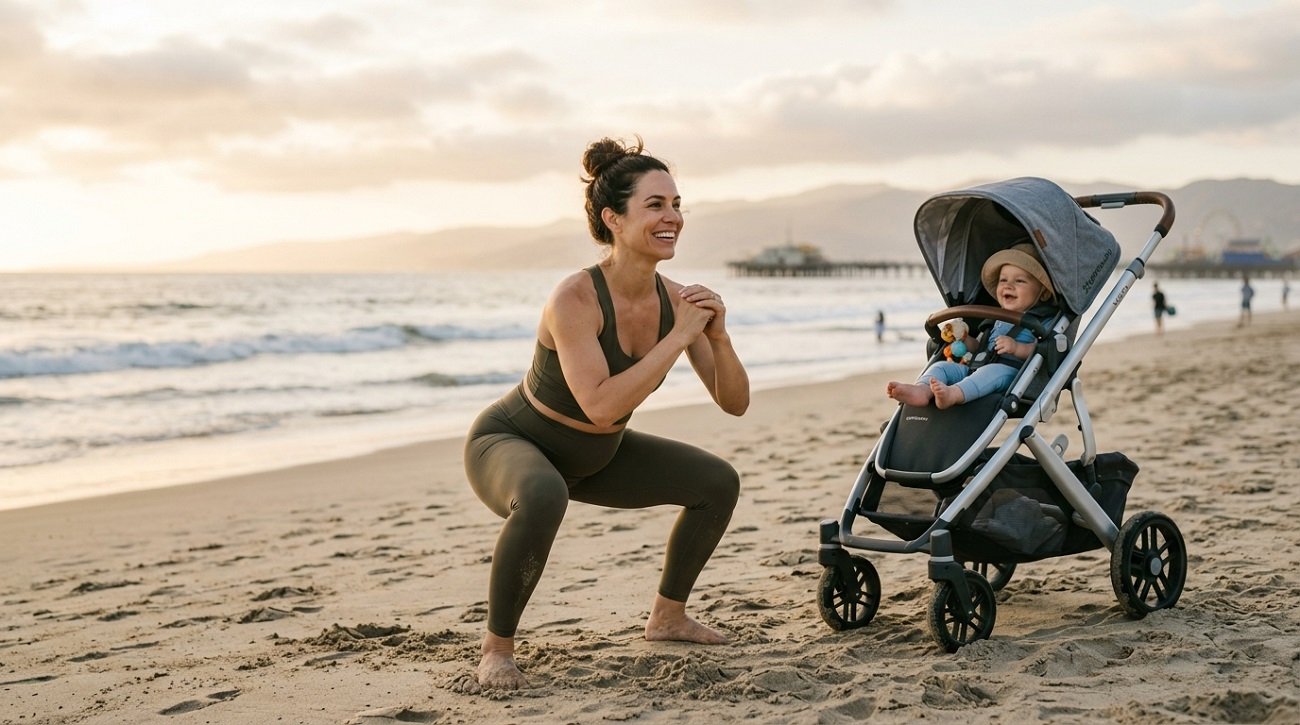
- Sand Walking/Lunging: Walking in the soft sand at Santa Monica Beach forces your foot and ankle stabilizers to work overtime, and it absorbs impact while building serious glute strength.
- Stroller Power Walking on Hills: Pushing a stroller up a slight incline (like the paths at Kenneth Hahn State Recreation Area) is a full-body workout. Pro Tip: Keep the stroller close to your body. Don’t lean forward and push from your toes—that kills your lower back. Engage your core, stand tall, and push from your legs.
- Aqua Fitness: The pool is a postpartum cheat code. The water provides resistance but removes gravity, taking all pressure off your pelvic floor and spine. Our aqua fitness sessions are an incredible bridge between rehab and high-intensity training.
Phase 4: Full Return to Impact (Months 6+)
Passing the “Return to Run” criteria above.
Now you can start introducing jogging, higher-impact bootcamp styles, and heavier lifting. We start with walk/run intervals (1 min run/2 min walk) on soft surfaces like the dirt paths in Griffith Park.
C-Section Recovery: Outdoor Workouts After Abdominal Surgery
If you had a C-section, you went through major abdominal surgery. The doctors cut through seven layers of tissue to get to your baby. The recovery requires a very specific outdoor approach.
Scar Tissue Mobilization
Around 4-6 weeks, once the incision is closed and cleared by your doctor, you must start mobilizing that scar. If you don’t, the fascia adheres to the underlying tissue, which pulls on your organs, causes lower back pain, and restricts your ability to fully engage your core.
How to do it: Gently massage around and then across the scar with your fingers. It might feel numb or tender—that’s normal. You need to bring blood flow and movement back to that tissue so it doesn’t permanently bind down your muscles.
Outdoor Modifications for C-Section Moms
- No overhead lifting: The tension from reaching up pulls directly on your incision. Stick to exercises below shoulder height (like rows and squats) for the first 8-10 weeks.
- Beware of uneven terrain: Hiking on rocky, uneven trails in the Santa Monica Mountains too early can cause micro-twisting at the incision site. Stick to flat, paved, or well-groomed dirt paths until you feel solid core engagement.
- Arm ergometers/Aqua: If walking still feels heavy on your pelvis, getting in the water for aqua fitness allows you to get a cardiovascular workout without the gravitational pull on your fresh scar.
Breastfeeding, Lactic Acid, and the LA Heat: The Practicalities
Being a postpartum mom in LA comes with specific environmental factors you have to account for.
The “Lactic Acid in Milk” Myth
I hear this all the time: “If I work out hard, lactic acid will ruin my breastmilk.” Let’s clear this up. Moderate to high-intensity exercise does not negatively affect breastmilk supply or composition. The only caveat: if you do an absolutely grueling, max-effort workout, there might be a temporary slight increase in lactic acid in the milk, which some babies might find tastes a bit sour. But a standard outdoor session? Totally fine. Just feed or pump before you work out for your own comfort.
Hydration and Heat
LA is dry and hot for much of the year. Breastfeeding requires an extra 25-30 ounces of water a day. Add an outdoor workout, and you are a dehydration time bomb. Dehydration leads to muscle cramps, lethargy, and a drop in milk supply.
- Rule of thumb: Drink at least 16-20 oz of water two hours before an outdoor session, and have a 24 oz bottle with you. Add electrolytes if you’re sweating heavily. For more on fueling your body right, check out our guide on nutrition strategies for outdoor fitness in Los Angeles.
The Sports Bra Reality
Your breasts are going to feel heavy and sensitive. Invest in a high-support, wire-free nursing sports bra. Compression is good, but you don’t want underwires pressing on ducts, leading to mastitis. Mastitis will put you on the couch faster than any workout injury.
Postpartum Mental Health: Why the Outdoors is Your Best Medicine
Let’s talk about the mental game. Postpartum anxiety and depression affect 1 in 5 women. The isolation of being indoors with a newborn, combined with hormonal crashes, is brutal.
Getting outside isn’t just about physical rehab; it’s about neurological regulation.
When you walk in nature (a concept known as “green exercise”), your cortisol levels drop, your parasympathetic nervous system (rest and digest) kicks in, and your brain gets a break from the overstimulation of a crying baby. We dive deep into this concept in our article on outdoor fitness programs in Los Angeles for mental health, but for a new mom, a 20-minute walk in the park can be the difference between a breakdown and a breakthrough.
This is why we emphasize community at Focus Camp. When you show up to a group functional training session, you aren’t just burning calories. You are standing next to another mom who hasn’t slept either, who also leaked a little when she jumped, who also feels like she lost her identity. That shared experience is deeply healing.
The Professional Postpartum Daily Movement Checklist
Don’t look at a massive workout schedule and feel overwhelmed. If you just do these five things every day, you will rebuild your foundation faster than doing a random HIIT class.
| Habit | Time | The “Why” |
|---|---|---|
| 5 Core Breaths | 2 minutes | Reconnects your diaphragm and pelvic floor, managing intra-abdominal pressure. |
| 10 Band Rows or Reverse Flys | 3 minutes | Counteracts the forward hunch of feeding and carrying the baby. |
| 1 15-Minute Outdoor Walk | 15 minutes | Regulates the nervous system, boosts vitamin D, promotes pelvic floor circulation. |
| 3 Calf Stretches | 1 minute | Reverses the shortening from wearing supportive postpartum shoes/flip flops. |
| Scar Tissue Massage (C-Section) | 2 minutes | Prevents fascial adhesions that cause back and core dysfunction. |
How Focus Camp Handles Postpartum Fitness Differently
If you’ve read this far, you realize we don’t mess around with postpartum care. We aren’t a standard bootcamp that will yell at you to push through the pain. We are a specialized outdoor training facility that respects the biology of the female body.
- Private Coaching: This is where 90% of postpartum women should start. We sit down, assess your diastasis, watch your breathing mechanics, and build a completely customized 12-week plan. If you are leaking or in pain, book a private session before you jump into a group.
- Yoga & Mindfulness: Our outdoor yoga classes are designed to open up the chest, stretch the hip flexors, and restore pelvic mobility without aggressive core crunching. It’s a staple for our postpartum clients.
- The Focus Camp Program: Once you’ve rebuilt your foundation in private sessions or physical therapy, our 20-session-a-month program seamlessly transitions you back into full-body strength, outdoor HIIT, and athletic movement.
You don’t have to accept leaking, back pain, or exhaustion as your new normal. You just need the right roadmap, a community that understands, and a willingness to rebuild from the ground up.
Ready to take the first step?
Don’t guess what your body needs. Reach out to us today, let us know you’re postpartum, and we’ll design a safe, outdoor strategy to get you feeling like yourself again—maybe even stronger than before.
See you out there,
François, Tina, and the Focus Camp Team