By François Frédéric, Co-Founder of Focus Camp — Last Updated May 2026
Look, I’m going to skip the fluffy intro where every fitness article tells you “Los Angeles is a great city for staying active!” You already know that. You live here. You also know that despite having a gym on every corner, most people in LA are still out of shape, still frustrated, and still bouncing between programs that don’t work.
I’ve been training people outdoors in this city for years. Not in a parking lot with a clipboard yelling “drop and give me twenty.” I mean real, structured, progressive training — on the sand at Venice Beach, up the stairs at Baldwin Hills, through the trails at Griffith Park, on the grass in Santa Monica. I’ve seen busy executives lose 20 pounds they’d been carrying for a decade. I’ve watched 55-year-olds who hadn’t exercised since college deadlift their body weight on sand within four months. I’ve trained former athletes who thought their best days were behind them and watched them come back stronger than they were at 25.
This article is everything I wish someone had told me when I was starting out — and everything I wish my clients knew before they walked through the door for the first time. No fluff. No filler. Just the real, detailed, honest truth about outdoor personal training in Los Angeles: what it costs, how it works, what results you can actually expect, and how to tell the difference between a program that’s going to change your life and one that’s going to waste your money.
WHY OUTDOOR TRAINING WORKS BETTER THAN GYMS (THE REAL SCIENCE)
I spent years training people inside gyms. Good gyms, bad gyms, expensive gyms, cheap gyms. And you know what the biggest problem was? Not the equipment. Not the programming. It was that people stopped showing up.
The average gym member in Los Angeles pays $50-$150 a month and goes 3-4 times a month. That’s it. The treadmill collects dust, the membership auto-renews, and guilt builds. I’ve had clients come to me after spending $2,000+ at Equinox over a year and barely using it.
Here’s why outdoor training flips that equation:
Your Brain Responds Differently Outside
- This isn’t motivational fluff. There’s hard science behind it. A study published in Environmental Science & Technology analyzed data from over 800 participants and found that outdoor exercise was associated with significantly greater reductions in tension, anger, and depression compared to indoor exercise.
- People also reported more enjoyment, felt less tired, and were more likely to repeat the activity.
- Why does this matter for your results? Because enjoyment is the single greatest predictor of long-term adherence. If you hate your workout, you’ll quit. Period.
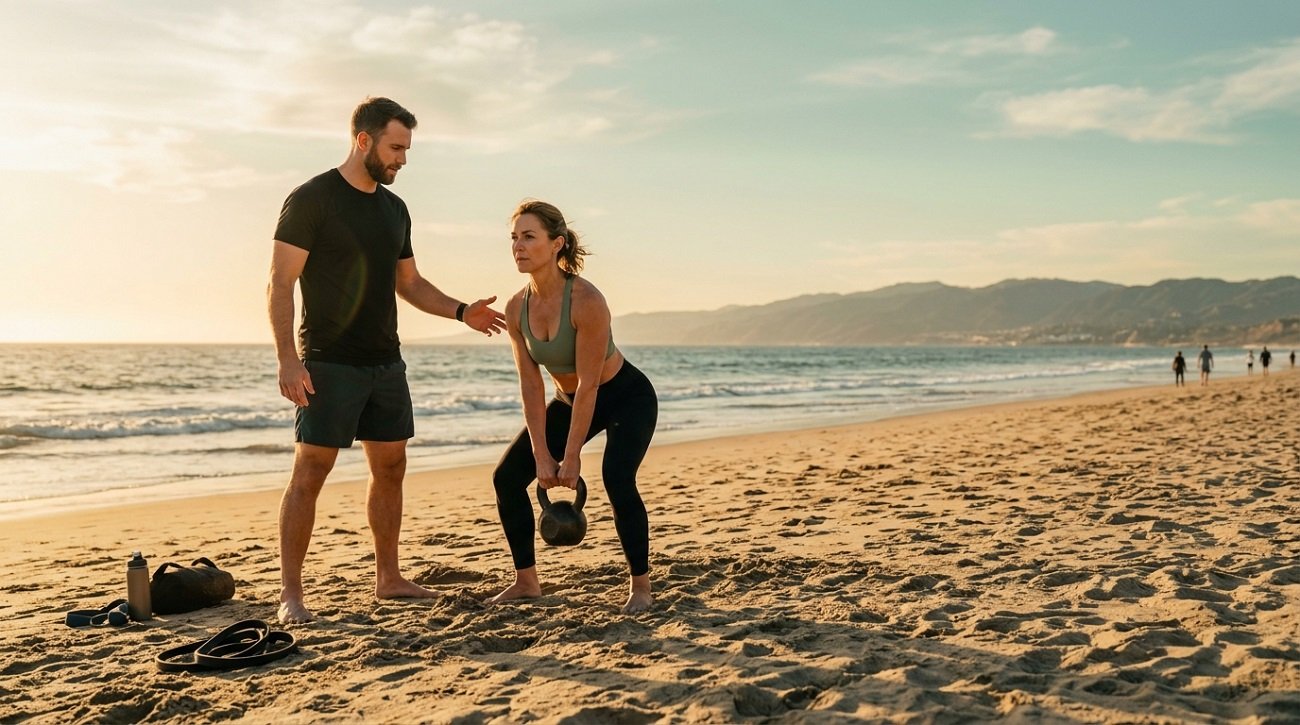
- When you’re training on the beach at golden hour, with the ocean breeze hitting your face and the Santa Monica mountains in the background — you don’t feel like you’re suffering through a workout. You feel like you’re living.
The Terrain Does What Machines Can’t
- A leg press machine moves along a fixed track. Your body doesn’t move like that in real life.
- When you’re walking on soft sand, your stabilizer muscles fire with every step.
- When you’re climbing stairs at Baldwin Hills, your glutes, hamstrings, calves, and core all have to coordinate.
- When you’re doing a lunge on grass, your ankle has to stabilize on an uneven surface.
- That’s your nervous system learning to coordinate your entire body as one unit — which is exactly how you move when you’re carrying groceries, playing with your kids, hiking on the weekend, or catching yourself when you trip.
The Air Quality and Vitamin D Factor
- LA has 280+ sunny days a year. That’s 280+ days of natural vitamin D exposure during training.
- Vitamin D plays a critical role in bone density, immune function, mood regulation, and muscle recovery.
- Fresh air also delivers more oxygen to your working muscles than a recycled-air gym.
Joint Preservation Is Not Optional After 30
- Hard concrete gym floors add impact with every step. Machines force your joints into fixed movement patterns that may not match your anatomy.
- Soft sand reduces impact by up to 50% compared to hard surfaces. Grass provides natural cushioning.
- Within 4-6 weeks of switching to outdoor training on proper surfaces, most clients report significant reduction in pain and stiffness.
WHAT OUTDOOR PERSONAL TRAINING ACTUALLY LOOKS LIKE DAY-TO-DAY
It’s Not a Boot Camp
- Boot camps have their place, but that’s not what we do.
- Personal training — even outdoors — is the opposite. Every single session is designed around your body, your goals, your limitations, and how you’re feeling that specific day.
What We Actually Bring to Sessions
| Equipment | What It’s Used For | Why It Works Outdoors |
|---|---|---|
| Resistance Bands (light to heavy) | Upper body work, pull-apart exercises, assisted pull-ups | Lightweight, portable, versatile — can anchor to trees, poles, or fences |
| Suspension Trainer (TRX-style) | Rows, chest presses, hamstring curls, core work | Can be attached to poles, lifeguard stands, or sturdy trees |
| Kettlebells (8-24 kg) | Swings, goblet squats, Turkish get-ups, farmer carries | Compact, full-body movements, easy to transport |
| Sandbags (15-50 lbs) | Carries, cleans, squats, presses | Unstable load forces core engagement |
| Jump Ropes | Warm-up, conditioning intervals, footwork drills | Requires minimal space, massive cardiovascular benefit |
| Cones & Agility Ladders | Footwork drills, speed training, HIIT circuits | Outdoor space means we can actually use them properly |
| Yoga Mats | Core work, stretching, mindfulness cooldown | Bare minimum for ground exercises on grass or sand |
| Battle Ropes | Upper body conditioning, core engagement, grip strength | Anchored to a post — explosive, full-body effort |
The Trainer-Client Relationship
- A good personal trainer isn’t just someone who counts your reps.
- They know your body better than you do.
- They adjust in real-time.
- They hold you accountable without being annoying.
- They teach you to eventually not need them.
STRENGTH TRAINING WITHOUT A GYM: HOW WE BUILD REAL POWER
What “Strength” Actually Means
- I want to look stronger — visible muscle definition, toned arms, a firmer core
- I want to function stronger — carry heavy things, climb stairs without getting winded, keep up with my kids
- I want to be stronger in a specific way — lift heavier weights, run faster, perform better at a sport
Outdoor training is exceptionally good at delivering #1 and #2.
How We Build Strength on Sand, Grass, and Hills
Progressive Overload Without Barbells
- Increasing reps and sets
- Slowing down the tempo
- Adding instability
- Reducing rest periods
- Using terrain for resistance
- Advancing the movement
Push-Up Progression Example:
| Week | Exercise | Sets x Reps | Tempo | Rest |
|---|---|---|---|---|
| 1-2 | Incline Push-Ups (hands on bench) | 3 x 12 | 2-0-2 | 90 sec |
| 3-4 | Standard Push-Ups | 3 x 12 | 3-1-2 | 75 sec |
| 5-6 | Push-Ups with Shoulder Taps | 4 x 10 | 3-1-2 | 75 sec |
| 7-8 | Decline Push-Ups (feet elevated) | 4 x 8 | 3-1-3 | 60 sec |
| 9-10 | Weighted Push-Ups (sandbags on back) | 4 x 6 | 3-1-3 | 60 sec |
| 11-12 | Archer Push-Ups or Single-Arm Push-Ups | 3 x 6 each | 4-1-3 | 90 sec |
The Sand Factor
- Training on sand requires 2.1 to 2.7 times more mechanical work than on firm surfaces.
- Sand also absorbs energy differently, forcing your muscles to generate more force.
Hill and Stair Training
- Baldwin Hills: 282 steps that work quads, glutes, calves, cardiovascular system, and core stability.
- Griffith Park: Longer inclines that build endurance-strength.
Strength Benchmarks We Track:
| Movement | Beginner Target | Intermediate Target | Advanced Target |
|---|---|---|---|
| Push-Ups (strict form) | 10 consecutive | 25 consecutive | 40+ consecutive |
| Bodyweight Squats | 20 consecutive | 50 consecutive | 100 consecutive |
| Single-Leg Glute Bridge | 10 reps/leg, 3-sec hold | 15 reps/leg, 5-sec hold | 20 reps/leg, 8-sec hold |
| Plank Hold | 30 seconds | 90 seconds | 3+ minutes |
| Sandbag Carry (50% body weight) | 100 meters | 200 meters | 300 meters |
| Stair Climb (Baldwin Hills) | Complete with breaks | Complete without stopping | Complete twice |
FAT LOSS: THE HONEST TRUTH ABOUT WHAT ACTUALLY WORKS
You Cannot Out-Train a Bad Diet
- If you’re eating 3,000 calories a day and burning 2,200, you’re not going to lose fat. Period.
- Exercise creates the metabolic conditions that make your body burn fat more efficiently all the time.
How Training Helps Fat Loss:
- Building lean muscle increases your resting metabolic rate (6-7 calories per pound of muscle per day).
- High-intensity training creates an “afterburn” effect (EPOC) that elevates metabolism for 12-24 hours.
- Consistent training regulates appetite hormones (ghrelin and leptin).
Our Fat Loss Approach: No Starvation, No Burnout
What We DON’T Do:
- 1,200-calorie diets
- Endless cardio
- 30 pounds in 30 days promises
Phase 1: Foundation (Weeks 1-4)
- 3 sessions per week of mixed strength and conditioning
- Add protein to every meal (0.7-1g per pound of body weight)
- Reduce processed food by 50%
- Improve sleep quality
Expected results: 3-5 pounds of fat loss, improved energy and mood, reduced bloating
Phase 2: Acceleration (Weeks 5-12)
- 4 sessions per week
- Metabolic circuits
- Targeted nutrition
- Recovery focus
Expected results: 8-15 pounds of fat loss, visible muscle definition, improved cardiovascular fitness
Phase 3: Refinement (Weeks 13-24)
- Advanced training variations
- Fine-tuned nutrition
- Body composition shifts
- Improved mental relationship with food
Expected results: 15-25+ pounds of fat loss, substantial muscle definition, clothes fitting differently
Why Outdoor Training Accelerates Fat Loss:
- Higher calorie burn on sand (2-3x more muscle activation)
- Natural interval training from terrain variations
- Lower cortisol from outdoor environments
- Better sleep from natural light exposure
- Higher adherence because it’s enjoyable
CONDITIONING: BUILDING ENDURANCE THAT MATTERS
True conditioning means building your cardiovascular and muscular endurance to a level where daily life feels easy.
The Three Energy Systems:
- The Phosphagen System (Power — 0 to 10 seconds)
- Explosive, short-burst energy
- Trained with: hill sprints, box jumps, medicine ball slams, sand sprints
- The Glycolytic System (Moderate — 10 seconds to 3 minutes)
- High-intensity energy
- Trained with: stair sprints, circuit training, sand circuits, battle ropes
- The Oxidative System (Endurance — 3+ minutes)
- Sustained energy
- Trained with: trail runs, sand walking, tempo circuits, beach runs
Conditioning Progression (12 Weeks):
| Week | Focus | Session Structure | Intensity |
|---|---|---|---|
| 1-2 | Aerobic Base | 30 min continuous (walk/jog) | Low-Moderate |
| 3-4 | Aerobic Development | 35 min with tempo intervals | Moderate |
| 5-6 | Threshold Training | 40 min circuits | Moderate-High |
| 7-8 | VO2 Max Intervals | 35 min hill sprints | High |
| 9-10 | Mixed Modal | 45 min (sand + stairs + trail) | High |
| 11-12 | Peak Conditioning | 50 min full circuit | Very High |
WHO THIS IS FOR (AND WHO SHOULD LOOK ELSEWHERE)
This Is For You If:
- You’re a busy professional who values time efficiency
- You’re over 40 and your body isn’t what it used to be
- You’ve tried gyms and hated them
- You want sustainable fat loss
- You want real-world strength
- You value community and personal attention
This Probably Isn’t for You If:
- Your primary goal is competitive powerlifting or bodybuilding
- You need a climate-controlled environment for medical reasons
- You want to work out alone with zero human interaction
- You’re looking for the cheapest possible option
WHAT A REAL SESSION LOOKS LIKE (MINUTE BY MINUTE)
Pre-Session (Before You Arrive)
- I’ve reviewed your last session notes
- Designed today’s session based on your progression plan
Minutes 0-8: Dynamic Warm-Up
- Joint circles (ankles, knees, hips, shoulders, wrists)
- Walking with purpose (high knees, butt kicks, lateral shuffles)
- Activation work (glute bridges, band pull-aparts, dead bugs)
- Movement prep (light versions of main exercises)
Minutes 8-25: Strength Block
Example Lower Body Day:
| Exercise | Sets x Reps | Coaching Focus |
|---|---|---|
| Sand Walking Lunges | 3 x 12 each leg | Upright torso, knee tracking over toes |
| Kettlebell Goblet Squats | 4 x 10 | Depth to parallel, chest up, drive through heels |
| Single-Leg Romanian Deadlift | 3 x 10 each | Hinge at hips, flat back, balance |
| Sandbag Deadlift to Carry | 3 x 8 + 30m | Hinge mechanics, grip strength, core bracing |
Minutes 25-38: Conditioning Circuit
4 Rounds, 90 Seconds Between Rounds:
| Exercise | Work Time | Rest | Primary Benefit |
|---|---|---|---|
| Sand Sprint (30m) | 10 sec | 20 sec | Power, anaerobic capacity |
| Push-Up to Plank Shoulder Tap | 45 sec | 15 sec | Upper body + core |
| Sandbag Squat to Press | 45 sec | 15 sec | Full body metabolic |
| Bear Crawl | 30 sec | 15 sec | Core, shoulders, coordination |
| Burpees | 30 sec | 90 sec | Full body conditioning |
Minutes 38-45: Core and Stability
| Exercise | Sets x Duration | Focus |
|---|---|---|
| Dead Bug (on sand) | 3 x 8 each side | Anti-extension, lower back protection |
| Side Plank with Rotation | 3 x 30 sec each | Anti-lateral flexion, oblique strength |
| Pallof Press with Band | 3 x 10 each | Anti-rotation, deep core stability |
| Bird Dog (on sand) | 3 x 8 each | Coordination, spinal stability |
Minutes 45-50: Cool-Down and Mindfulness
- Static stretching (hamstrings, hip flexors, chest, shoulders)
- Breathing exercises (4-7-8 breathing)
- Brief check-in on feelings and feedback
LA’S BEST TRAINING LOCATIONS AND WHY WE USE THEM
Venice Beach
- Surface: Soft sand
- Best For: Fat-loss circuits, conditioning, sand resistance
- Joint Impact: Very low
- Vibe: Energetic, social, iconic LA
- Parking: Metered along Ocean Front Walk, free before 8 AM and after 6 PM
- Crowd Level: High weekends, manageable weekday mornings
- Typical Session: Sand circuits, kettlebell work, partner challenges
Baldwin Hills Scenic Overlook
- Surface: Paved stairs (282 steps) with dirt trail alternatives
- Best For: Lower-body power, cardiovascular conditioning
- Joint Impact: Moderate (controlled with proper form)
- Vibe: Challenging, rewarding, incredible 360° views
- Parking: Small lot at base, street parking on Jefferson Blvd
- Crowd Level: Moderate, less crowded early mornings
- Typical Session: Stair intervals, hill sprints, bodyweight strength
Griffith Park
- Surface: Mixed (grass fields, dirt trails, paved paths)
- Best For: Trail running, endurance training, strength circuits
- Joint Impact: Low to moderate
- Vibe: Nature immersion, quiet, away from city
- Parking: Multiple free lots
- Crowd Level: Low to moderate, especially weekday mornings
- Typical Session: Trail runs, grass circuits, outdoor yoga
Santa Monica (Palisades Park & Beach)
- Surface: Grass, packed sand, pavement
- Best For: Beginners, recovery, outdoor yoga, mobility
- Joint Impact: Very low
- Vibe: Relaxed, scenic, ocean views
- Parking: Structure at Santa Monica Place, metered along Ocean Ave
- Crowd Level: Moderate, touristy but spacious
- Typical Session: Bodyweight circuits, yoga flows, light conditioning
Manhattan Beach / Sand Dune Park
- Surface: Sand and steep sand dunes
- Best For: Advanced conditioning, explosive power
- Joint Impact: Very low on sand, moderate on dunes
- Vibe: Athletic community, serious training atmosphere
- Parking: Lot at Sand Dune Park (permit required for dunes)
- Crowd Level: Low, local’s spot
- Typical Session: Dune sprints, sand carries, advanced circuits
HOW MUCH DOES OUTDOOR PERSONAL TRAINING COST IN LA?
The LA Personal Training Market (2026):
| Training Type | Price Range (per session) | What You Get |
|---|---|---|
| Big-Box Gym Trainer | $50-$80 | Often younger, less experienced, cookie-cutter |
| Mid-Range Independent | $80-$120 | More experience, some personalization |
| High-End Private Studio | $120-$200 | Experienced trainers, private facility |
| Premium (Equinox, etc.) | $150-$250 | Polished experience, brand-name trainers |
| Outdoor Personal Training (Focus Camp) | $120-$200 | Expert coaching, outdoor environment, personalized |
| Celebrity / Elite | $300-$500+ | Top-tier credentials, often with waitlists |
What Affects the Price?
- Session length (30, 60, or 90 minutes)
- Frequency (2x-5x per week)
- Private vs. group
- Trainer experience and certifications
The ROI Calculation
Don’t compare personal training to a gym membership. Compare it to the cost of NOT training:
- Medical costs from inactivity ($8,000+ per year average)
- Lost productivity from low energy
- Quality of life improvements
HOW TO CHOOSE THE RIGHT TRAINER (RED FLAGS TO WATCH FOR)
Green Flags (What Good Trainers Do):
[Y] They assess you before training you
[Y] They explain the “why” behind every exercise
[Y] They modify exercises in real-time
[Y] They track your progress
[Y] They have a progression plan
[Y] They listen more than they talk
Red Flags (What Bad Trainers Do):
[!] They don’t assess you first
[!] Every client gets the same workout
[!] They’re on their phone during your session
[!] They push supplements or products
[!] They can’t explain their methodology
[!] They ignore pain
[!] No certifications or education
Questions to Ask Before Hiring:
- “What certifications do you hold, and how long have you been training?”
- “Have you worked with people who have my specific goals before?”
- “What does a typical first session look like?”
- “How do you track and measure progress?”
- “What happens if I get injured or an exercise doesn’t feel right?”
- “Can you describe your training philosophy in 2-3 sentences?”
- “Do you provide any nutrition guidance, or is it strictly exercise?”
- “What’s your cancellation policy?”
REAL RESULTS: WHAT OUR MEMBERS ACTUALLY EXPERIENCE
The First Two Weeks:
- Most new members feel nervous before first session
- By end of second session: nervousness replaced with enjoyment
- Common feedback: “I can’t believe how much better I feel already”
- Immediate shifts in energy, mood, and sleep quality
Weeks 3-8:
- Clothes fit differently (waist and arms first)
- Energy levels stabilize (no more 3 PM crash)
- Sleep quality improves significantly
- Strength increases are obvious
- Joint pain and stiffness begin to reduce
- Confidence starts building
Months 3-6:
- 12-25 pounds of fat loss (depending on starting point)
- Visible muscle definition in arms, shoulders, and core
- Substantial improvement in cardiovascular fitness
- Significantly reduced joint pain and stiffness
- Dramatically improved mood and mental clarity
- Exercise becomes something you WANT to do, not HAVE to do
The Long-Term Members (12+ months):
- Fitness becomes part of life, not a “program”
- They train because they enjoy it
- They eat well because it makes them feel good
- They sleep better because their body craves recovery
- The discipline that was hard becomes automatic
NUTRITION, RECOVERY, AND THE STUFF NOBODY TALKS ABOUT
Nutrition Basics (Not a Diet Plan):
- Protein is non-negotiable: 0.7-1g per pound of body weight daily
- Eat real food 80% of the time: lean proteins, vegetables, fruits, whole grains, healthy fats
- Hydrate: at least half your body weight in ounces daily (more on training days)
- Time carbs around training: complex carbs 1-2 hours before, protein+carbs within 1 hour after
Recovery: The Missing Piece
- Sleep is #1: aim for 7-9 hours for growth hormone release and tissue repair
- Active recovery: light walking, yoga, swimming on off days
- Daily stretching: 10 minutes for hip flexors, hamstrings, thoracic spine, shoulders
- Manage stress: cortisol interferes with muscle building and fat loss
FREQUENTLY ASKED QUESTIONS
Q: How much does outdoor personal training cost in Los Angeles?
A: It depends on private vs. group and frequency. Private sessions are $120-$200, group sessions are more affordable. We offer packages for both.
Q: Can you really build muscle without a gym?
A: Absolutely. Training on sand requires 2-3x more muscle activation. Bodyweight progressions, sand resistance, hill work, and kettlebells build lean, functional muscle. Many members see definition within 6-8 weeks.
Q: How is outdoor training different from a boot camp?
A: Boot camps are group-based and one-size-fits-all. Our training is fully personalized with expert coaching, real-time form correction, and progressive programming.
Q: What if it rains?
A: In LA, rain is rare. We have indoor backup options or reschedule. We also monitor air quality and adjust session times during heat waves.
Q: I’m a complete beginner. Is this too advanced for me?
A: Not at all. We work with all levels. Every exercise is scaled to your ability. We start where you are and progress at your pace.
Q: How quickly will I see results?
A: Most feel better within 2 weeks (energy, sleep, stiffness). Visible changes typically appear within 6-8 weeks with consistent training (3x/week) and basic nutrition. Significant transformations happen over 3-6 months.
Q: What should I wear and bring to my first session?
A: Comfortable athletic clothes, athletic shoes (or barefoot on sand), water, sunscreen, and a small towel.
Q: Do you offer group sessions too?
A: Yes. Our Group Functional Training and Focus Camp Program combine group energy with expert coaching. Many start with private coaching, then transition to groups.
Q: What makes Focus Camp different?
A: Three things: (1) No cookie-cutter workouts – every session is personalized, (2) We integrate mindset and mindfulness with physical training, (3) We build community with genuine support and accountability.
HOW TO GET STARTED
If you’ve read this far, you’re clearly serious about making a change. Here’s exactly what to do next:
Option 1: Start with Private Coaching
Book a one-on-one session with me or Tina. We’ll assess your fitness level, discuss goals, and design a personalized plan. This is the fastest path to results.
Option 2: Try a Group Session First
Experience the energy and community before committing to private coaching. Meet other members and see if outdoor training works for you.
-> View Group Session Schedule
Option 3: Go All In with the Focus Camp Program
Our complete monthly program includes strength training, conditioning, yoga, aqua sessions, outdoor challenges, and community events.
-> Learn About the Full Program
Not Sure Yet?
Send us a message. We’ll help you figure out the best starting point based on your goals, schedule, and budget. No pressure, no sales pitch — just honest guidance.
Focus Camp is a Los Angeles-based outdoor fitness program founded by François Frédéric and Tina. We offer private personal coaching, group functional training, strength and conditioning classes, beach and outdoor workouts, yoga and mindfulness sessions, and aqua training. We serve clients across Venice Beach, Santa Monica, Manhattan Beach, Griffith Park, Baldwin Hills, and surrounding LA areas.
Our mission: To help you become stronger, healthier, and more confident — outdoors, under the LA sun, together.