Hey there, friend.
If you’re tired of gym memberships collecting dust, crowded weight rooms, or just craving real strength on your schedule without leaving the house, you’re exactly where you need to be. I’m François from Focus Camp, and along with instructor Tina, we’ve helped hundreds of busy professionals, parents, and folks in their 40s, 50s, and beyond right here in Los Angeles get stronger, move better, and feel more confident—many of them starting with nothing more than bodyweight and a few smart household items.
The truth most people miss? You can build serious muscle, protect your joints, boost your metabolism, improve posture, and feel unstoppable in everyday life without ever stepping foot in a commercial gym. But here’s the part almost every beginner guide skips: home weight training (or resistance training) is full of sneaky mistakes that quietly kill your progress or leave you with nagging pain.
In this complete, no-fluff guide, I’m laying out exactly what actually works—the 10 most common mistakes I see every week with new clients (and exactly how to fix them), ready-to-use beginner and intermediate workouts, a full 4-week progression plan you can track, a 5-minute warm-up routine, a realistic weekly schedule, nutrition and recovery essentials, and answers to the questions I get asked most often.
By the end, you’ll have a clear, mistake-proof system that fits your real life. And you’ll understand why so many of our LA clients use this exact home foundation on their off days before jumping into our outdoor strength sessions for even faster results.
Let’s build that stronger, more capable version of you—one smart session at a time.
Why Home Weight Training Without a Gym Delivers Real, Lasting Results
I used to believe you needed a full squat rack and heavy barbells to make meaningful progress. After years of coaching and watching clients transform, I can tell you that’s simply not true. Consistent resistance training at home improves muscle mass, bone density, posture, energy levels, and even mood—without any fancy equipment.
You get total privacy, zero commute time, and workouts that translate directly to real life: carrying groceries without back pain, playing with kids without getting winded, or just walking taller with more confidence. The secret isn’t equipment. It’s smart progression (making things gradually harder) and proper form.
If you’ve tried home workouts before and ended up feeling stuck, sore in the wrong places, or like nothing was changing, stay with me. The mistakes section below is where most people lose months—or even years—of potential gains.
Getting Started: Zero-to-Minimal Equipment That Actually Works
You do not need a home gym to start seeing results. Here’s the exact progression I give every private client who wants to train at home:
Level 1 – Bodyweight Only Your own body is the perfect starting “weight.” Perfect for true beginners.
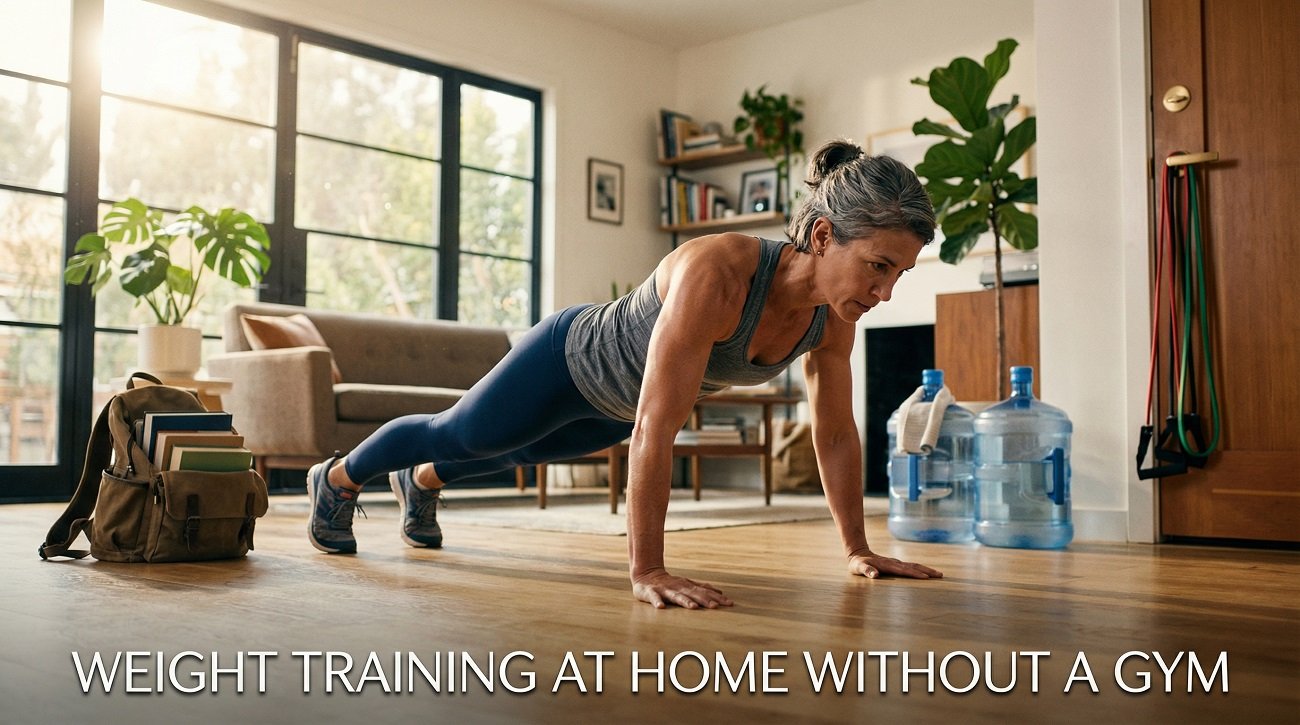
Level 2 – Household Items (Completely Free Upgrades) Turn everyday things into effective resistance.
Level 3 – Smart Minimal Investment (Under $50 and Game-Changing) Resistance bands with handles or a pair of adjustable dumbbells when you’re ready for the next level.
Here’s a quick-reference table of the best household items and how to use them:
| Household Item | How to Use It as “Weight” | Best For |
|---|---|---|
| Filled water jugs / milk cartons | Hold like dumbbells for rows, presses, goblet squats | Upper body + legs |
| Backpack loaded with books | Wear for squats, lunges, step-ups, or walks | Full-body overload |
| Resistance bands | Anchor to a door or use for rows, pull-aparts, presses | Pulling + shoulder health |
| Sturdy chair or stairs | Step-ups, dips, elevated push-ups, single-leg work | Lower body + core |
| Towel | Sliding mountain climbers, towel rows, or hamstring curls | Core, back, and stability |
Start at Level 1 for at least two weeks so you master form first. Then layer in resistance. This is the exact smart progression we use before clients join our outdoor group sessions.
Your 5-Minute Home Warm-Up Routine (Never Skip This Step)
Cold muscles + sudden loading is the fastest way to get injured. Here’s the exact warm-up I give every single client—no exceptions:
- March in place with big arm circles – 60 seconds
- Bodyweight squats (slow and controlled) – 10 reps
- Push-up position shoulder taps – 10 per side
- Glute bridges with 2-second squeeze at the top – 10 reps
- Bird-dog – 8 reps per side
Takes five minutes. Prevents 80% of the soreness and injury complaints I hear from people who skip it.
The 10 Most Common Home Weight Training Mistakes (And the Fixes That Work)
I see these mistakes week after week with new clients. Here’s the professional breakdown so you can avoid them:
| Mistake | Why It Hurts Progress or Causes Injury | Simple Fix |
|---|---|---|
| Skipping the warm-up | Cold muscles tear easily | Always do the 5-minute routine above |
| Poor form (rushing reps) | Zero gains + back/shoulder/knee pain | Film yourself or use a mirror; slow every rep down |
| No progressive overload | Same workout forever = plateau | Add reps, slow the lowering phase, or add resistance |
| Training the same muscles every day | No recovery = stalled progress & burnout | 3–4 sessions per week max with rest days between |
| Ignoring pulling movements | Rounded shoulders & posture problems | Always include rows (towel, band, or door-frame) |
| Using the wrong rep ranges | Random results | Strength: 4–8 reps; Muscle growth: 8–15; Endurance: 15+ |
| Copying advanced Instagram moves | Knee/back/shoulder issues as a beginner | Master basics first |
| Forgetting protein & nutrition | Can’t build muscle without fuel | 0.7–1 gram of protein per pound of body weight daily |
| Staying in your comfort zone | No real challenge = no growth | Last 2–3 reps should feel hard |
| No tracking | Can’t measure or celebrate progress | Use a notebook or notes app every session |
Fix these and you’ll see noticeable strength and energy improvements in 4–6 weeks instead of guessing for months.
Your Complete Beginner & Intermediate Home Workouts
Beginner Full-Body Routine (3x per week, 30–35 minutes) Do 3 full rounds. Rest 60–90 seconds between exercises and 2 minutes between rounds.
- Bodyweight Squats – 10–12 reps
- Knee or Wall Push-Ups – 8–10 reps
- Glute Bridges (2-second hold at top) – 12 reps
- Towel or Door-Frame Rows – 8–10 reps
- Bird-Dog – 8 reps per side
- Plank – 20–40 seconds
Intermediate Routine (once you’ve mastered the beginner version) Same structure, but upgrade the movements:
- Goblet Squats (hold backpack or water jugs)
- Regular Push-Ups (or diamond variation)
- Single-Leg Glute Bridges
- Resistance Band Rows or Backpack Rows
- Pike Push-Ups (for shoulders)
- Side Plank with hip dips
For exact form cues and video demonstrations, many of our clients start with these same movements before joining group training.
4-Week Progression Plan (Track It Like a Pro)
This is the exact system I hand to clients who want measurable results. Print it, screenshot it, or copy it into your notes.
| Week | Squat Variation | Push-Up Variation | Row Variation | Core Finish | Goal |
|---|---|---|---|---|---|
| 1 | Bodyweight – 3×10–12 | Knee – 3×8–10 | Towel rows – 3×10 | Plank 3×20–30s | Master perfect form |
| 2 | Bodyweight – 3×12–15 | Knee or regular – 3×10 | Backpack rows – 3×12 | Plank 3×30–45s | Add reps & control |
| 3 | Goblet (backpack/jugs) – 3×10 | Regular – 3×8–12 | Band or towel rows – 3×12 | Side plank 3x20s per side | Introduce resistance |
| 4 | Goblet – 3×12 + slow lower phase | Regular or diamond – 3×10 | Band rows – 3×15 | Side plank + hip dips | Increase challenge & intensity |
Review every Sunday night. Adjust as needed.
Sample Weekly Schedule That Actually Fits Real Life (3–4 Days)
- Monday: Full-body strength
- Tuesday: Rest or light walk
- Wednesday: Full-body strength
- Thursday: Rest
- Friday: Full-body strength
- Saturday: Optional outdoor walk, yoga, or active recovery
- Sunday: Full rest + meal prep
Life happens—adjust as your schedule demands. Consistency beats perfection every single time.
Nutrition, Recovery & Tracking – The Missing Pieces Most Guides Ignore
Training is only half the equation.
- Protein: Aim for 0.7–1 gram per pound of body weight daily (e.g., eggs, chicken, Greek yogurt, beans, or a quick shake).
- Sleep: 7–9 hours—your muscles grow while you rest.
- Recovery: Use the exact techniques we detail in our guide 5 Recovery Techniques Every Fitness Enthusiast Should Know.
Pair everything with our Nutrition Strategies for Outdoor Fitness in Los Angeles for simple, local meals that fuel both home sessions and outdoor training perfectly.
Track every workout: exercises, sets, reps, and how you felt. Review every four weeks—you’ll be shocked at how far you’ve come.
FAQ: Real Answers to the Questions I Get Every Week
Is home weight training as effective as the gym? Yes—when you apply progressive overload and good form. Many of our clients actually prefer the consistency of home training.
How long until I see results? You’ll feel stronger and have more daily energy in 2–4 weeks. Visible muscle tone and better posture usually show up in 6–8 weeks with consistency.
What if I’m over 40 or 50? This is perfect for you. Start with the beginner routine and check our Fit at 50 Without a Gym guide for joint-friendly tweaks.
Do I eventually need equipment? Only when bodyweight stops feeling challenging. Bands or dumbbells are the smart next step.
Home Training + Focus Camp = Unstoppable Long-Term Results
This home plan is an incredible foundation or maintenance tool. But nothing beats the energy, real-time form corrections, accountability, and community you get in our outdoor sessions.
That’s why so many clients do home workouts on their off days and join our Strength & Conditioning Classes, Group Functional Training, or the full Focus Camp Program for the extra push that makes habits stick for life.
Ready to stop guessing and start seeing real, lasting results?
→ Book your trial session or private coaching here → Explore all our LA outdoor programs and services
Drop your biggest home training question in the comments below—I personally read and reply to every single one because your success is our success.
You’ve got this. Let’s build the stronger, more confident version of you—one smart, mistake-free session at a time.
— François & Tina Focus Camp Team
P.S. Save or bookmark this page right now. Come back to the 4-week progression table every month as you level up. Consistency is what actually changes bodies—and lives. See you out there!