My mom called me on a Tuesday. She was weirdly calm about it — the way older people get when something actually scared them but they do not want you to worry. She had been reaching for a coffee mug. Top shelf. Lost her footing on the kitchen tile and went down.
No broken bones. Thank God.
But she sat on that floor for twenty minutes before she could get herself up. Twenty minutes. On a kitchen floor. She told me she was fine. She was not fine.
That phone call changed how I think about balance. Not as a fitness concept. Not as a thing you read about in a magazine. As the single most important thing standing between the people I love and a hospital bed.
Maybe you have had a moment like that. For yourself, or for someone you care about. Maybe your doctor said something about fall risk. Maybe you noticed your balance is just not what it was five years ago. Maybe you saw a neighbor take a spill on the sidewalk and thought, I need to do something.
This is that something.
I am going to walk you through exactly why falls happen after 60, what the latest research says about preventing them, and hand you a complete week-by-week outdoor exercise routine you can start in any Los Angeles park. No equipment. No gym membership. Just you, a park bench, and about half an hour.
Everything here comes from two places: the latest research from the CDC, NIH, and American College of Sports Medicine, and my years of working with adults over 50 at Focus Camp in Los Angeles. Real science. Real people. Real results.
Let’s get into it.
Table of Contents
- The Numbers Are Worse Than You Think
- Why Your Balance Falls Apart After 60
- The 7 Things That Actually Make You Fall
- Why Training Outside Beats Any Gym
- The Full 7-Day Outdoor Balance Routine
- How to Progress Over 12 Weeks
- What the Otago Program Teaches Us
- Tai Chi: The Overlooked Balance Tool
- Shoes, Vitamin D, and Your Medications
- Home Safety Checklist
- When to Talk to Your Doctor First
- Questions People Actually Ask
- How Focus Camp Can Help
The Numbers Are Worse Than You Think
I am not going to sugarcoat this. The numbers are bad.
More than one out of every four adults over 65 falls each year. That is not a guess. That is the CDC, updated January 2026. And less than half of those people ever tell their doctor about it. They just quietly start being more careful. They stop going for walks. They hold the railing a little tighter. They avoid stairs.
Here is the thing that gets me: falling once doubles your chances of falling again. Not increases slightly. Doubles. One fall starts a cascade. You get scared. You move less. You get weaker. Your balance gets worse. You fall again. It is a cycle, and it is brutal once it starts.
The rest of the numbers paint a clear picture:
| What | The Data | Source |
|---|---|---|
| Seniors who fall each year | 1 in 4 (25%+) | CDC, Jan 2026 |
| Falls causing injury needing medical care | 1 in 10 | CDC, Jan 2026 |
| ER visits from senior falls per year | ~3 million | CDC WISQARS |
| Hospitalizations from falls per year | ~1 million | CDC WISQARS |
| Hip fractures caused by falls | 83% of hip fracture deaths | CDC, 2023 |
| Hip fracture hospitalizations per year | ~319,000 | CDC, 2023 |
| Falls are the #1 cause of TBI in seniors | Confirmed | CDC, 2021 |
| Annual medical cost of falls | $50 billion+ | Florence et al., JAGS, 2018 |
| Seniors who fall and do NOT tell their doctor | Less than half | CDC, 2026 |
Fifty billion dollars a year. That is families dealing with hospital bills. Rehab costs. Lost independence. The emotional weight of watching someone you love struggle with something that did not have to happen.
The World Health Organization says it plainly: falls are the second leading cause of accidental injury deaths worldwide. Adults over 60 suffer the highest number of fatal falls. This is not a minor health thing. This is one of the biggest quality-of-life issues older adults face.
But here is the part that actually matters. The part I want you to hold onto:
Falls are preventable.
Not every single one. Nothing in life works that way. But the research is overwhelming. A structured balance and strength training program can reduce fall risk by 23 to 40 percent. That is not a small number. That is the difference between staying in your home and spending six weeks in a rehab facility.
Why Your Balance Falls Apart After 60
Most people think losing your balance is just aging. Hair goes grey, knees ache, balance gets worse. That is the story. But it is only partly true, and the part that is true is the part you can actually fix.
Your balance depends on three systems. When any one of them weakens, your whole stability suffers.
Your proprioceptive system. That is the sense that tells your brain where your body parts are without looking. Close your eyes. Touch your nose. That is proprioception. After 50, the nerve endings in your joints and muscles that send those position signals to your brain get less sensitive. Your brain gets a little slower at processing where you are and making corrections. You do not notice it happening. You just notice that you stumble more.
Your vestibular system. Tiny structures in your inner ear that detect head position and movement. They deteriorate with age. This is why some older adults feel dizzy when they turn their head fast or stand up too quickly. Vestibular decline is one of the most underappreciated causes of balance loss. Most people do not even realize it is happening until they trip.
Your visual system. Your eyes give your brain critical information about your environment — the slope of a sidewalk, the edge of a step, how far away a wall is. After 60, depth perception changes. Contrast sensitivity drops. Visual processing slows down. You might not see a hazard until you are already on top of it.
All three of these systems can be trained. Not back to what they were at 25. That is not realistic. But significantly improved through targeted exercise. When you practice standing on one leg, your proprioceptive system fires harder. When you walk on uneven ground, your vestibular system gets challenged. When you train with your head in different positions, your visual processing adapts.
There is a fourth factor that does not get enough attention: muscle strength. Your balance can be excellent, but if your legs are not strong enough to catch you when you stumble, you are going down. The National Institute on Aging has shown over and over that lower body weakness is the single strongest predictor of falls. Stronger legs mean faster recovery when something goes wrong. Even if your balance is not perfect.
That is why the routine below does not just practice standing on one leg. It combines balance work with strength exercises. Because you need both.
The 7 Things That Actually Make You Fall
The CDC has identified specific conditions that increase fall risk. Most falls come from a combination of these, and the more you have, the worse your odds.
1. Weak Legs
This is the big one. Your quads, hamstrings, glutes, and calves need to generate enough force to catch your entire body weight in about half a second. That is what happens when you trip — your front leg shoots forward and absorbs everything. If those muscles cannot fire fast enough, you hit the ground.
Squats, lunges, calf raises, step-ups. Nothing fancy. These are the exercises that work. The routine below has all of them.
2. Low Vitamin D
This one catches people off guard. Vitamin D directly affects muscle function and bone density. Low Vitamin D means weaker muscles, weaker bones, and a higher chance of fracture if you do fall. A Cochrane review found that Vitamin D plus exercise reduces fall risk more than either one alone.
Ask your doctor to test your levels. A simple blood test. Many adults over 60 are low, especially if they spend most of their time indoors. Supplementation is cheap and easy. Add outdoor exercise where your skin makes Vitamin D from sunlight, and you are addressing one of the most common and most fixable risk factors.
3. Poor Balance and Walking Problems
This is what the rest of this article directly addresses. If you sway when you stand, grab walls when you walk, or feel unsteady on your feet, your balance system needs training. The good news: balance responds to exercise faster than almost anything else. Measurable improvements in as little as four weeks.
4. Medications That Mess With Your Balance
Tranquilizers. Sedatives. Antidepressants. Some over-the-counter antihistamines. Blood pressure meds. They can all cause drowsiness, dizziness, or slow your reaction time. Blood pressure medications can cause orthostatic hypotension — a sudden drop when you stand up. That is a major fall trigger.
Do not stop taking anything on your own. But ask your doctor or pharmacist for a medication review focused on fall risk. There may be alternatives with fewer balance-related side effects.
5. Vision Problems
If you cannot see an obstacle, you cannot avoid it. Cataracts, glaucoma, macular degeneration, outdated prescriptions — they all increase fall risk. Bifocal and progressive lenses are a sneaky culprit too. They distort depth perception when you look down at the ground, which is exactly what you do when walking on uneven surfaces.
Get your eyes checked every year. If you wear bifocals or progressives, consider a separate pair of single-vision distance glasses for outdoor walking. Simple fix. Many eye doctors recommend it for active seniors.
6. Foot Pain and Bad Shoes
Your feet are your foundation. Bunions, neuropathy, arthritis, and shoes that do not fit right all compromise your ability to feel the ground and adjust. Thick-soled running shoes, high heels, floppy slippers — all major fall risks.
Wear shoes with a flat, stable sole and good traction. More on this in the shoes section.
7. Your Own House
Throw rugs. Clutter. Poor lighting. Broken steps. No grab bars in the bathroom. The CDC says home hazards play a role in a big chunk of senior falls. I have a complete home safety checklist later in this article. Print it out. Walk through your house. Fix what you find.
Why Training Outside Beats Any Gym
I have trained people in gyms for years. I have trained people outside for years. For balance and fall prevention, outdoor training wins. It is not even close.
Gym floors are flat. Your body adapts to that surface, and only that surface. You get good at balancing on smooth, level ground. Then you walk on a Los Angeles sidewalk that has cracked and shifted over thirty years, and your body does not know what to do. Real life is not flat. Grass has dips. Sand shifts. Trails slope and curve. If you have only trained indoors, you are not ready for any of that.
Outdoor surfaces make your stabilizer muscles work harder. When you stand on grass, your ankles, knees, and hips are making constant micro-adjustments to keep you upright. Those adjustments happen automatically, but only if your body has been trained to make them. A study in Frontiers in Public Health (2023) found that training on natural, uneven surfaces produced significantly better improvements in postural stability than flat indoor surfaces.
Natural light and fresh air change how your brain works. This is not woo-woo stuff. Stanford Medicine published research in January 2026 showing that outdoor exercise improves reaction time and spatial awareness in older adults. Both of those directly affect balance. Your brain processes balance information faster when you are in a natural environment with varied visual cues.
Los Angeles weather makes this possible year-round. Most of the country cannot train outside in January. You can. That is a real advantage. Use it. Our guide on the best times for outdoor fitness in LA breaks down temperature, crowd levels, and air quality by season and neighborhood.
Training outside builds confidence where you actually live. If you practice balance in a gym and then walk on an uneven sidewalk, there is a gap between your training and your reality. Training outdoors closes that gap. You learn to handle the exact conditions you face every day.
I have seen this hundreds of times at Focus Camp. Members who train outside — on grass, on sand, on trails — develop a physical confidence that gym-only people do not. They trust their feet. They stop grabbing railings. They stop avoiding stairs. That confidence is not just in their heads. It comes from a body that has been tested in real conditions and learned to respond.
If you are thinking about starting to exercise after 50, outdoor balance training is one of the best places to start. No equipment needed. Low impact. Benefits show up fast.
The Full 7-Day Outdoor Balance Routine
This is not a random list of exercises. Every movement targets a specific balance component or fall risk factor. Each day focuses on a different aspect of balance. Built-in recovery. Built-in progression.
What you need:
- A park with flat grass and a bench
- Supportive shoes (flat sole, good traction)
- Water
- 30 to 40 minutes
- The willingness to look a little silly (everyone does at first, it is fine)
Where to do this: Any Los Angeles park with flat grass and benches works. For specific spots, our guide to the best outdoor fitness locations in Los Angeles covers parks, beaches, and trails with details on surfaces and terrain.
Monday: Foundation Balance and Lower Body Strength
Your anchor day. Build the base everything else depends on.
Warm-Up — 5 Minutes
Walk slowly for three minutes. Not a stroll — an intentional walk. Pay attention to how your feet hit the ground. Heel first, then roll through to your toe. After three minutes, stop. Do ten ankle circles each direction, each foot. Ten shoulder rolls forward. Ten backward. You are waking up the nerve endings in your feet and loosening up your joints.
Exercise 1: Single-Leg Stand with Bench Support
This is the most important balance exercise you can do. Period. Research consistently shows that how long you can stand on one leg is one of the strongest predictors of whether you will fall.
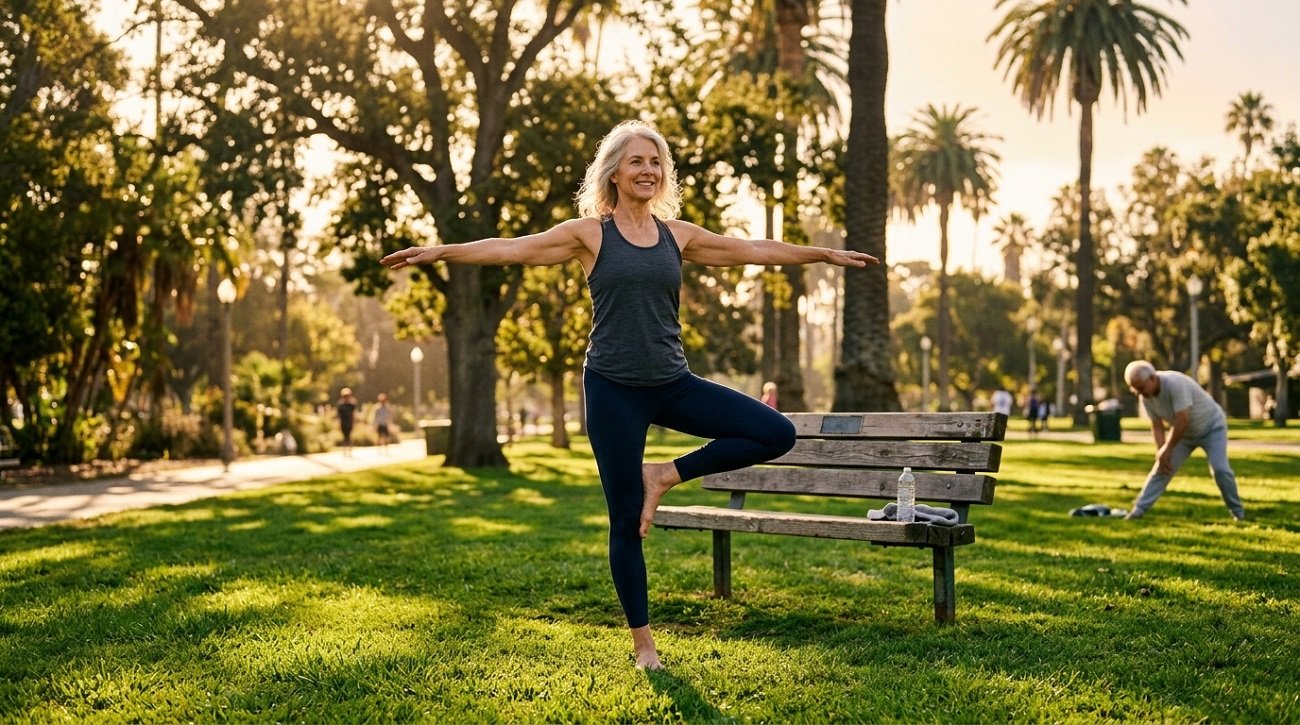
Stand next to a park bench. One hand on the bench — lightly. Like you are touching a wall for reference, not gripping it for dear life. Lift your right foot off the ground. Your standing knee should have a tiny bend. Do not lock it. Hold.
If you can hold 10 seconds, that is your starting point. Write it down somewhere. If you can do 20 or 30, write that down too. You are going to track this number over the coming weeks.
Three holds on each leg. Rest between each.
| Weeks | Support Level | Target Time |
|---|---|---|
| 1–2 | One hand on bench | 15–30 seconds |
| 3–4 | Fingertips only | 20–40 seconds |
| 5–6 | No support | 15–30 seconds |
| 7–8 | No support, eyes closed | 10–20 seconds |
| 9+ | Soft surface (towel/grass), no support | 20+ seconds |
Exercise 2: Heel-to-Toe Walking
Find a straight line on the sidewalk. Or use a line in the grass. Place your right heel directly in front of your left toe. Then your left heel directly in front of your right toe. Walk like this for 20 steps. Turn around. Come back.
Eyes forward. Not looking at your feet. This matters more than you think. When you look down, your vestibular system is in a different position than when you walk normally. Train the way you actually walk.
Three rounds. Rest between rounds.
Do not rush. Go slow. The slower you go, the harder your balance system works. Speed is not the goal here. Control is.
Exercise 3: Squats to Park Bench
Stand in front of the bench. Feet shoulder-width apart. Toes pointed slightly out — maybe 15 degrees. Lower your hips back and down like you are about to sit. Lightly touch the bench with your glutes. Do not actually sit. Stand back up.
Chest up. Weight in your heels. If your knees are shooting past your toes, you are leaning too far forward.
10 to 12 reps. Rest. Three sets.
Why this matters: squats build your quads, hamstrings, and glutes. Those are the three muscle groups that generate the force to catch you when you trip. A 2025 study in the Journal of Strength and Conditioning Research found that squat strength directly correlated with recovery speed after a simulated trip in adults over 65.
Exercise 4: Calf Raises
Behind the bench. Hands on the backrest for light support. Rise up onto your toes as high as you can. Hold two seconds at the top. Lower slowly — three full seconds to come back down.
15 reps. Three sets.
Your calf muscles fire first when you start to fall forward. They generate the initial ankle correction that stops your momentum. Research from the NIA shows calf strength is one of the strongest independent predictors of balance recovery. Stronger calves. Faster reaction when you stumble.
Exercise 5: Side Leg Raises
Behind the bench. Both hands on the backrest. Shift weight to your left leg. Lift your right leg out to the side — aim for 30 to 45 degrees. Hold one second at the top. Lower slowly.
10 each side. Three sets.
Your hip abductors — the muscles on the outside of your hip — are critical for side-to-side stability. When you trip and start falling sideways, these are the muscles that pull you back upright. Most seniors have weak hip abductors because walking on flat ground does not challenge them.
Cool-Down — 5 Minutes
Walk slowly for two minutes. Sit on the bench. Hamstring stretch — extend one leg straight, hinge at the hips, reach toward your toes. 30 seconds each leg. Five deep breaths.
Tuesday: Walking with Purpose
Not just any walking. A walk designed to train specific balance components.
The Walk — 30 Minutes
Start at a comfortable pace. Five minutes. Then begin this pattern:
Minutes 5–10: Posture Walk
All your attention on posture. Ears over shoulders. Shoulders over hips. Hands swinging naturally — not in your pockets. Slightly longer strides than normal. This trains your body to maintain alignment while moving. Reduces the energy cost of walking. Improves stability.
Minutes 10–15: Speed Intervals
Brisk pace for 30 seconds. Normal pace for 60 seconds. Repeat for five minutes. These intervals train your legs to handle pace changes. Real life is not one speed. You need to cross a street before the light changes. Hurry to catch something. Your body needs to be ready for that.
Minutes 15–20: Terrain Changes
If you are on a trail, this happens naturally. If you are on a flat path, walk on the grass next to it for a few minutes. Walk on the slight slope at the edge of a park. Walk across a flat sandy area if you find one. Terrain changes force your ankles and feet to adapt. That is the whole point.
Minutes 20–25: Head Turn Walk
Walk normally. Every 10 steps, slowly turn your head to the left. Back to center. Next time, turn right. This trains your vestibular system to keep you balanced while your head moves. That is what happens when you walk and look for traffic. Check over your shoulder. Scan for an address.
Minutes 25–30: Cool-Down
Slow your pace gradually. Five minutes. End with gentle standing stretches.
Walking is the most functional movement you do. Every day. Every environment. Every condition. Improving how you walk directly reduces your fall risk during the activity you spend the most time doing. Our article on walking workouts for weight loss after 50 goes deeper into structuring effective walking sessions.
Wednesday: Dynamic Balance and Core Stability
Things get harder today. Moving from static balance (standing still) to dynamic balance (balance while moving). Plus core work.
Warm-Up — 5 Minutes
March in place. Two minutes. Then hip circles — stand on one leg (hold the bench) and make big circles with the opposite knee. Ten each direction. This opens up your hips and activates the deep stabilizer muscles around the joint.
Exercise 1: Lateral Step-Overs
Find a small object. A stick. A water bottle. Draw a line. Stand with the object to your right. Step over it with your right foot. Bring your left foot to meet it. Step back over to the left. Leading with your left. Back and forth. Ten times each direction.
Torso upright. Do not lean over the object. Feet clear it cleanly — no dragging.
This trains lateral movement. Stepping over curbs. Avoiding obstacles. Navigating around furniture. Most balance exercises focus on forward-and-back. This one goes side-to-side. That is where a lot of falls actually happen.
Exercise 2: Standing Knee Lifts with Pause
Behind the bench. Hands on backrest. Lift your right knee to hip height — or as high as comfortable. Hold it at the top for three seconds. Lower slowly. Alternate legs.
10 lifts each side. Three sets.
When this gets easy, try one hand on the bench. Then fingertips. Then no hands. Then eyes closed during the three-second pause. That last one is surprisingly hard. Your vestibular system will let you know.
Exercise 3: Tree Pose
Stand on your left leg. Place your right foot against your left inner ankle or calf. Never against the knee. Find a spot on the ground about six feet in front of you. Stare at it. Hold 15 to 30 seconds.
Fingertip support on the bench if you need it. Switch sides. Three holds each.
Yoga balance poses work. A 2023 study in Frontiers in Public Health found they produce improvements in static and dynamic balance comparable to dedicated balance training programs. The bonus is they also train hip stability, ankle proprioception, and focused attention. All in one movement. Our article on yoga and fitness classes in Los Angeles covers this more.
Exercise 4: Bird-Dog on Grass
All fours on the grass. Hands under shoulders. Knees under hips. Slowly extend your right arm forward and left leg back at the same time. Keep your hips level. Do not let one hip drop. Hold five seconds. Return to start. Switch.
10 each side. Two sets.
This is one of the best core exercises for older adults. It trains anti-rotation — keeping your trunk stable while your limbs move. That is exactly what happens when you walk, carry groceries, or reach for something on a shelf. Stable core means your legs work better. Better legs means better balance.
Exercise 5: Seated Marching
Sit on the bench. Feet flat. Hands at your sides. Lift your right knee as high as you can. Hold two seconds. Lower. Left knee. Alternate. 20 total lifts.
Feels easy? Good. What you are training is hip flexor strength and the coordination of alternating leg movements. That is the fundamental pattern of walking.
Cool-Down — 5 Minutes
Sit on the bench. Gentle spinal twist — right hand on left knee, rotate your torso left. 20 seconds. Switch. Sit quietly. Five slow breaths.
Thursday: Active Recovery
Your body builds strength during rest. Not during exercise. Thursday is about moving gently.
Option A: Aqua Fitness (Best Choice)
If you have pool access, use it. Water gives you natural resistance without joint impact. Buoyancy cuts your body weight by about 90%. You move freely without worrying about falling.
Pool walking. Water arm circles. Gentle leg kicks. Standing balance in waist-deep water. The water resistance makes every movement a little harder than on land. Builds strength without the joint stress.
Our article on aqua fitness versus gym versus Focus Camp breaks down the benefits.
Option B: Easy 20-Minute Walk
Conversational pace. The pace where you could comfortably talk to someone beside you. No intervals. No terrain challenges. Just easy movement. Keeps blood flowing. Helps muscles recover.
Option C: Stretching at Home
15 to 20 minutes of gentle stretching. Calves. Hamstrings. Hip flexors. Shoulders. 30 seconds each. Deep breathing. Do not push into pain. Just a comfortable stretch.
Friday: Reactive Balance and Functional Strength
Hardest day of the week. Reactive balance — your body’s ability to respond fast when something unexpected pushes you off balance. This is the most real-world relevant training you can do.
Warm-Up — 5 Minutes
Easy walking with big arm swings. Let your arms cross your body slightly as you swing. Warms up shoulders and torso. Gets your nervous system going. Then ankle pumps — stand on the edge of a step, let your heels drop below the edge, rise up. Ten times.
Exercise 1: Tandem Stance with Head Turns
Heel-to-toe. Like the walking position, but standing still. Hold 20 seconds. Then, without moving your feet, slowly turn your head left. Hold five seconds. Right. Five seconds. Back to center.
Five holds. Switch which foot is in front each time.
This is harder than it sounds. Close together feet mean a narrow base. Head turns activate your vestibular system while your visual field shifts. You are being challenged from two directions at once. That is real life — walking on a narrow path, hearing something, turning to look, and now your balance is tested from multiple angles.
Exercise 2: Step-and-Reach in Four Directions
This one comes directly from the Otago Exercise Programme. New Zealand-developed. Clinically validated. One of the best fall prevention exercises that exists.
Stand on your left leg. Bench for fingertip support if needed.
- Forward: Right foot extends forward. Right arm reaches forward like touching a wall. Tap the ground. Return.
- Side: Right foot extends to the side. Right arm reaches sideways. Tap. Return.
- Back: Right foot extends behind you. Right arm reaches back. Tap. Return.
- Diagonal: Right foot crosses your body. Right arm follows. Tap. Return.
That is one round. Five rounds each leg.
Most people find the back reach and diagonal reach hardest. Those are the directions you practice least. But those are also the directions life throws at you — stepping back from a closing door, turning quickly when someone calls your name.
Exercise 3: Sit-to-Stand Without Hands
Sit on the bench. Cross your arms over your chest. Feet flat on the floor, slightly behind your knees. Lean forward a bit. Shift your weight over your feet. Stand up using only your legs. No pushing off the bench. No hands on your thighs. Sit back down with control.
10 reps. Three sets.
If you cannot do it without your hands, that is okay. One hand on the bench. Use it as little as possible. Over weeks, reduce the pressure until you can stand without it.
Why this is critical: the sit-to-stand test is used by physical therapists worldwide. Adults who cannot stand from a chair without using their hands have significantly higher fall rates. This is not just an exercise. It is a predictor. Build up to 15 or more in 30 seconds without your hands, and your fall risk drops meaningfully.
Exercise 4: Walking Lunges on Grass
Big step forward with your right foot. Lower your back knee toward the ground. Go as low as comfortable — even a quarter of the way down counts. Push off your right foot. Left foot forward into the next lunge.
10 lunges. Rest. Two more rounds.
If lunges are too much, do supported step-ups instead. Find a low step or curb. Right foot on it. Step up. Step down. Alternate legs. 10 each.
Exercise 5: Clock Reaches
Stand on your left leg. Imagine a clock under your feet. Reach your right foot to 12 o’clock (forward). Then 3 o’clock (right side). Then 6 o’clock (behind). Then 9 o’clock (left side). Light tap at each position.
Two full rotations each leg.
Cool-Down — 5 Minutes
Standing quad stretch — hold your right foot behind you, pull heel toward your glute. 30 seconds. Switch. Seated forward fold on the bench — legs extended, hinge at hips, reach for toes. 30 seconds. Five deep breaths.
This day mirrors the functional fitness training we do at Focus Camp — movements built to translate directly into everyday life.
Saturday: Community and Social Movement
Not a throwaway day. Social exercise is a documented factor in long-term fitness adherence and fall prevention.
Research in the Journal of Aging and Physical Activity shows older adults who exercise in groups are significantly more likely to stick with it over 12 months versus solo exercisers. Social accountability. Enjoyment. Belonging. All of it adds up to consistency.
Options:
Join a group outdoor session at Focus Camp. Our open-air training programs include balance work in every class. Plus you get the benefit of training with people your age.
Walk with someone. Not a solo walk. A social walk. Talk. Laugh. Catch up. Our guide on outdoor fitness activities for couples in Los Angeles has ideas.
Try something new. Rock climbing. Swimming. Even bowling. Anything that challenges your balance in a new way helps. Our article on rock climbing at 40 in Los Angeles shows it is never too late.
Why this matters for fall prevention: fear of falling creates isolation. Isolation creates inactivity. Inactivity creates weakness. Weakness creates falls. Breaking that cycle requires other people. When you train with someone, you push a little harder. You show up more consistently. Someone notices when you do not.
Sunday: Full Rest
No exercise. Your muscles need to repair. Your nervous system needs to consolidate the balance patterns you practiced all week.
Use today to:
Self-assess. Which exercises were hardest? Which got easier? Write it down. Tracking progress is one of the strongest predictors of sticking with a program long-term.
Check your shoes. Soles worn down? Still supportive? Good traction? Replace if needed.
Think about Vitamin D and medications. If you have not talked to your doctor about either one, schedule that appointment today.
Plan next week. Pick your park. Lay out your clothes. Decide what time. Fewer decisions in the moment means more follow-through.
How to Progress Over 12 Weeks
Your body adapts fast. What hurts in week one feels easy by week four. Progression keeps you improving.
| Week | Single-Leg Stand | Heel-to-Toe Walk | Squats | Calf Raises | Key Change |
|---|---|---|---|---|---|
| 1–2 | 1 hand on bench, 15–30 sec | 20 steps × 3 | Bench touch, 10 reps × 3 | 15 reps × 3 | Learn the moves |
| 3–4 | Fingertips, 20–40 sec | 25 steps × 3 | Light touch, 12 reps × 3 | 18 reps × 3 | Less hand support |
| 5–6 | No support, 15–30 sec | 30 steps × 3 | No touch, 10 reps × 3 | 20 reps × 3 | Support gone |
| 7–8 | No support, 30–45 sec | 30 steps × 3, eyes forward | No touch, 12 reps × 3 | Single leg, 10 × 3 | Add difficulty |
| 9–10 | Eyes closed, 10–20 sec | 35 steps × 3, head turns | Weighted, 10 reps × 3 | Single leg, 12 × 3 | Eyes closed + load |
| 11–12 | Soft surface, 20 sec | 40 steps × 3, varied terrain | Deeper range, 12 × 3 | Single leg on step, 12 × 3 | Real-world surfaces |
One rule: change one variable at a time. If you are increasing hold time, do not also remove hand support that same week. Master one thing. Then add the next.
What the Otago Program Teaches Us
You might have heard of the Otago Exercise Programme. Developed in New Zealand. One of the most researched fall prevention programs on the planet. It uses 17 strength and balance exercises done three times a week, plus a walking program.
A 2022 meta-analysis in BMC Geriatrics found Otago reduced falls by 35% in community-dwelling older adults. That is a serious number.
The routine in this article draws heavily from Otago principles. Single-leg stands. Tandem walking. Step-and-reach. Sit-to-stand. Progressive difficulty. The key differences: this one is designed for outdoor training in Los Angeles. It adds yoga and functional movements Otago does not include. And it has the social and community component that Otago — which is typically done alone at home — does not offer.
Want the most evidence-based approach possible? Combine this outdoor routine with Otago’s structured progression schedule. Best of both worlds.
Tai Chi: The Overlooked Balance Tool
Tai Chi deserves its own section because the research on it is kind of incredible.
A 2023 meta-analysis in Frontiers in Public Health found that Tai Chi prevents falls and improves balance in older adults. Healthy or high-risk. The slow weight shifts. The posture focus. The controlled single-leg movements. All of it trains balance gently enough that most seniors can do it.
Tai Chi is especially good at:
- Improving proprioception (where your body is in space)
- Reducing the fear of falling
- Improving reaction time
- Training weight transfer between legs (critical for walking stability)
Look for classes at Los Angeles recreation centers. Many offer free or low-cost Tai Chi for seniors. Outdoor Tai Chi groups meet at Griffith Park, Echo Park, and the beaches on weekend mornings.
At Focus Camp, we weave Tai Chi-inspired balance flows into our sessions. The slow, controlled movements pair well with our strength and outdoor work. Our article on how outdoor workouts improve motivation and mental health covers how mind-body practices benefit both physical and mental well-being.
Shoes, Vitamin D, and Your Medications
Exercises matter. A lot. But they are not the whole picture.
Shoes
Your shoes are where your body meets the ground. Wrong shoes undo all the balance training you do.
| What to Look For | What to Avoid |
|---|---|
| Flat, firm, non-slip sole | Thick cushioning, high heels, slippery soles |
| Snug heel, roomy toe box | Loose, floppy, too tight |
| Ankle support if needed | Flip-flops, backless shoes, worn-out soles |
| Light to medium weight | Heavy boots |
| Moderate ground feel (you feel the surface) | Zero ground feel (thick foam blocks everything) |
Cross-training shoes or walking shoes with flat, stable bases work best. Running shoes with thick cushioning are designed for forward motion on flat surfaces. They can actually make balance exercises harder by reducing your connection to the ground.
Vitamin D
A Cochrane review found Vitamin D supplementation reduces fall risk in older adults who are deficient. And a lot of adults over 60 are deficient. Especially the ones who do not get outside much.
Get tested. Simple blood test — 25-hydroxyvitamin D. Below 30 ng/mL and your doctor will probably recommend supplementation. Add outdoor exercise where your skin makes Vitamin D from sunlight. You are now attacking one of the most common risk factors from two angles.
Medications
A medication review focused on fall risk is one of the highest-value things you can do. Ask your doctor or pharmacist to look at everything you take. Including over-the-counter drugs. For side effects that affect balance.
The usual suspects:
- Blood pressure meds — dizziness when standing up
- Sleep meds (benzodiazepines, Z-drugs) — next-day drowsiness affects balance
- Antidepressants (SSRIs, tricyclics) — dizziness, orthostatic hypotension
- Antihistamines (diphenhydramine/Benadryl) — slows reaction time
- Opioid pain meds — drowsiness, dizziness, impaired judgment
Do not stop anything on your own. Start a conversation. Ask about alternatives. Ask about dosage adjustments. It is a simple conversation that could keep you on your feet.
Home Safety Checklist
Most falls happen at home. Walk through your house with this list. Fix what you find.
Throughout the House
- Throw rugs removed or secured with non-slip backing
- Pathways clear of clutter, cords, small furniture
- Bright lighting in all rooms and hallways
- Nightlights in bedrooms, hallways, bathrooms
- Loose carpet edges and floor transitions secured
Bathroom
- Grab bars next to toilet and in shower/tub
- Non-slip mats in tub and on bathroom floor
- Raised toilet seat if getting up is hard
- Nightlight on in the bathroom at night
Kitchen
- Frequently used items at waist height — not high shelves or low cabinets
- Spills cleaned up immediately
- Sturdy step stool with handrail for reaching high shelves
Stairs
- Handrails on both sides
- Bright, even stair lighting
- Broken or uneven steps repaired
- Non-slip treads on smooth stair surfaces
Bedroom
- Lamp and phone within reach of the bed
- Clear path from bed to bathroom
- Nightlight between bed and bathroom
- Bed rails if getting in and out is hard
When to Talk to Your Doctor First
This routine is for generally healthy adults who walk independently. Talk to your doctor before starting if:
- You fell in the past 12 months
- You take medications that cause dizziness or drowsiness
- You have neuropathy (numbness or tingling) in your feet
- You have Parkinson’s, stroke history, or another neurological condition
- You get frequent vertigo or dizziness
- You had recent surgery on your legs, hips, or spine
- You have uncontrolled high or low blood pressure
- You have a heart condition that limits activity
If any of those apply, a supervised program is a safer starting point. At Focus Camp, we work with adults at every level. Including people who need modifications, extra support, and medical clearance. Our private coaching sessions in Los Angeles exist exactly for this.
Questions People Actually Ask
How long until I see improvement in balance?
Four to six weeks of consistent training, three to four times a week. A 2025 study in the Journal of Strength and Conditioning Research found measurable improvements starting at the four-week mark in a combined resistance and balance program. Improvements kept accumulating over the full 24 weeks.
Consistency is everything. Once a week helps. Three to four times a week produces dramatically better results. Think of it like brushing your teeth — once a week is better than nothing, but daily is what actually prevents problems.
Can exercises really prevent falls, or just lower the risk?
No exercise guarantees you will never fall. But structured balance and strength training reduces fall risk by 23 to 40 percent. The Otago programme showed 35% reduction. Tai Chi studies show similar numbers.
The biggest risk reduction comes from combining balance training, strength training, and environmental changes (like the home safety checklist). No single approach works as well as combining them.
What time of day is best for balance exercises?
Morning, generally. You are more alert. In Los Angeles, mornings are cooler during warm months. But the best time is the time you will actually do it. If you reliably exercise at 4 PM but skip mornings, exercise at 4 PM. Consistency beats timing.
Our guide on best times for outdoor fitness in LA covers temperature, crowds, and air quality by time and season.
Do I need special shoes?
Flat, stable sole. Good traction. Not running shoes with thick cushioning. Not high heels. Not flip-flops. Not anything loose or worn out. Cross-training shoes or walking shoes work well. If you have foot problems, talk to a podiatrist.
Is outdoor exercise safe for balance training?
Yes. And it is more effective than indoor training. Start on flat grass near a bench. Avoid wet surfaces, steep inclines, and areas with hidden obstacles until you feel confident. Los Angeles parks with maintained grass are ideal.
One thing: sunscreen, hat, water. Avoid the hottest part of the day in summer (11 AM to 3 PM). Early morning or late afternoon work best.
How do I know if I am actually improving?
Track two things:
Single-leg stand time. Most people start at 10 to 15 seconds. Build to 30 to 60 seconds in a few weeks. Write it down each week.
30-second sit-to-stand count. Sit in a chair. Arms crossed. Count how many times you can stand and sit in 30 seconds. Under 8 means higher fall risk. 10 to 14 is average for ages 60–69. 15 or more is excellent.
Two simple tests. Objective feedback. Real progress you can see.
What if I already fell — should I still do this?
If you fell and did not get seriously hurt, this routine can still work. Start with the easiest versions. Talk to your doctor first. If you fell and broke a bone, hit your head, or needed medical attention, get clearance before starting anything.
The fact that you fell once means your risk doubled. That is exactly why you should train. But do it safely. With guidance if you need it.
What if I use a cane or walker?
Some exercises can be modified. But this specific routine is designed for independent walkers. If you use an assistive device, start with a private coaching session where a trainer can assess you and build a modified program around your specific needs.
How is this different from physical therapy?
Physical therapy is for when something is already wrong. This routine is for preventing something from going wrong. Both are valuable. They are not interchangeable.
If you have a diagnosed balance disorder, neurological condition, or recent injury, physical therapy is the right first step. If you are generally healthy and want to proactively protect your balance, this routine is built for that.
How Focus Camp Can Help
I gave you this routine because I wanted you to have something you could start today. On your own. In any park in Los Angeles. But I want to be straight with you about something.
The exercises work. But how you do them matters as much as what you do. Your posture. Your alignment. How you breathe. The speed of your movements. How you distribute your weight. Those details are the difference between an exercise that helps and one that just makes you tired.
At Focus Camp, our trainers Francois and Tina have spent years working with adults over 50 on exactly these movements. They spot things most people do not notice in themselves. The way you favor one leg without realizing it. The way you lean too far forward. The way you hold your breath when something gets hard. Small corrections. Big results.
What we offer:
- Small group outdoor sessions — community training with balance and strength built into every class. Our open-air programs.
- Private one-on-one coaching — personalized for your body, your goals, your limitations. Private sessions.
- A real community — people who motivate each other and actually enjoy showing up. Why outdoor group workouts beat gyms.
Not sure where to start? Our beginner’s guide to Focus Camp covers everything. What to expect. What to bring. What your first session feels like.
Ready to Start?
Book your first session with Focus Camp and see what outdoor training built for your body actually feels like. You do not have to figure this out alone. And you do not have to wait until after a fall to start.Book Your First Session
About the Author: Focus Camp is an outdoor fitness community in Los Angeles, founded by trainers Francois and Tina. We specialize in strength training, yoga, aqua fitness, and balance programming for adults over 50. See our services · Meet the team
4 Responses