You’re over 50. You haven’t had a real workout routine in years—maybe decades. The idea of walking into a packed gym, or trying to keep up with a 25-year-old on YouTube, feels completely impossible. Your knees ache when you walk up stairs, your back stiffens up the second you sit too long, and honestly? You’re just tired of feeling like your best years are behind you.
I get it. We talk to people in this exact spot every single day at Focus Camp.
The fitness industry doesn’t make it easy for adults over 50. Everything is marketed toward young people who want six-pack abs. But what if you just want to get off the floor without grunting? What if you want to carry your groceries without your back screaming at you?
This isn’t another generic article telling you to “take the stairs instead of the elevator.” You already know that. This is a deep-dive, realistic guide on how to start exercising again after 50 when you’re out of shape, dealing with stiff joints, and absolutely terrified of getting hurt.
In This Article
What’s Actually Happening to Your Body After 50 (And Why It’s Not Your Fault)
Before we talk about what to do, we need to talk about why it feels so incredibly hard to get started.
If you feel like your metabolism just hit a brick wall, you aren’t imagining it. Once we cross 50, our physiology shifts. It’s not a character flaw—it’s biology.
Here are the three big changes happening right now:
1. Sarcopenia (The Silent Muscle Loss)
Starting in your 30s, you naturally lose about 3% to 8% of your muscle mass every decade if you aren’t actively doing resistance training. By the time you hit 50 or 60, that loss compounds. Less muscle means a slower metabolism, which is why you can eat the exact same amount you did ten years ago, but you’re suddenly gaining weight.
2. Joint Dehydration and Stiffness
The cartilage that cushions your joints gets thinner, and the synovial fluid that lubricates them decreases. That’s why you might feel like the Tin Man needing an oil can first thing in the morning.
3. Hormonal Shifts
Fluctuations in estrogen and testosterone change where your body stores fat—usually shifting straight to the midsection. It also makes your body less efficient at turning protein into muscle.
But here is the most important thing you’ll read today: Your body is still incredibly adaptable. Research has proven over and over that you can rebuild muscle, improve balance, and increase bone density well into your 70s, 80s, and beyond. You just have to press the right buttons.
The Biology vs. The Fix
| The Biological Shift | What It Feels Like Day-to-Day | The Exercise Fix | Why It Actually Works |
|---|---|---|---|
| Sarcopenia (Muscle Loss) | Weakness, difficulty lifting grandkids or carrying groceries. | Progressive Resistance Training | Forces muscle fibers to adapt and grow, reversing the loss. |
| Decreased Bone Density | Fear of falling, brittle bones. | Weight-Bearing Movement | Wolff’s Law: Bones get denser when physical stress is applied to them. |
| Cartilage Thinning | Creaky, painful knees and hips when walking. | Low-Impact Cardio & Mobility | Pumps synovial fluid into the joint capsule—literally oiling the hinge. |
| Slower Metabolism | Weight gain despite eating the same amount of food. | Building Active Tissue | Muscle burns calories at rest. Add 5 lbs of muscle, speed up your engine. |
| Nervous System Decline | Clumsiness, tripping over curbs, poor balance. | Proprioceptive Training | Re-wires the brain-muscle connection to improve reaction time. |
The Mental Block: Getting Past the “I’ll Wait Until I’m In Shape” Trap
The hardest part of getting fit after 50 isn’t your knees. It’s the fear of looking foolish.
We hear this constantly: “I need to lose 20 pounds before I can join a group class.” That is like saying you need to clean your house before the cleaning lady arrives. It makes zero sense. You start exactly where you are.
You also have to be willing to modify. If a full squat hurts your knees, you do a half squat. If a push-up on the floor is impossible, you do it against a wall. Modifying isn’t a sign of weakness; it’s the intelligence that keeps you in the game long enough to actually get strong. Nobody is judging you. And if they are, they aren’t the people you want to work out with anyway.
How to Start Exercising Again: The 4-Week “Restart” Protocol
Forget “no pain, no gain.” That mantra is for 20-year-olds with invincible spines. For adults over 50, it’s about the minimum effective dose—doing just enough to trigger your body to adapt, but not so much that you end up on the couch with an ice pack for a week.
Weeks 1 & 2: The Awakening Phase
Your only goal here is consistency. We are waking up muscles that have been asleep for a decade.
Do this routine 3 to 4 days a week. It should take you about 15 minutes.
- The Get-Up (3 minutes): Sit on the edge of a sturdy chair. Without using your hands (or using them as little as possible), stand up. Sit back down slowly. Do this 5 to 8 times. Why this works: This is the single most functional movement you can do. It builds leg strength and ensures your independence.
- The Wall Push-Up (3 minutes): Stand about an arm’s length from a wall. Place your palms flat on the wall. Lower your chest toward the wall, then push back. Do 2 sets of 8. Why this works: Rebuilds chest and shoulder strength without putting any strain on your lower back.
- The Glute Bridge (3 minutes): Lie on your back, knees bent, feet flat on the floor. Squeeze your glutes and push your hips toward the ceiling. Lower slowly. Do 2 sets of 10. Why this works: Counteracts “desk slouch” by firing up the muscles in your lower back and butt.
- The Balance Brush (3 minutes): Stand next to a counter. Brush your teeth while standing on one leg (use the counter if you wobble). Switch legs halfway through. Why this works: Rebuilds ankle stability and trains your brain to prevent falls.
- The 10-Minute Walk (10 minutes): Walk at a pace where you could hold a conversation, but you notice you’re actually breathing.
Weeks 3 & 4: The Building Phase
Your joints are waking up. Your balance is coming back. Now, we add a little stress to force the body to adapt and get stronger.
Do this routine 4 days a week. It should take about 30 minutes.
- The Chair Squat (5 minutes): Place a chair behind you. Push your hips back and lower down until your butt taps the chair, then stand up forcefully. Squeeze your glutes hard at the top. Do 3 sets of 8.
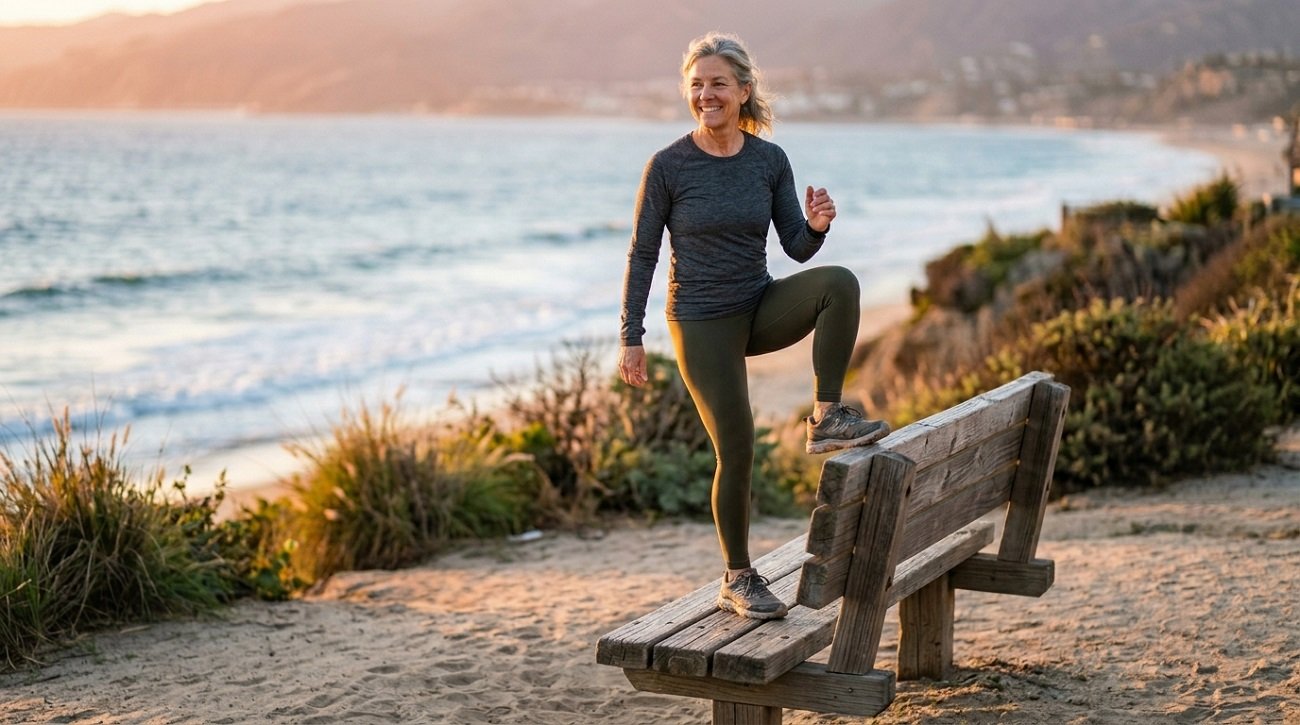
- The Incline Push-Up (5 minutes): Move from the wall to a sturdy kitchen counter or a park bench. The lower the surface, the harder it is. Do 3 sets of 8.
- The Step-Up (5 minutes): Find a step or a low curb. Step up with your right foot, bring your left foot up to tap, and step down slowly. Do 8 per leg. Why this works: Incredible for balance and fixing strength imbalances between your left and right sides.
- Zone 2 Cardio (15 minutes): Walk briskly. You should be breathing heavily enough that you can talk, but you don’t really want to. This builds cardiovascular endurance without frying your nervous system.
How to Modify Exercises So You Don’t Wreck Your Joints
One of the most searched questions by adults returning to fitness is how to work around pain. If something hurts, you don’t push through it. You adjust. Here is exactly how to tweak the big three movements.
| The Exercise | If Your Knees Hurt | If Your Lower Back Hurts | If Your Shoulders Hurt |
|---|---|---|---|
| Squat | Don’t go as deep. Only lower 1/3 of the way down. Push through your heels. | Keep your chest lifted. Look straight ahead, not down at the floor. Brace your core like someone is going to poke you in the stomach. | N/A (Shoulders shouldn’t hurt here) |
| Push-Up | N/A | Keep your core tight. Don’t let your hips sag or stick your butt up in the air. | Don’t go as deep. Only lower an inch or two before pushing back up. |
| Cardio/Walking | Walk on softer surfaces like dirt trails or the hard-packed sand at the beach. Avoid steep downhills. | Keep a brisk pace—slouching while walking causes back pain. Wear highly supportive shoes. | N/A |
The Unsung Heroes: Breathing, Protein, and Sleep
You do not get stronger while you are working out. You get stronger while you are recovering from the workout. For the over-50 crowd, recovery is the secret weapon.
1. Stop Holding Your Breath
Never hold your breath during exercise (it’s called the Valsalva maneuver). It spikes your blood pressure, which is the last thing you want. Exhale on the effort (when you push up or stand up), and inhale on the easy part (when you lower down or sit).
2. The Protein Timing Problem
As you age, your body becomes stubborn about using protein to build muscle. You need more of it to trigger the same response you got in your 30s. Aim for 25-30 grams of protein within an hour or two after your workout. It acts like mortar for the bricks you just tried to build. A protein shake, a piece of fish, or Greek yogurt works perfectly.
3. Sleep is the Ultimate Supplement
We see this all the time—people over 50 struggle with sleep, and poor sleep completely destroys your fitness gains. If your body isn’t resting, it stays in a state of stress, holding onto belly fat and repairing muscle painfully slowly. If you’re struggling with this, check out our guide on the best exercises to sleep better after 50 in Los Angeles.
Why Outdoor Workouts Beat the Gym for Beginners Over 50
If you are dreading the idea of fluorescent lights, floor-to-ceiling mirrors, and 20-somethings grunting in a gym, don’t go. The data is incredibly clear: outdoor exercise provides significantly greater mental and physical benefits than indoor exercise.
When you work out outdoors—whether it’s on the sand, in a park, or on a trail—the ground is uneven. That forces your stabilizing muscles to fire. Your brain has to navigate the terrain, improving your proprioception (your body’s awareness of where it is in space, which prevents falls). Plus, the Vitamin D from the sun and the mental shift of being in nature lower cortisol (the stress hormone that stores belly fat).
That’s exactly why we built Focus Camp around our Beach & Outdoor Workouts. You get the low-impact, high-reward benefits of nature, and you don’t have to worry about anyone judging you.
When to Stop Guessing and Get Professional Help
The 4-week plan above will get you moving. But there comes a point where guessing slows you down—or gets you hurt.
If you have a specific injury, if your balance is truly compromised, or if you just know deep down that you won’t stick to a routine unless someone is waiting for you, it’s time to call in a professional. But not just any professional. A trainer in their 20s who mostly works with college athletes doesn’t understand the nuance of a 55-year-old’s joint health.
You need someone who understands how to assess your starting point without breaking you, how to scale movements for your specific body, and how to build a program that fits into your actual life.
If you’re in Los Angeles, we offer Private Coaching for people who want 1-on-1 attention and zero intimidation. We also have Group Functional Training for those who want the accountability and energy of a supportive community of peers. We even incorporate Yoga & Mindfulness to ensure your joints stay mobile and your nervous system stays calm.
If you’ve tried the standard gym route and it didn’t work, read our breakdown on Private Coaching vs. an LA Fitness Membership. And if you spend your days hunched over a computer, our outdoor posture correction sessions can undo decades of desk damage.
Frequently Asked Questions About Getting Fit After 50
Is it safe to start exercising after 50 if I haven’t worked out in years?
Yes—when done gradually and with proper form. Always get doctor clearance first, especially if you have cardiovascular risk factors. Start with low-impact movements and focus on consistency over intensity.
Can I actually build muscle after 50?
Absolutely. Studies show that resistance training effectively reverses age-related muscle loss, even in people in their 80s and 90s. Your muscles still respond to the stimulus of resistance.
How long until I see results?
Most people notice better sleep and more energy within 1 to 2 weeks. Strength improvements follow in 3 to 4 weeks. Visible changes in body composition usually take 8 to 12 weeks of consistent effort.
What if I have severe arthritis or joint pain?
Gentle, consistent movement is one of the best treatments for joint pain. Low-impact activities like walking, swimming, and yoga can reduce stiffness and improve joint lubrication. Avoid high-impact activities like running or jumping.
How many days a week should I exercise?
Start with 3 days a week of moderate activity (like walking) and 2 days of basic strength training. As you get stronger, you can gradually build up to the recommended 150 minutes of moderate cardio and 2-3 strength sessions per week.
Stop Waiting for the “Perfect Time”
Being over 50 and out of shape is not a life sentence. It’s just a starting point.
Your body is still incredibly responsive. You just have to respect the process. Start small. Modify when you need to. Prioritize strength over endless cardio. And for the love of God, get off the concrete and get out into nature.
You don’t need to be fit to start. You need to start to get fit.
If you’re ready to stop putting it off and want a professional, no-BS plan built for the body you have today, reach out to us at Focus Camp. Let’s get you moving again.