You show up every single day. You sweat. You watch what you eat—mostly. You push through another grueling workout, and then you step on the scale… and nothing. Or worse, the number actually goes up.
If that sounds painfully familiar, I want you to take a deep breath and hear me loud and clear: You are not broken, and this is definitely not a willpower problem.
Hey, François here, and Tina is right beside me. At Focus Camp, we hear this exact frustration almost every single day from people all across Los Angeles. They are putting in the effort—pounding the treadmill, taking those expensive boutique classes, lifting weights in crowded gyms—but the weight just will not budge. Some of our most successful members walked through our door ready to quit entirely because they hit this exact wall.
Here is what we’ve learned after years of helping Angelenos break through: the problem isn’t your effort. It’s that most standard exercise programs are actively working against your body’s natural physiology. The fix isn’t spending more hours trapped inside a gym or starving yourself on a stricter diet. It’s a fundamentally different approach to how, where, and with whom you train.
Outdoor training in Los Angeles isn’t just a scenic alternative to the gym. It directly targets the hidden, biological reasons your current routine isn’t delivering results—ranging from hijacked stress hormones and chronic inflammation to metabolic adaptation and recovery debt.
Let me show you exactly why you’re stuck, and how stepping outside under the LA sky can finally unlock the progress you deserve.
In this article…
The 7 Hidden Reasons You’re Not Losing Weight (Despite Killing Yourself in the Gym)
Before we get to the fix, we need to get brutally honest about what’s happening inside your body right now. These are the silent culprits we see most often—and most people are fighting several of them at once.
1. The Cortisol-Insulin Death Loop
This is the biggest, most overlooked barrier in the fitness industry. Most programs completely ignore the reality of your hormones: chronic stress hormones literally instruct your body to store fat, specifically around your midsection.
Your body doesn’t know the difference between a deadline at work, a fight with your spouse, and a grueling hour on the stairclimber. To your nervous system, it’s all stress. When you’re stressed, your body pumps out cortisol. And cortisol has one primary evolutionary job: keep you alive by storing energy (fat) for the “hard times” it thinks are coming.
Here is the exact biological loop you might be stuck in:
- Stress spikes cortisol (from life, plus intense indoor workouts).
- Cortisol spikes blood sugar to give you immediate energy to “flee the danger.”
- Insulin spikes to bring blood sugar down, but high cortisol makes your cells insulin resistant.
- Insulin stores the excess sugar as fat, specifically visceral fat around your organs.
- Your blood sugar crashes, leaving you exhausted and craving sugar.
This is especially critical for women over 35. As estrogen begins to fluctuate during perimenopause, your body naturally becomes more sensitive to cortisol. The fat-storing effect amplifies. If you’re a woman dealing with stubborn belly fat that won’t respond to exercise, our hormone-balancing outdoor fitness program was engineered specifically to break this loop.
The Gym Problem: Indoor high-intensity workouts in a stressful environment—fluorescent lights blaring, crowded spaces, loud bass thumping—actually spike cortisol further. You leave feeling “wired,” but your nervous system is exhausted.
The Outdoor Fix: Training in nature measurably lowers cortisol faster than indoor exercise. When we train at Venice Beach or the Santa Monica bluffs, the combination of open sky, ocean sounds, and fresh air physically shifts your nervous system from “fight or flight” (sympathetic) into “rest and digest” (parasympathetic). You’re burning calories while actively resetting the hormone that’s been blocking fat loss. We break down the full science behind this in our guide on how outdoor workouts in Los Angeles improve motivation and mental health.
2. Metabolic Adaptation & The Chronic Cardio Trap
You know the routine: 45 minutes on the elliptical, maybe a jog on the treadmill, perhaps a spin class. You’re drenched in sweat, so it must be working… right?
Here’s the uncomfortable truth: long-duration, steady-state cardio is one of the least effective strategies for sustainable fat loss. The initial weight loss many people experience with cardio plateaus fast because of metabolic adaptation. Your body is a brilliant survival machine. It figures out how to do your 3-mile run using less and less energy (calories) each time.
Meanwhile, excessive cardio without adequate strength training does massive damage:
- It eats your muscle: Long cardio sessions eventually break down lean muscle tissue for energy. Less muscle means a slower resting metabolism.
- It skyrockets hunger: Chronic cardio drives ghrelin (the hunger hormone) through the roof, making it nearly impossible to maintain a caloric deficit without feeling miserable.
- It wrecks your NEAT: Non-Exercise Activity Thermogenesis (NEAT) is the energy you burn just moving around during the day—walking, fidgeting, standing. When you drain your battery with a grueling cardio session, you subconsciously move less the rest of the day to conserve energy.
If your knees or hips are already talking to you from all this pavement pounding, our guide on burning fat fast without joint pain or burnout shows you a much better way.
The Outdoor Fix: Outdoor training naturally breaks the chronic cardio pattern. The varied terrain—sand, trails, hills, grass—forces your body to constantly adapt. You can’t “zone out” on a treadmill when you’re navigating a beach circuit. This variation prevents metabolic adaptation. A beach circuit includes sand-resistance strength work, short metabolic bursts, and natural recovery periods. You get the metabolic boost of intensity with the muscle-preserving benefits of resistance training, creating the “afterburn effect” (EPOC)—where your body continues burning calories at an elevated rate for up to 48 hours after the session ends.
3. The Indoor Inflammation Trap
This might be the most overlooked barrier to weight loss in Los Angeles. Chronic, low-grade inflammation doesn’t just cause joint pain and fatigue—it literally locks your cells in “storage mode.”
Think of your cells like a house. Insulin is the key that unlocks the door to let glucose (energy) inside. When you’re inflamed, the locks get jammed. This is called insulin resistance. The glucose can’t get into the house, so it floats around in your bloodstream until your liver converts it into fat for storage.
LA residents face massive, unique inflammation triggers:
- Air pollution: Microscopic particulates from freeway traffic trigger systemic inflammation.
- Hard surfaces: Pounding concrete on a treadmill or at a boutique gym creates micro-trauma in your joints that never fully heals.
- Indoor air quality: Gyms are notorious for poor ventilation, recycled air, and chemical off-gassing from rubber mats and cleaning supplies.
The Outdoor Fix: Natural environments actively reduce inflammation markers. The phytoncides released by trees in parks like Griffith Park have been clinically shown to lower inflammatory cytokines in your bloodstream. Ocean air contains negative ions that support respiratory function and reduce oxidative stress. The soft surfaces—sand, grass, dirt trails—eliminate the joint-pounding impact that keeps your body in a state of chronic repair. We designed our anti-inflammatory outdoor workout program specifically to combat this cycle.
4. Vitamin D Deficiency & The “Indoor Metabolic Slowdown”
Here’s a weird irony: we live in Los Angeles, one of the sunniest cities on earth, yet a massive percentage of the people who come to us are severely deficient in Vitamin D. Why? Because they go from their house, to their car, to an indoor gym, to an indoor office, and back home.
Vitamin D isn’t just a vitamin; it acts like a pro-hormone in your body, and it is directly tied to your metabolism. Low Vitamin D levels are linked to:
- Increased parathyroid hormone, which triggers fat storage.
- Lower testosterone and estrogen, making it harder to build fat-burning muscle.
- Impaired insulin sensitivity, pushing you further into that fat-storing state we talked about.
The Outdoor Fix: Training outdoors at Focus Camp naturally optimizes your Vitamin D levels safely. Just 20-30 minutes of morning sun exposure on your skin before the UV index gets too high can generate thousands of IUs of Vitamin D, regulating your circadian rhythm, improving your sleep, and waking up your sluggish metabolism.
5. Your Recovery Is Broken (You’re Overtraining)
This one surprises people the most. You do not get fitter from exercise—you get fitter from recovering from exercise. The workout is just the architectural blueprint; recovery is the construction crew.
Most people trying to lose weight are massively under-recovered. They think “more is better,” so they train hard 5, 6, or 7 days a week. But when your recovery is insufficient, your body stays in a catabolic state—breaking down tissue instead of building it up. Cortisol remains elevated, testosterone and growth hormone drop, and fat loss becomes biologically impossible.
The Outdoor Fix: At Focus Camp, we treat recovery as part of the training, not an afterthought. The natural environment itself accelerates recovery in ways that indoor training cannot match. After a challenging beach session, our members have immediate access to the Pacific Ocean for cold water therapy—LA’s free, built-in cryotherapy. Walking into the 58-62°F ocean water for just 3-8 minutes reduces systemic inflammation, flushes metabolic waste from your muscles, and cuts delayed-onset muscle soreness (DOMS) by up to 48%.
We’ve documented our complete recovery system in our guide to recovery techniques every active person in Los Angeles needs after workouts, including ocean therapy, targeted myofascial release, and precision nutrition timing.
6. You’re Losing Weight, But It’s Muscle (The “Skinny Fat” Trap)
The scale is a liar. If you are doing hours of cardio and eating in a severe calorie deficit, the scale might go down, but you’re likely losing a 50/50 mix of fat and muscle.
This is the “skinny fat” trap. When you lose muscle, your basal metabolic rate (BMR) drops. Each pound of lean muscle you carry burns approximately 6-10 calories per day at rest. Lose 5 pounds of muscle, and you’re burning 30-50 fewer calories every single day just existing. Over a year, that’s up to 18,000 unburned calories. This makes it incredibly easy to regain the weight (usually as pure fat) the second you stop starving yourself.
The Outdoor Fix: You need resistance training that builds lean muscle. Outdoor training naturally incorporates functional, varied strength work that builds real, usable muscle. Sand resistance alone can double the muscle activation of certain exercises compared to performing them on solid ground. Hill sprints build powerful glutes and legs. Bodyweight circuits on unstable surfaces challenge your stabilizer muscles in ways that machines never can. Our Group Functional Training sessions ensure you’re building the metabolic engine you need to keep weight off permanently.
7. Motivation Dies and Consistency Crumbles
The best workout program in the world only works if you actually do it. Consistently. For months. And most indoor gym programs have terrible adherence rates—studies show that up to 50% of people drop out within the first 6 months.
The cycle is familiar: You start motivated. The novelty wears off after 2-3 weeks. Results plateau, motivation dips. You start making excuses to skip sessions. Guilt sets in, which increases stress, which blocks fat loss. You quit.
The Outdoor Fix: This is where outdoor training in Los Angeles has its most powerful advantage. Every session feels different. One morning you’re doing sand circuits at Venice Beach as the sun rises. The next, you’re flowing through strength movements in the shade of trees at Griffith Park. But the real game-changer is the community. Research consistently shows that social support dramatically improves exercise adherence. When you train with a group that expects you, cheers for you, and notices when you’re not there, showing up stops being a willpower battle and starts being the best part of your day. Our deep dive into why outdoor group workouts outperform gyms covers the full data on this.
The Professional Breakdown: Indoor Gym vs. Focus Camp Outdoor Training
To really understand the shift, let’s look at the hard data. This is what your body experiences in a typical indoor gym environment versus our structured outdoor training program in LA.
| Physiological Metric | Traditional Indoor Gym (High-Intensity/Cardio) | Focus Camp Outdoor Training (Nature/Hybrid) |
|---|---|---|
| Cortisol Response | Spikes during workout; stays elevated post-workout due to indoor stressors (lighting, noise, crowds). | Spikes appropriately during effort, but rapidly drops post-workout due to nature exposure (phytoncides, negative ions). |
| Insulin Sensitivity | Often impaired due to high cortisol and poor post-workout recovery. | Improves via balanced hormone response, Vitamin D absorption, and lean muscle development. |
| Muscle Activation | Isolated, single-plane movement on machines. Body adapts quickly, plateauing results. | Multi-planar, functional movement on uneven terrain (sand/grass). Stabilizer muscles fire continuously. |
| Joint Impact | High impact on concrete/rubber surfaces. Leads to micro-trauma and chronic inflammation. | Low-to-moderate impact. Sand and grass absorb up to 50% of shock, protecting joints and fascia. |
| EPOC (Afterburn) | Moderate. Treadmill/elliptical calorie burn stops shortly after the session. | High. Varied intensity + muscle loading = elevated metabolism for 24-48 hours post-workout. |
| Adherence Rate | 50% dropout rate within 6 months. Repetitive, isolating environment. | Significantly higher. Community accountability + daily environmental variety = long-term consistency. |
The LA Terrain Advantage: How Your Environment Becomes Your Equipment
People ask us all the time: “What kind of equipment do you use at Focus Camp?” The truth is, the environment is the equipment. Los Angeles has some of the most diverse and effective training terrain on the planet. Here is how we leverage it for real fat loss:
The Beach & Sand (Venice, Manhattan, Santa Monica)
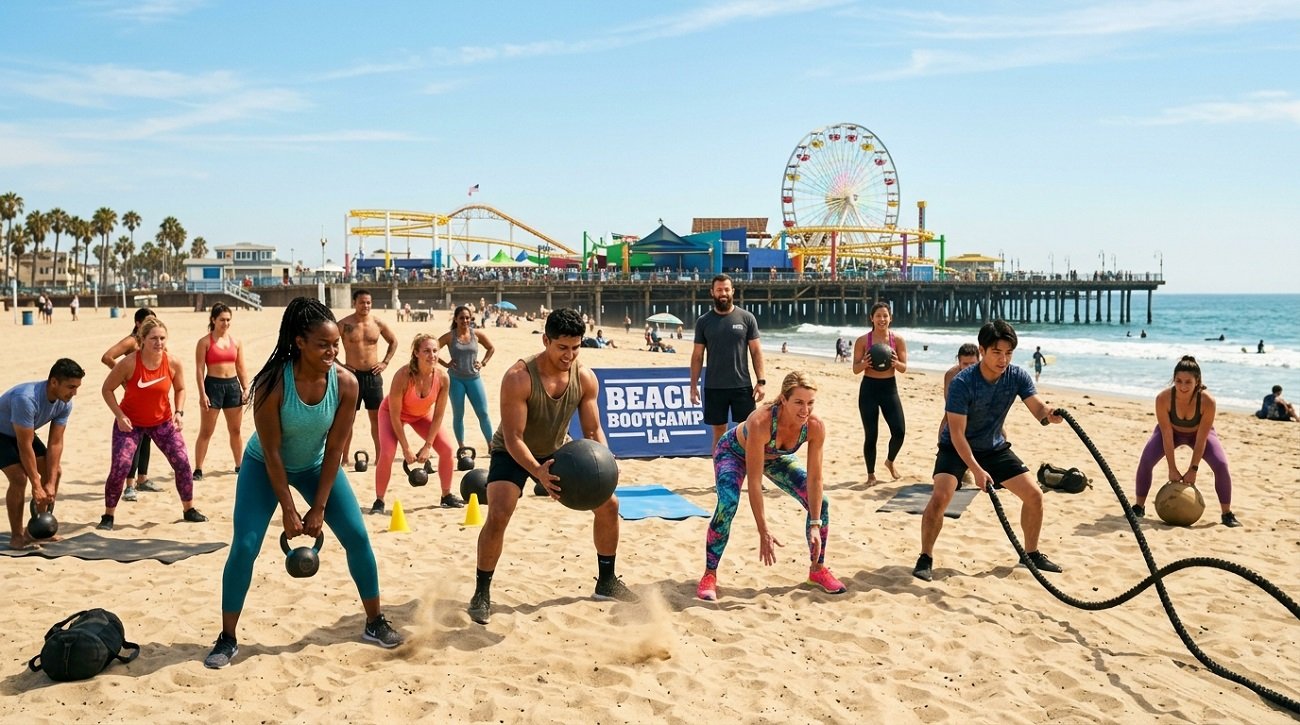
Sand is the ultimate metabolic equalizer. When you run or walk on sand, your foot sinks and shifts, forcing the small stabilizing muscles in your ankles, knees, hips, and core to fire intensely just to keep you upright. Studies show that running on sand burns between 1.2x to 1.6x more calories than running on a solid surface at the exact same speed. Plus, the soft impact means zero joint pain. You get a massive cardiovascular and muscular stimulus without the next-day agony.
The Hills & Trails (Griffith Park, Runyon Canyon)
Hills are nature’s stairmaster, but better. Incline running or walking shifts the load directly into your posterior chain—your glutes, hamstrings, and calves. These are the largest muscles in your body. When you work them hard, you create a massive metabolic demand. Trails also require proprioception (awareness of your body in space), meaning your brain is actively engaged, navigating roots and rocks, which sharpens your nervous system.
The Ocean (Pacific Cold Therapy)
We use the ocean not just for the view, but as a recovery tool. Cold water immersion shifts blood from your extremities to your core, flushing lactic acid and reducing systemic inflammation. It also triggers a massive release of dopamine and norepinephrine, elevating your mood and focus for the rest of the day.
The Parks & Grass (Palisades Park, Local Fields)
Flat grass is the perfect staging ground for high-intensity interval training (HIIT), bodyweight strength circuits, and yoga. It provides enough cushion for dynamic movements like bear crawls and broad jumps, but enough stability for heavy resistance band work and plyometrics.
Want to explore these spots yourself? Check out our guide to the best outdoor fitness spots in Los Angeles for beach, park, and trail workouts.
The Nutrition Reality: You Can’t Out-Train Poor Fuel
You’ve heard it a million times: “Abs are made in the kitchen.” It’s a cliché because it’s true. But that doesn’t mean you need to starve yourself. In fact, under-eating is one of the main reasons you’re not losing weight. When you drastically cut calories while increasing exercise, your body panics, slows your metabolism, and hoards fat.
What you need is strategic fueling that matches the demands of outdoor training in the LA climate.
The LA Climate Factor
Los Angeles is dry and hot. Even on overcast days, the dry air pulls moisture from your body rapidly. Most people mistake the fatigue from dehydration for a lack of willpower. When your cells are dehydrated, your body cannot metabolize fat efficiently. You need a hydration strategy that goes beyond just drinking water—you need electrolytes (sodium, potassium, magnesium) to actually pull that water into your cells.
The 30-60 Minute Post-Workout Window
After a Focus Camp session, your muscles are primed to absorb nutrients. Their “doors” are wide open. If you skip a meal or just have a black coffee, you miss the window, cortisol rises, and you stay sore for days. If you hit the window with the right ratio of carbohydrates to protein (roughly 3:1), you replenish glycogen, spike muscle-building insulin safely, and kickstart recovery immediately.
Strategic Fueling Table for Outdoor Fat Loss
| Timing | Goal | Practical Food Example (Real People Food) | Why It Works |
|---|---|---|---|
| 1-2 Hours Pre-Workout | Sustained energy, no heaviness | 1/2 banana + 1 tbsp almond butter OR 1/2 cup Greek yogurt + handful berries | Simple carbs for immediate energy; fat/protein prevents blood sugar crash mid-workout. |
| During Session | Hydration & electrolyte balance | 8-10 oz water every 15-20 mins + pinch of sea salt or electrolyte drop | Replaces fluid loss from LA heat/dry air; maintains nerve conductivity for muscle firing. |
| 30-60 Min Post-Workout | Rapid glycogen replenishment & muscle repair | Protein smoothie (whey/plant protein + spinach + 1/2 banana + almond milk) OR grilled chicken bowl with white rice & veggies | 3:1 carb-to-protein ratio stops cortisol, spikes muscle protein synthesis, and eliminates next-day soreness. |
| Evening Meal | Overnight recovery & hormone building | Baked wild salmon + roasted sweet potato + large portion of steamed greens | High Omega-3s reduce inflammation; complex carbs aid deep sleep; protein supports overnight tissue repair. |
For the complete, practical 7-day meal plan designed specifically for our outdoor sessions, check out our nutrition strategies for outdoor fitness in Los Angeles.
A Typical Focus Camp Training Week: Structured for Results
People think “outdoor workout” and they picture someone just doing random push-ups in the park. That couldn’t be further from the truth. At Focus Camp, our programming is periodized, structured, and intentional. Here is what a typical week looks like for someone whose primary goal is fat loss and metabolic reset:
Monday — Beach Sand Strength Circuit
- Location: Venice or Manhattan Beach
- Duration: 60 minutes
- Focus: Metabolic conditioning and lower-body strength.
- The Work: Sand-resistance training—squats, walking lunges, push-ups, bear crawls, and short shuttle sprints.
- The Benefit: The sand doubles muscle activation in the legs and glutes while completely protecting the knees and lower back. Ends with 5 minutes of ocean cold therapy.
Tuesday — Yoga & Mindfulness Flow
- Location: Palisades Park or Griffith Park
- Duration: 45-60 minutes
- Focus: Active recovery, parasympathetic nervous system activation, mobility.
- The Work: Deep hip openers, thoracic spine rotations, diaphragmatic breathing, and gentle strengthening holds.
- The Benefit: This lowers cortisol, flushes lactic acid from Monday’s session, and improves range of motion. This isn’t “easy”—it’s the strategic recovery that makes Wednesday’s session effective.
Wednesday — Trail Strength & Conditioning
- Location: Runyon Canyon or Griffith Park trails
- Duration: 60 minutes
- Focus: Posterior chain power, cardiovascular endurance, proprioception.
- The Work: Incline step-ups, hill repeats, bodyweight squats on the trail, and functional band work using the trees.
- The Benefit: Builds the lean muscle in your glutes and hamstrings that acts as your metabolic engine. The uneven terrain sharpens your nervous system and prevents adaptation.
Thursday — Group Functional Training
- Location: Rotates between beach, park, and sports field
- Duration: 60 minutes
- Focus: High-intensity interval training (HIIT), team accountability, fun.
- The Work: Team-based circuits, partner drills, agility work, and team challenges.
- The Benefit: The community energy pushes you beyond what you’d do alone. The fun factor releases dopamine, keeping you coming back week after week.
Friday — Active Recovery or Aqua Session
- Location: Pool or beach
- Duration: 45 minutes
- Focus: Joint decompression, low-impact movement.
- The Work: Swimming, water treading, or light mobility work.
- The Benefit: Water provides 360-degree resistance with zero impact. Perfect for flushing the system out after a heavy week.
Weekend — Rest, Play, Live
- Recovery, meal prep, outdoor recreation. Many members join optional community activities or just enjoy their vibrant, energized bodies exploring LA.
If you’re looking at this thinking, “I’m not in shape enough for this,” don’t worry. Every session is scaled. Beginners get the support they need, and advanced members get the challenge they’re looking for. Our fitness classes in Los Angeles for beginners guide explains exactly how we modify everything safely.
What Real Progress Looks Like (The Timeline)
One of the biggest mistakes people make is expecting the scale to drop 5 pounds in the first week. If you want sustainable, biological fat loss, you have to understand the timeline. Here is what practically happens when you switch from indoor chronic cardio to structured outdoor training:
Weeks 1-2: The Internal Reset
- Scale: Might not move much. You might even gain a pound or two as your muscles store more glycogen and water.
- How you feel: This is where the magic starts. You will sleep deeper. You will wake up with more energy. Your sugar cravings will diminish because your cortisol is finally dropping. You will feel less anxious.
Weeks 3-4: The Body Recomposition Phase
- Scale: Slow, gradual movement (1-3 lbs).
- How you feel/look: Your clothes will fit differently. The waistband gets looser even if the scale barely moves, because you are losing dense fat and building lean, compact muscle. Your face looks less puffy (decreased inflammation). Your posture improves.
Months 2-3: The Metabolic Ignition
- Scale: Consistent, healthy weight loss (1-2 lbs a week).
- How you feel/look: Visible muscle tone. People start noticing and commenting. Your stamina skyrockets—you can run up a flight of stairs without losing your breath. Your mood is stable. Exercise is no longer a chore; it’s your therapy.
6 Months and Beyond: The New Set Point
- Your body has established a new metabolic baseline. You are burning more calories at rest than you were 6 months ago. Your joints feel great. Your hormones are balanced. You have a community of friends. You aren’t “on a diet” anymore; you just live a healthy, active life.
Setting these realistic expectations is crucial. Our guide on how to set realistic fitness goals you can actually stick to helps you track the metrics that actually matter (like sleep quality, energy, and inches lost) rather than obsessing over the scale.
The Focus Camp Program: Your Complete Outdoor Fat Loss Solution
Everything we’ve talked about—the cortisol reduction, the terrain advantage, the nutrition timing, the community accountability—it’s all built into our signature Focus Camp Program. It’s not a random assortment of workouts. It’s a deliberately engineered system to fix the 7 barriers keeping you stuck.
Your Monthly Membership Includes:
- 20 Dynamic Classes: 5 sessions per week with flexible scheduling.
- Strength & Conditioning Training: Build the metabolic engine.
- Cardio & Endurance Workouts: Smart, varied cardio that doesn’t tank your hormones.
- Aqua Training Sessions: Joint-friendly, high-resistance conditioning.
- Yoga & Flexibility Training: Active recovery and stress reduction.
- Obstacle Challenges & Outdoor Activities: Functional, engaging fitness that never gets boring.
- Team-Based Fitness Games: Community, competition, and pure enjoyment.
- Recovery & Mindfulness: Breathing practices and cooldown for inner calm.
Every class is led by us—François or Tina—with real-time coaching, form correction, and the kind of personal attention that keeps you safe and progressing. We also offer Private Coaching for members who want fully customized programming and nutrition guidance. If you’re torn between the two, read our breakdown of private personal training vs. group fitness in LA to see which fits your lifestyle.
Getting Started: Your First Steps
If you’ve read this far, you recognize yourself in those 7 barriers. You know that grinding away in the gym isn’t working. Here is exactly what to do next:
Step 1: Book a conversation.
Reach out through our online booking page or text us. We’ll listen to your goals, your frustrations, and your schedule. No pressure, no aggressive sales pitch—just an honest conversation about what’s holding you back.
Step 2: Come try a session.
Experience an outdoor workout with our community. Feel the difference between grinding on a treadmill and moving through nature with people who genuinely support you. One session is usually enough to understand why this approach works.
Step 3: Dress comfortably.
Check our guide on what to wear and bring to your first aqua or outdoor session in LA if you’re unsure. But honestly? Moisture-wicking clothes, supportive sneakers, water, and sunscreen are all you need.
Step 4: Let the environment do the work.
Show up, follow the program, eat to fuel your body, and let the LA sunshine, ocean breeze, and community support do the rest.
The Bottom Line
You’ve been working against your body for too long. It’s time to start working with it.
Stop fighting cortisol with stressful indoor environments. Stop wrecking your joints on hard concrete. Stop starving yourself and slowing your metabolism. The solution is outside. It’s in the sand, the trails, the ocean, and in a community that actually cares about your progress.
At Focus Camp, you’re not joining a gym. You’re joining a family that’s committed to your success. We’re François and Tina, and we’re ready when you are.
📍 Visit us: 1119 Albany Street, Los Angeles, CA
📞 Call or text: (323) 595-3766
✉️ Email: info@focuscamp1.com
Book your first session now — no pressure, all welcome. Your stronger, leaner, healthier self is waiting just outside.