By François & Tina · Focus Camp, Los Angeles · May 15, 2026 · ~20 min read
In This Article
- Why I Wrote This (And Who It’s For)
- What’s Actually Happening Inside Your Bones
- The Five Types of Exercise Your Bones Need
- The 10 Best Exercises — Full Detail
- Your 12-Week Workout Program
- Nutrition for Bone Density — The Complete Breakdown
- Understanding Your DEXA Scan
- Mistakes That Hurt Your Bones
- Why Los Angeles Gives You an Advantage
- Frequently Asked Questions
- Your Next Step
Why I Wrote This (And Who It’s For)
Patricia walked into Focus Camp holding a piece of paper.
It was her DEXA scan results. Osteoporosis in her hip. Osteopenia in her spine. Her doctor had handed her a prescription for Fosamax and said — and I’m quoting her here — “You should also do some weight-bearing exercise.” That was it. No explanation. No specifics. No follow-up plan.
She sat in her car in the parking lot for twenty minutes before driving home.
Not because she was scared of the diagnosis, exactly. She was scared because she didn’t understand what was happening inside her own body. And when you don’t understand something like that, your imagination fills in the blanks with worst-case scenarios.
I’m François. I train alongside Tina. We’ve been doing this for years — working with women in Los Angeles who are navigating exactly this kind of moment. The confusion. The frustration. The feeling that nobody’s giving you straight answers.
So here’s what I told Patricia that first morning.
Your bones are alive. They’re not rocks. They respond to what you do with them. Every single day, your body is breaking down old bone and building new bone. After 50 — especially after menopause — the breaking-down part starts winning. But you can shift that balance back. Not with a calcium pill alone. Not with wishful thinking. With specific movements, specific foods, and specific habits that tell your body, clearly, “Hey — I need stronger bones right here.”
Eleven months later, her follow-up DEXA showed measurable improvement. Her hip T-score had moved by 0.4 points. Her doctor asked what she’d been doing.
“Training on the beach with two French people who make me stomp my feet and carry sandbags,” she said.
That’s the kind of exercise that builds bone. And that’s what this article is going to teach you. In detail. Nothing held back.
What’s Actually Happening Inside Your Bones Right Now
I need to explain how your bones work. Not a textbook version — the practical one. The version that helps you make actual decisions about your body.
How Bones Remodel
Your skeleton is constantly under construction. Two types of cells are always at work.
Osteoblasts are the builders. They lay down new bone tissue. Think of them as the crew pouring fresh concrete.
Osteoclasts are the demolition team. They break down old, worn-out bone so it can be replaced.
When you’re young, these two teams work in balance. Demolition tears out old bone. Construction replaces it with new bone. Your skeleton gets stronger. This full cycle takes about 10 years — your entire skeleton essentially rebuilds itself over a decade.
Here’s where things go sideways.
What Menopause Does to Your Bones
Before menopause, estrogen acts as a supervisor. It keeps the demolition crew in check — they don’t tear out more than the builders can replace. It also helps the construction crew work efficiently.
When estrogen drops during perimenopause and menopause, that supervisor leaves. The demolition crew goes into overdrive. They start tearing out bone faster than the builders can keep up. And the builders, without estrogen’s support, slow down.
You start losing more bone than you’re building. Every month. Every year.
| Life Stage | What’s Happening | Bone Loss Rate |
|---|---|---|
| Ages 20–30 | Peak bone building — you’re adding more than losing | Building toward peak |
| Ages 30–35 | You hit peak bone mass — the highest density you’ll ever have | Stable |
| Ages 35–40 | Slow decline begins — you won’t feel it | ~0.3–0.5% per year |
| Ages 40–50 | Perimenopause starts — loss accelerates | ~1–2% per year |
| First 5–7 years after menopause | Rapid loss — this is the danger zone | ~2–5% per year |
| Ages 60–70 | Loss continues but slows | ~1–2% per year |
| Ages 70+ | Cumulative damage is significant if you’ve done nothing | ~0.5–1% per year |
A woman who goes through menopause at 50 could lose 10–25% of her bone density in the first decade alone. If she does nothing.
But — and this is the part that matters — this isn’t a one-way street.
A 2025 study in Scientific Reports (Nature) confirmed that postmenopausal women who followed structured resistance training programs showed measurable improvements in bone mineral density. Even women in their 60s and 70s who had never exercised before. Your bones want to be strong. They just need the right signals.
The Calcium Myth
Here’s something I hear constantly: “I take calcium every day. My bones should be fine.”
They shouldn’t. And here’s why.
Calcium is raw material. It’s the brick. But bricks don’t build a house by themselves. You need a construction crew (osteoblasts), a blueprint (hormonal signals), and a reason to build (mechanical stress from exercise).
If you take calcium but don’t exercise, it’s like dumping a pile of bricks on an empty lot. The material’s there. Nobody’s building anything.
Worse — excess calcium that isn’t used by bone can end up in your arteries. Which is a different problem entirely.
Here’s what actually needs to happen for calcium to build bone:
| Step | What Needs to Happen | Why It Matters |
|---|---|---|
| 1. Eat enough calcium | 1,200 mg/day from food, supplements if needed | Raw material for new bone |
| 2. Have enough vitamin D | 800–2,000 IU/day — get your blood level tested | Without it, your gut absorbs only 10–15% of dietary calcium. With enough, 30–40% |
| 3. Get vitamin K2 | 90–120 mcg/day from food or supplements | Activates osteocalcin — the protein that directs calcium INTO bones, AWAY from arteries |
| 4. Do resistance exercise | 2–3x per week, targeting major muscle groups | Creates the mechanical stress signal that tells osteoblasts to use that calcium |
| 5. Include impact loading | Heel drops, stomps, small hops — scaled to ability | Impact force is the strongest bone-building signal your body receives |
| 6. Eat enough protein | 1.0–1.2 g per kg of body weight daily | Provides the collagen framework bones are built on — calcium is deposited INTO this framework |
Miss any step and the whole system works worse. That’s why a calcium pill alone doesn’t do much. It’s step one out of six.
The Five Types of Exercise Your Bones Need
Most women I meet are doing one or two types of exercise. Walking. Maybe some yoga. Both good. Neither complete.
Your bones need five distinct types of stimulus. Each one does something different.
1. Resistance Training — The Foundation
Using your muscles against external resistance. Bodyweight, bands, dumbbells, sandbags, heavy grocery bags — anything that makes your muscles work hard.
When your muscles contract forcefully, they pull on the bones they’re attached to. That pulling force — scientists call it “muscle-pull force” — stimulates the osteoblasts in those specific areas to build more bone. The harder the muscle works, the stronger the signal.
You need this 2–3 times per week. Each session should include 4–6 exercises targeting all major muscle groups. The weight should be heavy enough that the last 2–3 reps of each set feel genuinely hard. Not painful. But hard. If you can do 15–20 reps easily, the weight isn’t enough.
A 2017 study in the Journal of Bone and Mineral Research found that high-intensity resistance and impact training improved bone density at the hip and spine in postmenopausal women — in just 8 months.
2. Impact Loading — The Missing Piece
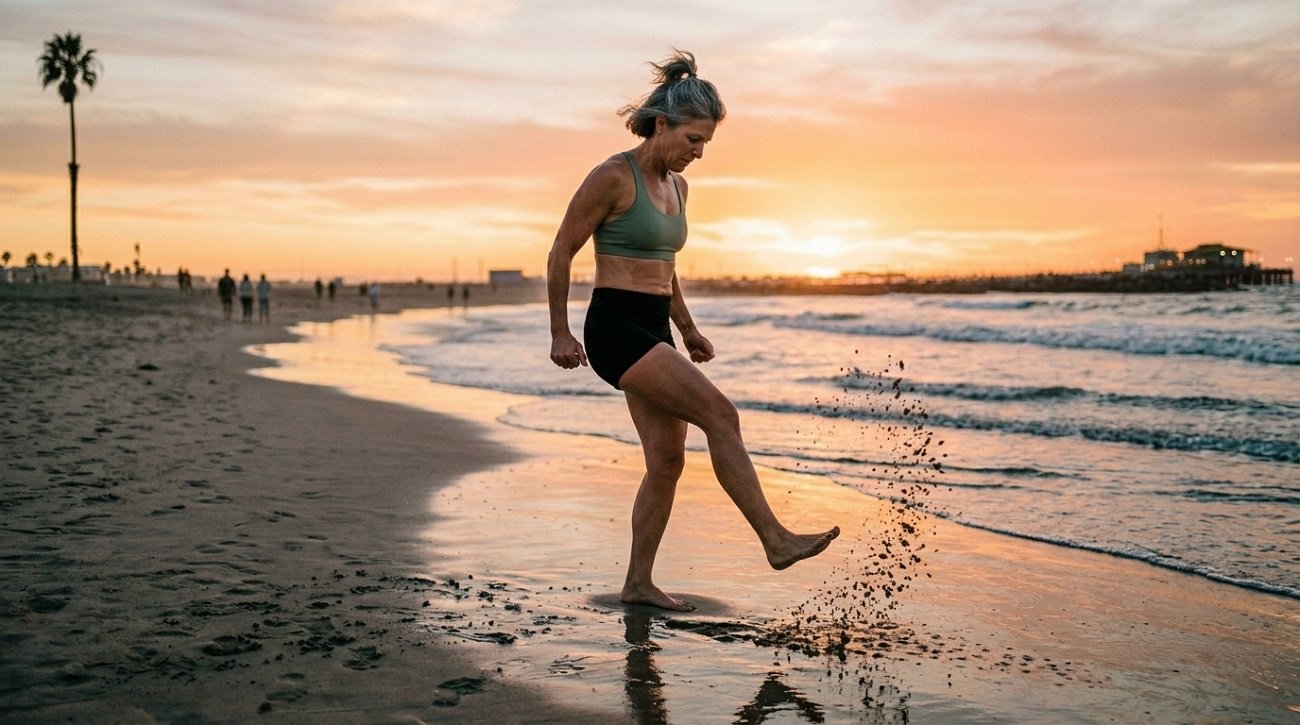
Any movement where your body absorbs force from hitting the ground. Stomping, hopping, jumping, skipping, even brisk walking with intentional heel strikes.
Impact creates “ground reaction force” — the force the ground pushes back into your body when you land. This is the single most powerful bone-building signal your skeleton receives. It’s why astronauts lose bone density in space. No gravity, no impact, no signal.
You need small amounts, frequently. 50–100 heel drops or stomps, 3–5 times per week. The total volume doesn’t need to be high. The signal just needs to be consistent.
Important safety note: If you have osteoporosis (T-score below -2.5) or have had a fragility fracture, start with heel drops only. Get your doctor’s clearance before adding hops. If you have osteopenia (T-score -1.0 to -2.5), you can start with heel drops and progress to small hops within 4–6 weeks.
3. Balance Training — The Fall Preventer
Exercises that challenge your ability to stay upright. Single-leg stands, tandem walking, stability work on uneven surfaces.
Here’s the reality nobody talks about: osteoporosis itself doesn’t kill people. Falls do. A hip fracture in a woman over 65 carries a 20–30% mortality rate within one year. The most important thing you can do for your bones might not be building them — it might be preventing the fall that breaks them.
Balance doesn’t directly build bone. But it protects every bone in your body.
You need this daily. Even 5 minutes of single-leg standing while you brush your teeth makes a difference.
4. Flexibility and Mobility Work — The Joint Protector
Stretching, yoga, gentle range-of-motion work for your hips, spine, shoulders, and ankles.
Stiff joints limit your ability to do the other types of exercise safely. If your hips are so tight you can’t squat below parallel, you’re getting less bone-building stimulus from every squat. If your spine is rigid, you can’t press overhead safely.
Flexibility isn’t about touching your toes. It’s about maintaining the range of motion that lets you load your bones fully.
You need 10–15 minutes after every workout, plus one dedicated 20–30 minute session per week.
5. Postural and Spinal Extension Work — The Spine Saver
Exercises that strengthen the muscles along your spine. Erector spinae, multifidus, upper back muscles.
The front of your vertebrae — the vertebral bodies — are the first place osteoporosis shows up. They’re also the most vulnerable to compression fractures. The kind that happen when you bend forward to pick up a bag of groceries and a vertebra essentially crushes.
Strong spinal muscles act as a natural brace. They distribute force more evenly across each vertebra. They reduce the concentration of stress on the fragile front portion.
You need this 3–4 times per week. Bird-dogs, back extensions, band pull-aparts, prone Y-raises.
The 10 Best Bone Density Exercises — Every Single One, In Full Detail
I’m not going to give you a quick list. You deserve the full version. Form details. Common mistakes. Progressions. Which bones each one targets. All of it.
Exercise 1: Stomp-and-Pause Walking
What it does: Adds controlled impact to your regular walking routine. Sends bone-building signals through your hips, femur, spine, and feet.
Why it works: Regular walking provides about 1.0–1.2 times your body weight in ground reaction force. A deliberate stomp increases that to 1.5–2.0 times. That extra force is the difference between maintenance and actual stimulation.
Step by step:
Start walking at your normal pace. After 20–30 steps, stop. Plant one foot firmly into the ground. Not violently — firmly. You should hear it. Hold for a second with your weight pressing through that foot. Repeat 3–5 times on the same foot. Switch. Resume walking. Repeat the cycle for the entire duration.
What it should feel like: A firm, deliberate stomp. Hard enough to hear. Not hard enough to hurt your knee. Think of it as “ringing a bell” with your foot.
Common mistakes and fixes:
| Mistake | Why It’s a Problem | The Fix |
|---|---|---|
| Stomping too hard | Jars knees and ankles | Aim for firm, not violent — hear it, don’t feel pain |
| Stomping with a locked knee | Absorbs force in the joint, not the bone | Keep a slight soft bend when you stomp |
| Only stomping with one foot | Uneven bone stimulus | Alternate feet, even if one side feels less coordinated |
| Thin-soled shoes on concrete | Too much jarring through the foot | Wear cushioned shoes or stomp on packed sand |
12-week progression:
| Week | Stomps per Stop | Total per Walk | Surface |
|---|---|---|---|
| 1–2 | 3 per foot | 30–40 | Flat pavement or boardwalk |
| 3–4 | 5 per foot | 50–60 | Flat pavement or boardwalk |
| 5–6 | 5 per foot | 60–80 | Packed sand or grass |
| 7–8 | 8 per foot | 80–100 | Packed sand |
| 9–12 | 10 per foot | 100–120 | Mixed — sand, grass, stairs |
Where in LA: Venice Beach boardwalk for beginners. Santa Monica Strand once you’re comfortable. Manhattan Beach packed sand when you’re ready for more challenge.
Exercise 2: Bodyweight Squats with Slow Tempo
What it does: Loads your femur, hip joint, lumbar spine, and knee simultaneously. Slow tempo increases time under tension — more bone stimulus per rep.
Why it works: Every time you sit down, stand up, get out of a car, or pick something off the floor — you’re squatting. The muscles involved (quadriceps, glutes, hamstrings, core) attach to some of the most important bones in your skeleton. The femur. The pelvis. The lumbar vertebrae.
Step by step:
Stand with feet shoulder-width apart, toes slightly out. Shift your weight into your heels — you should be able to wiggle your toes. Take a breath. Brace your core like someone’s about to poke your stomach. Push your hips back first. Like you’re reaching for a chair behind you. Lower yourself slowly — count to three on the way down. Go as low as you can while keeping your heels on the floor and your chest up. Pause at the bottom for one count. Drive through your heels to stand up. Squeeze your glutes at the top. Exhale on the way up.
What it should feel like: Thighs working. Core engaged. Knees tracking over toes. Stable and in control at every point.
Common mistakes:
| Mistake | Why It’s a Problem | The Fix |
|---|---|---|
| Knees caving inward | Sideways stress on the knee joint | Think “push knees out” — a light band above knees helps as a cue |
| Rising on toes | Shifts load from glutes to knees | Keep weight in heels — try barefoot or flat shoes |
| Rounding the lower back | Compresses the front of lumbar vertebrae | Chest proud, look forward, brace core throughout |
| Not going deep enough | Reduces range and bone stimulus | Go at least to parallel — use a chair as a depth guide |
| Holding breath | Increases blood pressure, reduces stability | Inhale down, exhale up |
12-week progression:
| Week | Reps | Sets | Tempo | Variation |
|---|---|---|---|---|
| 1–2 | 8 | 2 | 3 sec down, 1 pause, 2 up | Chair squat — sit fully, stand up |
| 3–4 | 10 | 3 | 3 sec down, 1 pause, 2 up | Chair squat — hover above seat |
| 5–6 | 12 | 3 | 3 sec down, 2 pause, 2 up | Bodyweight squat, no chair |
| 7–8 | 12 | 3 | 4 sec down, 2 pause, 2 up | 2-second pause at the bottom |
| 9–12 | 15 | 3 | 4 sec down, 3 pause, 2 up | Goblet squat with light weight |
Exercise 3: Step-Ups
What it does: Single-leg strength combined with impact loading. Every step up drives bone-building force through your hip, femur, and knee — one leg at a time. Which is how your bones actually function in real life.
Why it works: The step-up mimics the most common real-world movement that leads to fractures. Going up stairs. Stepping onto a curb. Getting in and out of a bathtub. Training this under load makes your bones and muscles stronger for exactly the situations where fractures happen.
Step by step:
Find a sturdy bench, step, or stair. Start with 6–8 inches high. Stand facing it. Place your entire right foot on the step — not just the toes. Press through your right heel and drive your body up. Stand fully upright. Don’t lean forward. Step back down with your left foot. Control the descent. Complete all reps on one side, then switch.
What it should feel like: Your working leg doing almost all the work. Glute and quadriceps burning. The step down should be controlled. Not a drop.
Common mistakes:
| Mistake | Why It’s a Problem | The Fix |
|---|---|---|
| Pushing off the back foot | Cheats the working leg | Keep the back foot light — balance only |
| Leaning forward | Shifts load from hips to knees | Stand tall, chest up, eyes forward |
| Step too high | Strains knees, compromises form | Start low — 6 inches is fine |
| Knee caving inward | Stresses the knee joint | Track knee over second toe throughout |
| Dropping back down | Misses the eccentric bone-building portion | Lower yourself — 2–3 seconds down |
12-week progression:
| Week | Height | Reps per Leg | Sets | Notes |
|---|---|---|---|---|
| 1–2 | 6 inches | 8 | 2 | Wall or rail for balance |
| 3–4 | 6–8 inches | 10 | 2 | Less hand support |
| 5–6 | 8 inches | 10 | 3 | No hand support |
| 7–8 | 8–10 inches | 12 | 3 | 2-second pause at top |
| 9–12 | 10–12 inches | 12 | 3 | Hold light dumbbells |
Where in LA: Park benches at Palisades Park or Griffith Park. Concrete steps at Santa Monica Beach. The bottom steps of the Baldwin Hills stairs — work up to the full 282 over time.
Exercise 4: Resistance Band Rows
What it does: Strengthens the muscles along your spine. Erector spinae, rhomboids, rear deltoids, mid-trapezius. These act as a natural corset for your vertebrae.
Why it works: Compression fractures in the spine happen when the front of a vertebra collapses. Often from something as simple as bending forward to pick up a bag. Strong back muscles distribute force more evenly across each vertebra. They reduce the stress concentration on the fragile front portion.
Step by step:
Anchor a resistance band at chest height around a pole, tree, or door anchor. Hold one end in each hand. Step back until there’s tension. Stand tall, knees slightly bent, core braced. Pull both handles toward your ribcage. Squeeze your shoulder blades together. Hold for two seconds. Release slowly — three seconds back. Don’t let your shoulders round forward at the end.
What it should feel like: Between your shoulder blades. That’s where the work should be. If you feel it mostly in your arms, your hands are too close together or the band is too light.
Progression:
| Week | Exercise | Reps | Sets | Band |
|---|---|---|---|---|
| 1–2 | Seated band row | 10 | 2 | Light |
| 3–4 | Standing band row | 12 | 2 | Light–Medium |
| 5–6 | Row + pull-aparts | 10 + 10 | 3 each | Medium |
| 7–8 | Slow tempo row + pull-aparts | 12 + 12 | 3 each | Medium–Heavy |
| 9–12 | Row + pull-aparts + face pulls | 12 + 12 + 10 | 3 each | Heavy |
Exercise 5: Overhead Press
What it does: Loads your spine, shoulders, upper arms, and wrists while standing. One of the few exercises that directly loads your wrist bones — a common fracture site.
Why it works: When you press overhead, force travels down through your arms, through your shoulders, down your spine, through your hips, into your feet. That entire chain receives a bone-building signal. Standing forces your whole body to stabilize.
Step by step:
Stand on the middle of a resistance band. Feet hip-width apart. Hold one end in each hand at shoulder height, palms forward. Brace your core. Press both hands straight overhead until arms are fully extended. Don’t arch your lower back — if you feel yourself leaning back, the band is too heavy. Hold one second at the top. Lower slowly — three seconds back to shoulder height. Keep your ribs down.
Common mistakes:
| Mistake | Why It’s a Problem | The Fix |
|---|---|---|
| Arching the lower back | Compresses lumbar vertebrae | Tuck pelvis slightly, brace core, reduce weight |
| Pressing forward instead of up | Shifts load from spine to shoulders | Press straight up — band travels alongside ears |
| Too much resistance too soon | Compromises form | Start light. Perfect form first |
| Shrugging shoulders | Engages upper traps instead of deltoids | Shoulders down, away from ears |
Exercise 6: Heel Drops and Small Hops
What it does: Creates ground reaction force. The impact signal that tells your bones to build more density. The most direct bone-building exercise you can do.
Why it works: When your heel hits the ground with force, impact travels up through your foot, ankle, tibia, femur, hip, and spine. Every bone in that chain gets a signal to strengthen. A 2023 study in PMC found high-impact exercises were among the most effective for improving bone density at the hip and spine in postmenopausal women.
Heel drops — step by step:
Stand tall. Feet hip-width apart. Near a wall or rail for balance. Rise up onto your toes as high as you can. Drop your heels firmly back to the ground. You should hear a distinct thud. The impact travels up through your legs — you’ll feel it in your shins, knees, hips. Immediately rise again. Repeat.
Small hops — step by step:
Stand tall. Feet hip-width apart. Soft bend in your knees. Push off with both feet — just 1–2 inches of air. Land softly with bent knees. Let your ankles, knees, and hips absorb the impact. Immediately hop again. Repeat.
Safety table — this one matters:
| Your Bone Status | Start With | Progress To | Doctor Clearance? |
|---|---|---|---|
| Normal (T-score above -1.0) | Heel drops + small hops | Hops with light weight | No |
| Osteopenia (T-score -1.0 to -2.5) | Heel drops only | Small hops after 4–6 weeks | Recommended |
| Osteoporosis (T-score below -2.5) | Gentle heel drops | More force after 8–12 weeks | Yes — required |
| History of vertebral fracture | Seated heel taps | Standing heel drops after clearance | Yes — required |
| History of hip fracture | Ask your doctor | Follow rehab protocol | Yes — required |
Volume progression:
| Week | Heel Drops | Small Hops (if cleared) | Frequency |
|---|---|---|---|
| 1–2 | 20 per session | Not yet | 3x/week |
| 3–4 | 30 per session | Not yet | 3x/week |
| 5–6 | 40 per session | 2 sets of 5 | 4x/week |
| 7–8 | 50 per session | 2 sets of 8 | 4x/week |
| 9–12 | 60–80 per session | 3 sets of 10 | 5x/week |
Exercise 7: Farmer’s Carry
What it does: Walking while holding heavy weight. Loads your spine, hips, wrists, forearms, and grip simultaneously. One of the most functional exercises in existence.
Why it works: Creates compressive force along your spine — bone-building. Loads your wrists and forearms — common fracture sites. Trains your grip — grip strength correlates with overall bone density and fall risk. Forces your core to stabilize under load. And it mimics real life. Carrying groceries. Luggage. Grandchildren.
Step by step:
Pick up a heavy object in each hand. Dumbbells, water jugs, grocery bags, sandbags. Stand tall. Shoulders back and down. Chest up. Engage your core. Walk forward with controlled, even steps. Don’t shuffle. Keep the weights at your sides. Don’t let them swing. Walk for 30–50 steps. Set the weights down carefully. Rest 30–60 seconds. Repeat.
What it should feel like: Your whole body working. Grip challenged. Core braced. Posture tall. If your shoulders are caving forward, the weight is too heavy.
Progression:
| Week | Weight per Hand | Distance | Sets | Rest |
|---|---|---|---|---|
| 1–2 | 5–10 lbs | 30 steps | 3 | 60 sec |
| 3–4 | 10–15 lbs | 40 steps | 3 | 45 sec |
| 5–6 | 15–20 lbs | 50 steps | 3 | 45 sec |
| 7–8 | 20–25 lbs | 50 steps | 4 | 30 sec |
| 9–12 | 25–35 lbs | 60 steps | 4 | 30 sec |
Where in LA: Walk the length of Venice Beach with weighted bags. The sand adds extra instability. Carry dumbbells along Santa Monica Strand. Walk with heavy grocery bags through any flat park.
Exercise 8: Deadlifts (Hip Hinge Pattern)
What it does: Loads your entire posterior chain. Hamstrings, glutes, erector spinae. Every bone those muscles attach to — pelvis, femur, lumbar spine, thoracic spine.
Why it works: The deadlift loads more bone simultaneously than any other exercise. It’s also the most functional — it’s literally how you pick things up off the ground. Learning to hip hinge properly protects your spine from dangerous flexion during daily activities.
Step by step — start with the bodyweight version:
Stand with feet hip-width apart. Hands at your sides. Push your hips straight back. Like you’re trying to touch a wall behind you with your butt. Let your torso lean forward naturally. Keep your back completely flat. Keep pushing hips back until you feel a stretch in your hamstrings. Your knees should have a slight soft bend. Not locked, not deeply bent. Pause one second. Drive your hips forward to stand back up. Squeeze your glutes at the top.
What it should feel like: Deep hamstring stretch on the way down. Glutes and hamstrings working on the way up. Your back flat and stable throughout. Never rounded.
Common mistakes:
| Mistake | Why It’s a Problem | The Fix |
|---|---|---|
| Rounding the lower back | Dangerous compressive force on lumbar vertebrae | Chest proud, back flat. Imagine a broomstick along your spine — it should touch head, upper back, and tailbone throughout |
| Bending knees too much | Turns it into a squat | Push hips back, not knees forward. “Close a car door with your butt” |
| Looking up | Strains cervical spine | Neutral head — look at a spot 6 feet ahead on the floor |
| Jerking the weight up | Momentum replaces muscle | Controlled — 2 seconds down, 1 pause, 2 up |
Progression:
| Week | Variation | Reps | Sets | Load |
|---|---|---|---|---|
| 1–2 | Bodyweight hip hinge | 10 | 2 | None |
| 3–4 | Hip hinge, hands behind head | 10 | 3 | None |
| 5–6 | Hip hinge with light dumbbell or jug | 10 | 3 | 5–10 lbs |
| 7–8 | Romanian deadlift with dumbbells | 10 | 3 | 10–15 lbs each |
| 9–12 | Romanian deadlift with dumbbells | 12 | 3 | 15–25 lbs each |
Exercise 9: Bird-Dog and Back Extension
What it does: Strengthens the deep muscles along your spine. The ones that keep you upright and protect your vertebrae from compression fractures.
Why it works: Women with osteoporosis are most vulnerable to vertebral compression fractures. The front of a vertebra collapses — often during forward bending. Strong spinal extensor muscles act as a natural brace. They distribute force more evenly. They protect the fragile anterior vertebral bodies.
Bird-dog — step by step:
Get on your hands and knees. Hands under shoulders, knees under hips. Brace your core. Extend your right arm straight forward and your left leg straight back. Simultaneously. Keep your hips level — don’t let one hip drop. Hold for 3–5 seconds. Return to start slowly. Repeat on the other side.
Back extension — step by step:
Lie face down on the floor. Arms at your sides. Lift your chest off the floor by squeezing your upper back muscles. Keep your feet on the ground. Don’t lift your legs. Hold for 3–5 seconds at the top. Lower slowly. Repeat.
Progression:
| Week | Exercise | Reps | Sets | Hold |
|---|---|---|---|---|
| 1–2 | Bird-dog — arms only, then legs only | 6 each side | 2 | 3 sec |
| 3–4 | Bird-dog — opposite arm and leg | 8 each side | 2 | 3 sec |
| 5–6 | Bird-dog + back extension | 8 + 10 | 3 each | 5 sec |
| 7–8 | Slow bird-dog + back extension with arms extended | 8 + 12 | 3 each | 5 sec |
| 9–12 | Bird-dog with 5-sec hold + back extension with weight | 10 + 12 | 3 each | 5 sec |
Exercise 10: Standing Balance Work
What it does: Trains your proprioceptive system. The network of nerves in your joints, muscles, and inner ear that tells your brain where your body is in space. This is what prevents falls.
Why it matters: A woman with osteopenia who never falls will never fracture. A woman with perfect bone density who falls badly can fracture anything. Balance training is the insurance policy.
Step by step:
Stand near a wall or sturdy surface. Lift one foot off the ground — just an inch or two. Hold for 10 seconds. Switch feet. As you get more stable, progress: fingertip on wall, then no wall, then eyes closed.
Progression:
| Week | Surface | Support | Eyes | Hold |
|---|---|---|---|---|
| 1–2 | Flat floor | Hand on wall | Open | 10 sec/leg |
| 3–4 | Flat floor | Fingertip on wall | Open | 15 sec/leg |
| 5–6 | Flat floor | No support | Open | 20 sec/leg |
| 7–8 | Flat floor | Fingertip on wall | Closed | 10 sec/leg |
| 9–10 | Foam pad or folded towel | No support | Open | 15 sec/leg |
| 11–12 | Foam pad or folded towel | No support | Closed | 10 sec/leg |
Your Complete 12-Week Bone Density Workout Program
Everything put together. Week by week. This is designed for a woman over 50 who walks regularly but hasn’t been doing structured strength training. If you’re already active, start at Week 3 or 5.
Phase 1: Foundation (Weeks 1–4)
Learn the movements. Build the habit. Wake up your bones gently.
| Day | Focus | Duration | Exercises |
|---|---|---|---|
| Monday | Lower body + impact | 30 min | Stomp walk (15 min) → Squats 2×8 → Heel drops 20 → Balance 2×10 sec/leg |
| Wednesday | Upper body + spine | 25 min | Band rows 2×10 → Pull-aparts 2×10 → Overhead press 2×8 → Bird-dog 2×6/side → Back extension 2×8 |
| Friday | Full body + carry | 30 min | Step-ups 2×8/leg → Hip hinge 2×10 → Farmer’s carry 3×30 steps → Heel drops 20 |
| Saturday | Recovery | 20 min | Gentle yoga or easy walk with full-body stretching |
Phase 2: Building (Weeks 5–8)
Increase load. Add impact. Build confidence.
| Day | Focus | Duration | Exercises |
|---|---|---|---|
| Monday | Lower body + impact | 35 min | Stomp walk (15 min) → Squats with pause 3×10 → Step-ups 3×10/leg → Heel drops 40 → Hops 2×5 (if cleared) |
| Wednesday | Upper body + spine | 30 min | Band rows 3×12 → Pull-aparts 3×12 → Overhead press 3×10 → Bird-dog 3×8/side → Back extension 3×10 |
| Friday | Full body + carry + deadlift | 35 min | Romanian deadlift 3×10 → Farmer’s carry 3×50 steps → Squats 3×12 → Balance 3×15 sec/leg |
| Saturday | Active recovery | 30 min | Trail walk at Griffith Park or yoga at the beach |
Phase 3: Progression (Weeks 9–12)
Push the challenge. Progressive overload. Prepare for long-term maintenance.
| Day | Focus | Duration | Exercises |
|---|---|---|---|
| Monday | Lower body + impact | 40 min | Stomp walk with weights (20 min) → Goblet squats 3×12 → Step-ups with weight 3×12/leg → Heel drops 60 + Hops 3×8 |
| Wednesday | Upper body + spine | 35 min | Heavy band rows 3×12 → Pull-aparts 3×15 → Overhead press 3×12 → Bird-dog 5-sec hold 3×10/side → Back extension with weight 3×12 |
| Friday | Full body + carry + deadlift | 40 min | Romanian deadlift with weight 3×12 → Heavy farmer’s carry 4×60 steps → Squats 3×15 → Balance on unstable surface 3×20 sec/leg |
| Saturday | Active recovery + bonus | 30–40 min | Long beach walk, hike, or yoga session |
Nutrition for Bone Density — The Complete Breakdown
Exercise sends the signal to build bone. Food provides the building blocks. You need both.
Calcium — The Raw Material
How much: 1,200 mg per day for women over 50. That’s the National Osteoporosis Foundation recommendation and the NIH consensus.
The absorption problem nobody talks about: Your body can only absorb about 500 mg of calcium at one time. If you take a 1,200 mg calcium pill once a day, you’re wasting most of it. It passes right through. Spread your calcium across 2–3 meals for maximum absorption.
Complete food source list:
| Food | Serving | Calcium (mg) | Notes |
|---|---|---|---|
| Plain yogurt (low-fat) | 1 cup | 415 | Best absorbed form — also protein |
| Sardines with bones | 3 oz | 325 | Also omega-3s and vitamin D |
| Fortified orange juice | 1 cup | 350 | Check label — not all brands fortified |
| Milk (skim or 1%) | 1 cup | 300 | Lactose-free versions work too |
| Part-skim mozzarella | 1.5 oz | 300 | Also protein |
| Greek yogurt (plain) | 1 cup | 250 | Higher protein than regular |
| Tofu (calcium-set) | ½ cup | 250–800 | Varies by brand — look for “calcium sulfate” in ingredients |
| Kale (cooked) | 1 cup | 177 | Better plant source than spinach — spinach has oxalates that block absorption |
| Canned salmon with bones | 3 oz | 180 | Convenient, affordable, also vitamin D |
| Bok choy (cooked) | 1 cup | 160 | One of the best plant sources — very high absorption rate |
| White beans (cooked) | 1 cup | 160 | Also protein and fiber |
| Dried figs | 5 figs | 135 | Sweet snack with decent calcium |
| Almonds | ¼ cup | 96 | Also magnesium and healthy fats |
| Broccoli (cooked) | 1 cup | 62 | Modest calcium but excellent absorption |
| Fortified cereal | 1 serving | 100–1,000 | Check labels — varies enormously |
A sample day hitting 1,200 mg from food alone:
| Meal | Food | Calcium |
|---|---|---|
| Breakfast | 1 cup plain yogurt + ¼ cup almonds + berries | ~510 mg |
| Lunch | Kale salad with sardines and white beans | ~340 mg |
| Snack | 1.5 oz mozzarella + 5 dried figs | ~435 mg |
| Total | ~1,285 mg |
No supplement needed. It’s doable. It just takes awareness.
Vitamin D — The Gatekeeper
How much: 800–2,000 IU per day. Many endocrinologists recommend 2,000 IU for postmenopausal women.
Why it’s non-negotiable: Without adequate vitamin D, your intestines absorb only 10–15% of the calcium you eat. With enough vitamin D, that jumps to 30–40%. You could eat a perfect calcium-rich diet and still be calcium-deficient if your vitamin D is low.
The LA sunshine advantage: 15–20 minutes of midday sun on your arms and face produces approximately 10,000–20,000 IU of vitamin D. Enough for several days. But many women in LA still test low — they wear sunscreen, avoid midday sun, or have darker skin that reduces production.
Get tested: Ask your doctor for a 25-hydroxyvitamin D blood test. Optimal levels: 30–50 ng/mL. Below 30 is insufficient. Below 20 is deficient.
Food sources:
| Food | Serving | Vitamin D (IU) |
|---|---|---|
| Wild salmon | 3 oz | 570 |
| Sardines | 3 oz | 165 |
| Egg yolk | 1 large | 45 |
| Fortified milk | 1 cup | 115 |
| Fortified OJ | 1 cup | 100 |
| UV-exposed mushrooms | 1 cup | 400–1,000 |
| Cod liver oil | 1 tsp | 450 |
Supplement form: Vitamin D3 (cholecalciferol) is more effective than D2. Take it with a meal containing fat — it’s fat-soluble and absorbs better with food.
Vitamin K2 — The Traffic Director
How much: 90–120 mcg per day.
Why it matters: Vitamin K2 activates osteocalcin — a protein that acts like a taxi. It picks up calcium from your blood and deposits it into your bones. Without K2, calcium can end up in your arteries instead of your skeleton. This is why some studies have linked high-dose calcium supplements (without K2) to cardiovascular risk.
A 2017 study in PMC on the synergistic interplay between vitamins D and K confirmed that K2 is essential for directing calcium into bone tissue — vitamin D absorbs it, K2 routes it.
Food sources:
| Food | Serving | Vitamin K2 (mcg) |
|---|---|---|
| Natto (fermented soybeans) | 1 oz | 313 |
| Hard cheeses (Gouda, brie) | 1 oz | 20–75 |
| Egg yolks (pasture-raised) | 1 large | 15–30 |
| Chicken liver | 3 oz | 13 |
| Butter (grass-fed) | 1 tbsp | 2–3 |
| Sauerkraut | 1 cup | 5 |
If you don’t eat natto or cheese regularly, a K2 supplement (MK-7 form, 100–200 mcg) is worth discussing with your doctor.
Magnesium — The Overlooked Partner
How much: 320 mg per day for women over 50.
Why it matters: About 60% of your body’s magnesium is stored in bone. It’s essential for converting vitamin D into its active form. Low magnesium means poor vitamin D function, which means poor calcium absorption, which means weaker bones.
UCLA Health published an article in late 2025 titled “Strong bones aren’t built by calcium alone” — emphasizing that magnesium, phosphate, and vitamin K2 work together with calcium and vitamin D as a system. Not individually.
Food sources:
| Food | Serving | Magnesium (mg) |
|---|---|---|
| Pumpkin seeds | 1 oz | 156 |
| Spinach (cooked) | 1 cup | 157 |
| Black beans (cooked) | 1 cup | 120 |
| Almonds | 1 oz | 80 |
| Brown rice (cooked) | 1 cup | 84 |
| Dark chocolate (70%+) | 1 oz | 65 |
| Avocado | 1 medium | 58 |
| Banana | 1 medium | 32 |
Protein — The Framework
How much: 1.0–1.2 grams per kilogram of body weight per day. For a 150-pound woman (68 kg), that’s 68–82 grams daily.
Why it matters: Protein provides the collagen matrix — the scaffolding that calcium and other minerals are deposited into. Without enough protein, your bones lack the structural framework to mineralize properly. Calcium is the brick. Protein is the mortar.
Most women I work with are eating 40–50 grams when they start. They need 70–80+. That gap matters.
Easy protein swaps:
| Swap | Before | After | Protein Gain |
|---|---|---|---|
| Breakfast | Toast with jam | 2 eggs + cheese on toast | +20g |
| Snack | Apple | Apple + Greek yogurt | +15g |
| Lunch side | Chips | Lentil soup | +18g |
| Post-workout | Nothing | Protein shake with milk | +30g |
| Dinner | Pasta with marinara | Pasta with chicken + parmesan | +30g |
What to Limit (For Bone Health Specifically)
| Substance | Why It Hurts Bones | How Much Is OK |
|---|---|---|
| Excess sodium | Increases calcium loss through urine | Under 2,300 mg/day |
| Alcohol (more than 1 drink/day) | Toxic to osteoblasts, increases fall risk | 1 drink or less per day |
| Excess caffeine | Slightly increases calcium excretion | 2–3 cups coffee is fine |
| Carbonated soft drinks | Phosphoric acid may leach calcium (debated, but minimize anyway) | Minimize |
| Excess fiber supplements | Can bind calcium and reduce absorption | Don’t take fiber and calcium at the same meal |
Understanding Your DEXA Scan — In Plain Language
Most women get a DEXA scan, look at the numbers, and have no idea what they mean. Let me fix that.
What It Measures
DEXA stands for Dual-Energy X-ray Absorptiometry. It measures your Bone Mineral Density (BMD) — how much mineral is packed into a given area of bone. It gives you a T-score, which compares your bone density to a healthy 30-year-old woman at peak bone mass.
What Your T-Score Means
| T-Score | Category | What It Means | What to Do |
|---|---|---|---|
| +1.0 to -0.9 | Normal | Healthy bones | Maintain with exercise, calcium, vitamin D |
| -1.0 to -1.4 | Mild osteopenia | Early bone loss — the warning light | Start resistance + impact training now |
| -1.5 to -1.9 | Moderate osteopenia | Significant loss — you’re in the danger zone | Structured program + nutrition overhaul + talk to doctor |
| -2.0 to -2.4 | Severe osteopenia | Close to osteoporosis | All of above + FRAX fracture risk assessment |
| -2.5 or below | Osteoporosis | Fracture risk significantly elevated | Medical treatment + supervised exercise + fall prevention |
| -2.5 + fragility fracture | Severe osteoporosis | Fracture from minimal force | Medical treatment + supervised rehab + bone protection |
The FRAX Score — What Your Doctor Might Not Mention
Your T-score tells you how dense your bones are. The FRAX score tells you how likely you are to break one in the next 10 years. It factors in your T-score plus age, weight, family history, smoking status, alcohol use, and other risk factors.
Ask your doctor for a FRAX assessment. A woman with a T-score of -1.8 who is 52, doesn’t smoke, and has no family history has a very different fracture risk than a woman with the same T-score who is 68, smokes, and broke her wrist last year.
When to Get Scanned
| Your Situation | When to Scan |
|---|---|
| Over 65, no prior scan | Now — this is your baseline |
| Postmenopausal with risk factors | Now — regardless of age |
| Over 50 with a fracture from a minor fall | Now |
| Already diagnosed with osteopenia or osteoporosis | Every 1–2 years |
| Starting a bone-health exercise program | Baseline now, follow-up in 12–18 months |
Questions to Bring to Your Doctor
Write these down. Take them to your appointment. Don’t leave without answers.
- What are my T-scores at the hip, spine, and femoral neck?
- What is my FRAX score — my 10-year fracture risk?
- Am I cleared for resistance training and moderate-impact exercise?
- Should I be on medication? What are the side effects?
- What’s my vitamin D blood level? Am I deficient?
- How much calcium should I get from food vs. supplements?
- When should I get re-scanned?
- Are any of my current medications affecting my bone density? Common culprits: PPIs for acid reflux, corticosteroids, some antidepressants, certain diabetes medications.
Mistakes That Hurt Your Bones — The Full Version
These aren’t quick bullet points. Each of these is something I’ve seen derail women’s progress. I’m going to explain each one so you understand why it matters.
Walking as Your Only Exercise
I hear this every week. “But I walk 30 minutes every day!”
Walking is wonderful. Your heart loves it. Your mood loves it. Your bones? They’re bored.
Walking provides about 1.0–1.2 times your body weight in ground reaction force. Enough to maintain bone density in someone who already has strong bones. Not enough to rebuild bone that’s been lost. Your bones need 2–3 times your body weight in force to trigger meaningful new growth.
Walking should be part of your plan. It should never be the whole plan.
Only Doing Yoga
Yoga improves flexibility, balance, and stress reduction. All valuable. But a 2023 meta-analysis in Osteoporosis International found that yoga alone had minimal effect on bone mineral density.
Most yoga poses don’t create enough mechanical load to stimulate bone growth. Your bones need heavy forces — the kind that come from lifting, pressing, jumping, stomping. Yoga’s forces are typically too low and too sustained. Held positions rather than dynamic loading.
Yoga is an excellent complement. It’s not a substitute.
Being Afraid of Impact
This one breaks my heart.
Women with osteopenia or osteoporosis become so afraid of breaking a bone that they stop doing anything that creates impact. They walk slowly. They avoid stairs. They definitely don’t jump.
But avoiding impact accelerates bone loss. Which increases fracture risk. Which makes you more afraid. Which makes you avoid more impact. It’s a downward spiral.
Controlled, progressive impact is medicine for your bones. Start gentle. Progress gradually. Get clearance if you need it. But don’t avoid it entirely.
Lifting Weights That Are Too Light
If you’re doing bicep curls with 2-pound weights and can easily do 20 reps, you’re not stimulating bone. Your bones need loads heavy enough that the last 2–3 reps of each set feel genuinely hard.
The research is clear: high-intensity resistance training (relative to your capacity) is more effective for bone density than low-intensity training. “High intensity” doesn’t mean heavy for a 25-year-old. It means heavy for you.
Ignoring Protein
Women in our programs average 40–50 grams of protein when they start. They need 70–80+. That gap matters because protein provides the collagen framework bones are mineralized onto.
Without enough protein, your body can’t build the scaffolding that calcium gets deposited into. Like pouring concrete without building forms first.
Taking Calcium Without Vitamin D and K2
Taking calcium without vitamin D is like buying groceries and leaving them in the car. The building blocks are there. They’re not getting where they need to go.
Taking calcium without K2 is like having a delivery driver with no GPS. The calcium might end up in your arteries instead of your bones.
The full protocol matters. Calcium + vitamin D + K2 + exercise. All four.
Not Getting a DEXA Scan
You can’t fix what you can’t measure. Many women assume their bones are fine because they feel fine. Osteoporosis has no symptoms until a fracture happens. By the time you feel it, the damage is done.
Get a baseline scan. Know your numbers. Track your progress.
Why Los Angeles Gives You an Advantage
This isn’t hometown pride. There are real, specific reasons why training in LA gives you an edge for bone health.
Year-Round Sunshine = Year-Round Vitamin D
LA averages 284 sunny days per year. You can produce vitamin D from sun exposure almost every day. Try that in Seattle, Chicago, or Boston for 4–5 months of the year.
The optimal formula: 15–20 minutes of midday sun (10 AM – 2 PM) on your arms and face, 3–4 times per week, without sunscreen. Then apply sunscreen. You get the vitamin D without the skin cancer risk.
Natural Training Surfaces
| Surface | Where in LA | What It Does | Joint Impact |
|---|---|---|---|
| Soft sand | Venice Beach, Dockweiler | 2.1–2.7x more muscle work than pavement | Very low |
| Packed sand | Manhattan Beach, Santa Monica | Good for walking, stomps — more impact than soft sand | Low |
| Grass | Griffith Park, Palisades Park | Comfortable for squats, lunges, balance work | Very low |
| Dirt trails | Runyon Canyon, Griffith Park | Uneven surface trains proprioception | Low–moderate |
| Concrete stairs | Baldwin Hills (282 steps), Santa Monica Beach stairs | Serious impact and resistance loading | Moderate |
| Park benches | Every park in LA | Perfect height for step-ups, incline work | Low |
The Cortisol Factor
LA is stressful. Traffic, cost of living, career pressure. It keeps cortisol elevated. And chronic high cortisol directly breaks down bone — it stimulates osteoclasts (bone destroyers) and suppresses osteoblasts (bone builders).
Training outdoors with ocean air, natural light, and open sky measurably lowers cortisol. A 2010 study in Environmental Science & Technology found that just 5 minutes of outdoor exercise produced significant mood improvements compared to indoor exercise.
When you train at the beach or in a park, you’re building bone through exercise AND removing one of the biggest obstacles to bone growth — chronic stress — simultaneously.
Frequently Asked Questions
Can exercise actually reverse osteoporosis?
Exercise can slow bone loss significantly. In many cases — especially osteopenia — it can improve bone density. For established osteoporosis, exercise is the most effective non-pharmaceutical intervention, but it may not fully reverse severe bone loss on its own. The best outcomes come from combining exercise with proper nutrition, vitamin D optimization, and — when appropriate — medication.
A 2017 study in the Journal of Bone and Mineral Research showed that 8 months of high-intensity resistance and impact training improved bone density at the hip and spine in postmenopausal women with low bone mass. The key: consistency over 6–12+ months.
How long until I see results on a DEXA scan?
You’ll feel stronger and more balanced within 4–8 weeks. Visible body composition changes show up in 8–12 weeks. But measurable DEXA improvements take 6–12 months of consistent, progressive training.
Don’t get discouraged. Your bones are responding from day one. It just takes time for the density changes to register on a scan.
Is it safe to do impact exercises with osteopenia?
Yes. And it’s recommended by the National Osteoporosis Foundation. Controlled, moderate impact is one of the most effective bone-building stimuli. Start with heel drops. Progress to small hops over 4–6 weeks. If you have osteoporosis (not just osteopenia), get your doctor’s clearance first.
What if I have arthritis AND osteoporosis?
Exercise is one of the most effective treatments for both conditions simultaneously. Low-impact strength training improves joint stability and reduces arthritis pain while providing the bone-building stimulus your skeleton needs. Sand training, band work, and controlled tempo exercises are ideal.
Should I take medication for my bones?
That’s between you and your doctor. What I can tell you: medication without exercise is significantly less effective than medication with exercise. The studies are clear — combining pharmaceutical treatment with resistance and impact training produces better outcomes than either alone.
What about those vibration plate machines?
Whole-body vibration platforms have some evidence for improving bone density in postmenopausal women. But the evidence is weaker than for resistance training. If you enjoy them, they can be a supplement. Not a replacement.
I’ve already had a fracture. Can I still do these exercises?
Yes — with modifications and medical clearance. A prior fracture means you’re at higher risk, which means proper form and progressive loading are even more critical. We’ve trained many women with fracture histories. The program is adjusted — less impact, more controlled resistance, more emphasis on balance and fall prevention. Talk to your doctor first.
Can menopause hormone therapy help my bones?
Estrogen therapy does slow bone loss. It’s one of the approved treatments for osteoporosis prevention. But this is a medical decision involving benefits and risks based on your personal health history. Ask your doctor specifically about the bone-protective effects of MHT.
Your Next Step
You’ve just read a detailed guide about building stronger bones. Here’s what to do with it.
This week:
Schedule a DEXA scan if you haven’t had one. Get your vitamin D blood level tested. Start the Phase 1 workout program — three sessions. Track your protein intake for three days. See where you actually are. Add one calcium-rich food to each meal.
This month:
Complete Weeks 1–4 of the program. Close your protein gap — get to 70+ grams per day. Get your DEXA results and bring them to a trainer who understands bone health. Start supplementing vitamin D if your blood level is below 30 ng/mL.
This year:
Complete the full 12-week program. Then move into maintenance. Get a follow-up DEXA scan at 12 months. Watch the numbers move.
Ready to Build Stronger Bones?
If you’re in Los Angeles, bring your DEXA scan to Focus Camp. We’ll build a program around your specific numbers, your specific goals, your specific body. Not a generic plan. Yours.
Book Your First Session Contact Us
See the Focus Camp Program Explore Private Coaching
Not in LA?
Start with the Phase 1 program. Three sessions this week. Bodyweight squats, heel drops, band rows, step-ups, farmer’s carries. Be consistent for eight weeks. You’ll feel the difference. In 6–12 months, your bones will show it.
Your skeleton’s been waiting for the right signal.
Time to send it.
2 Responses