

By Focus Camp Coaching Team | Los Angeles, California
Picture this. Your alarm goes off at 5:45 in the morning. It’s still dark outside, your joints feel like they’ve been sitting in cement all night, and somewhere in the back of your mind you’re wondering — is this actually doing anything? Would I get the same results if I just worked out after work when I actually feel like a functioning person?
Or maybe you’re on the flip side. You’re a natural night owl who does their best training at 6 PM, but you keep seeing those Instagram posts about morning fasted cardio being the secret to burning fat, and now you feel like you’re doing it all wrong.
Here’s the thing — both of you are onto something. And neither of you has the full picture yet.
The morning versus evening workout debate has sparked more gym arguments, conflicting YouTube videos, and confused Reddit threads than almost any other topic in fitness. And the reason it stays so confusing? Most of the people weighing in aren’t talking about adults over 50. They’re not addressing the specific hormonal environment that comes with being in your 50s, 60s, or 70s. And they’re definitely not factoring in what it actually means to train outdoors in Los Angeles — where summer heat, air quality, and the city’s relentless pace all play real roles in your results.
So let’s cut through all of it. Real science. Real physiology. Real practical advice for real people living real lives in one of the most active cities in the world.
What We Cover in This Article
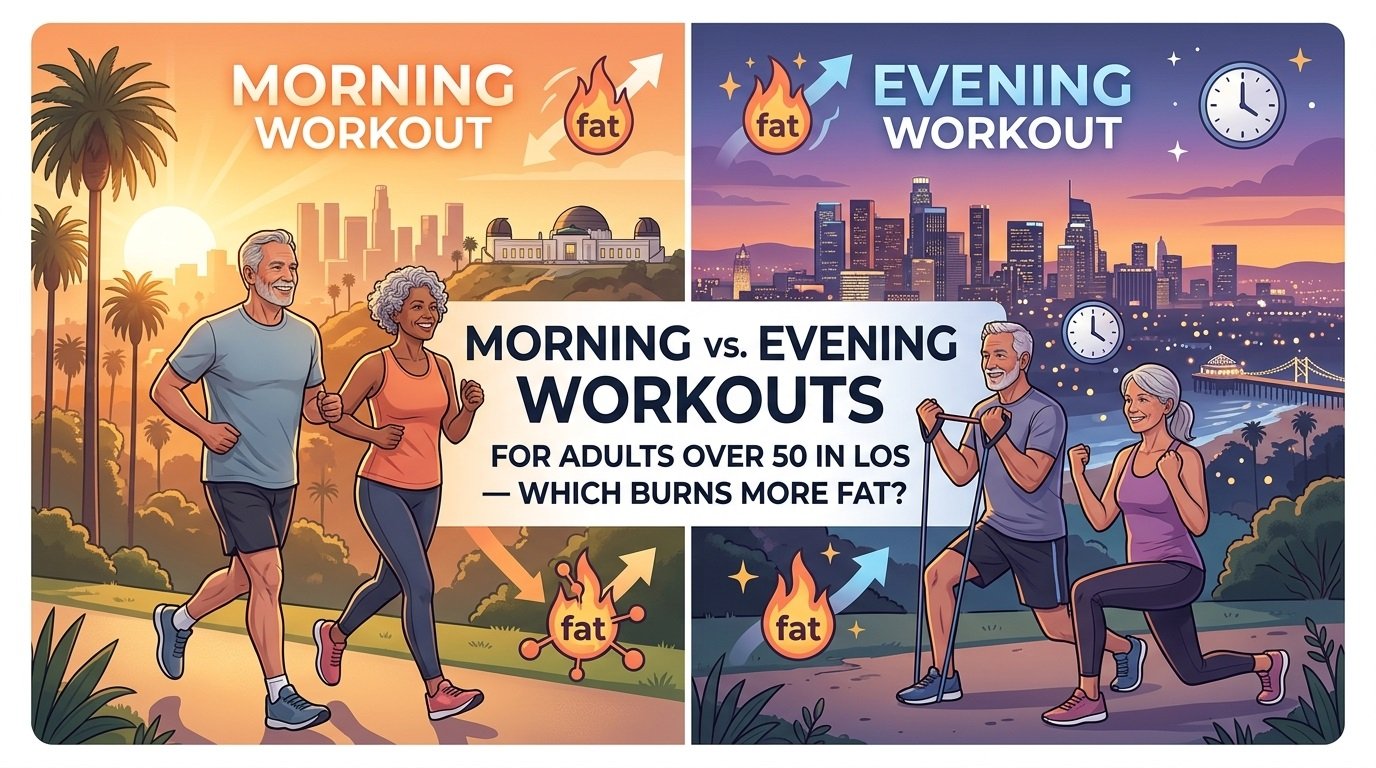
1. Why Workout Timing Actually Matters More After 50 — The Biology
Before we get into morning versus evening, we need to talk about something most fitness content completely skips over: the reason this debate is genuinely more important after 50 than it ever was in your younger years.
In your 30s, your body absorbs almost everything you throw at it. Bad sleep? You recover. Skipped warm-up? Fine. Trained at weird hours? Doesn’t matter much. Your hormones are robust, your recovery is fast, and your metabolic flexibility — your ability to switch between burning fat and carbs — is high.
After 50, that changes. Not in a doom-and-gloom way — but in a way that makes being strategic about when you train genuinely matter for your results.
Here’s What Shifts After 50 That Makes Timing Important
Your circadian rhythm becomes more sensitive. The circadian rhythm is your body’s internal 24-hour clock that controls everything from hormone release to body temperature to when your muscles are primed to perform. Research published in Frontiers in Neuroscience (2025) confirmed that older adults show a more pronounced dependence on external timing cues — like morning light and consistent exercise schedules — to keep their biological clock properly calibrated. When your circadian rhythm is well-calibrated, your sleep deepens, your hormones balance better, and your metabolism runs more efficiently.
Your hormone production follows a stricter daily schedule. Testosterone and growth hormone — the two hormones most responsible for preserving lean muscle and burning fat — follow a tight circadian pattern that becomes less flexible as you age. Catching the right hormonal windows matters more at 55 than it did at 35.
Your core body temperature takes longer to rise. Morning stiffness isn’t just an inconvenience — it reflects the fact that your muscles, tendons, and joints need more time to reach optimal working temperature. This is a real injury risk and a real performance limiter that needs to factor into your training decisions.
Sleep architecture changes significantly. Adults over 50 experience less deep, restorative sleep. Vigorous late-night training can push back sleep onset and disrupt the slow-wave sleep phase — which is exactly when your body releases growth hormone and repairs muscle tissue. Disrupting this has metabolic consequences that pile up over weeks and months.
Metabolic flexibility decreases. Your body’s ability to readily switch between burning fat and carbohydrates as fuel slows with age. This makes the specific metabolic state you’re in when you start training — fasted versus fed, morning versus evening — more meaningful for fat loss outcomes.
2. What the Science Really Says About Morning Workouts and Fat Loss
The Fasted State Advantage — Why Empty Stomach Training Burns More Fat
When you wake up in the morning — assuming you haven’t eaten since the night before — you’re in a fasted state. Your blood glucose is low. Your insulin levels, which normally signal your body to store energy rather than burn it, are also at their lowest point of the day. In this metabolic environment, your body has a stronger incentive to pull from stored fat as its primary fuel source.
A 2025 study published in Frontiers in Physiology (Lan, Wu, Deng et al.) measured fat oxidation rates during morning versus evening exercise performed before and after meals in a controlled setting. The researchers found that morning exercise performed in a fasted state produced significantly higher fat oxidation both during the workout and in the four-hour recovery window that followed. The elevated fat-burning effect lasted well into the morning — not just during the session itself.
A separate study published in the journal Obesity analyzed two years of accelerometer data from more than 5,200 adults tracked by the U.S. Centers for Disease Control. The researchers found that people who exercised between 7 AM and 9 AM had lower BMIs and smaller waist circumferences than those who trained at other times of day. Even when controlling for other lifestyle factors, the association was described as a strong linear relationship — not a weak statistical trend.
Your Morning Cortisol Is Actually an Asset, Not a Problem
Most people hear the word cortisol and immediately think of stress, belly fat, and everything going sideways. And yeah — chronically elevated cortisol is genuinely harmful to body composition. But the morning cortisol spike is a different animal entirely.
It’s called the Cortisol Awakening Response, or CAR. This is a natural, programmed surge in cortisol that serves a specific purpose: it mobilizes stored energy, increases alertness, raises blood pressure to an appropriate waking level, and suppresses inflammation. Think of it as your body’s built-in performance enhancer — not a stress response gone wrong.
Research from Frontiers in Neuroscience (2025) found that morning exercise — particularly when performed consistently — actually strengthens the CAR response and helps stabilize circadian clock gene expression (specifically the Per2 gene). In plain language: training in the morning helps your biological clock stay accurate, which has downstream benefits for sleep quality, hormonal balance, and metabolic efficiency that last all day and accumulate over weeks.
Consistency and Habit Psychology — The Most Underrated Advantage
Here’s the most important morning workout advantage that no physiology textbook covers, but every experienced coach knows: life doesn’t get in the way at 5:30 AM.
There’s no last-minute work call. Nobody has scheduled a dinner. Your kids haven’t asked you for a ride. The traffic that would have delayed you doesn’t exist yet. The evening excuses — all of them completely understandable and real — simply haven’t happened yet.
Learn how to set realistic fitness goals you can actually stick to in 2026.
The All-Day Mental and Metabolic Effect
Morning exercise doesn’t just burn fat during the session — it creates a metabolic and neurological ripple effect that lasts for hours. A 2021 study from Appalachian State University tracked blood pressure, sleep quality, and cognitive function in adults who exercised in the morning versus the evening. Morning exercisers showed meaningfully lower blood pressure throughout the day, improved slow-wave sleep at night, and better attention and memory performance during the afternoon hours.
Read about how outdoor workouts in Los Angeles improve motivation and mental health.
3. The Honest Case for Evening Workouts — Strength, Performance, and Stress Relief
If morning workouts have so many advantages, why do millions of highly effective people train in the evenings and get fantastic results? Because the evening environment has its own set of genuine, science-backed strengths — and understanding them is just as important as knowing the morning advantages.
Your Body Is Physically Stronger Later in the Day — This Is Not a Small Difference
Multiple studies, including a comprehensive 2022 review published in Nature Communications, confirm that physical performance metrics follow a reliable daily curve that peaks between 4 PM and 7 PM for most adults. This isn’t a small effect. Here’s what the research shows:
- Muscle strength is 5 to 8 percent higher in the late afternoon and early evening compared to early morning — a meaningful difference whether you’re doing bodyweight exercises or resistance training
- Core body temperature peaks between 4 PM and 7 PM, improving muscle elasticity, nerve conduction speed, and joint mobility — all of which contribute to both performance and injury prevention
- VO2 max — the gold standard measure of cardiovascular fitness — is higher in the late afternoon, meaning your aerobic engine can work harder with less perceived effort
- Reaction time and neuromuscular coordination are both superior in the evening, particularly relevant for any training involving balance, agility, or complex movement patterns
- Injury risk is demonstrably lower when muscles are warm from a full day of activity, making the evening a genuinely safer time to push intensity if you have joint or soft-tissue concerns
Discover why your 50s and 60s are actually your strongest years if you train right.
Evening Exercise Metabolizes the Day’s Stress — Literally
By the time most adults over 50 finish a full workday, their cortisol levels have been running elevated for hours — driven by meetings, emails, traffic, family responsibilities, and the general relentlessness of modern life. This circulating cortisol, in excess over time, directly promotes visceral fat storage, disrupts sleep, and suppresses immune function.
A structured evening workout is one of the most effective tools known to science for clearing that cortisol load. Physical exercise metabolizes circulating stress hormones efficiently and triggers a cascade of endorphin, serotonin, and dopamine release that creates both an acute sense of calm and a longer-term resilience to stress.
It’s physical training and emotional decompression in one session. This is one of the reasons our evening group sessions at Focus Camp tend to have a particular energy — people arrive wound up and leave genuinely reset.
Workout Quality Can Be Meaningfully Higher in the Evening
When your muscles are warm, your joints are mobile, you’ve had food and water throughout the day, and your nervous system is fully activated — you simply tend to train harder and recover better than when you’re fighting through morning stiffness on an empty stomach after three hours of sleep.
This translates directly to better form, more complete range of motion, heavier loads, more repetitions, and less compensatory movement that leads to injury. All of these factors compound over weeks and months into meaningfully better results.
The caveat — and it’s an important one: The timing of your evening session matters. Vigorous high-intensity training within two hours of bedtime can delay sleep onset, suppress melatonin, and interfere with the deep sleep stages during which your body does most of its fat loss and muscle repair work. Aim to finish by 7 PM if possible, or by 8 PM at the latest if your sessions are moderate-intensity.
4. The Gender-Specific Truth — Women and Men Respond Differently to Workout Timing
This is the section most articles skip entirely, and it’s arguably the most practically important information in this entire piece. The research is unambiguous: women and men over 50 respond differently to morning versus evening training — and the difference is significant enough to change your recommendation.
What the Skidmore College Study Found — and Why It Matters So Much
Published in Frontiers in Physiology (2022), exercise physiologist Dr. Paul Arciero and his team at Skidmore College had 50 men and women train with identical workout protocols — resistance training, HIIT intervals, stretching, and endurance work — either in the morning or the evening for 12 consecutive weeks. The results were striking.
Women who trained in the morning lost significantly more total body fat and belly fat than women who trained in the evening. They also showed greater improvements in blood pressure and lower reported stress levels. The morning advantage for women was consistent and clear across multiple health markers.
Men who trained in the evening lost more total body fat than men who trained in the morning. They also built more lean muscle and showed greater improvements in mood and emotional well-being. The evening advantage for men was equally consistent.
This doesn’t mean women can’t get results in the evening or men can’t get results in the morning — both groups improved regardless of timing. But if you’re a woman over 50 specifically targeting belly fat, the morning evidence is compelling. And if you’re a man over 50 looking for the best body composition results, the evening data is hard to ignore.
5. The Complete Morning vs. Evening Comparison — 14 Key Factors
Use this table as a reference guide. Every factor is backed by peer-reviewed research, not gym-floor opinion.
| Factor | Morning Training | Evening Training |
|---|---|---|
| Fat Oxidation | Higher — especially in fasted state | Lower, but still effective |
| Muscle Strength | 5–8% below peak | Peak performance window |
| Injury Risk | Higher (cold muscles, stiff joints) | Lower (warm, mobile body) |
| Consistency Rate | Higher — fewer schedule conflicts | Lower — more life interruptions |
| Sleep Impact | Improves sleep quality | Can disrupt if too close to bedtime |
| Cortisol Management | Strengthens healthy CAR response | Clears day’s accumulated cortisol |
| Testosterone Window | Peak levels available | 30–50% declined from peak |
| Core Body Temp | Low — longer warm-up needed | Peak — muscles primed |
| VO2 Max | Below peak | Peak cardiovascular capacity |
| LA Summer Safety | Clearly safer — before heat builds | Acceptable after 6 PM only |
| Air Quality (LA) | Cleanest air of the day | Higher ozone and PM2.5 |
| Women’s Belly Fat | Superior results | Good, but less optimal |
| Men’s Body Comp | Good, but less optimal | Superior results |
| Mental Reset | Sets up the day positively | Clears the day’s accumulated stress |
6. Your Body’s Internal Clock — What Circadian Biology Really Means for Your Fat Loss
You might have heard the term circadian rhythm before and filed it away as something relevant only to jet lag and night shift workers. But in the context of fat loss over 50, your circadian biology is one of the most powerful — and most overlooked — forces shaping your results.
What the Circadian Rhythm Actually Controls
Your circadian rhythm isn’t just a sleep-wake cycle. It’s a 24-hour master program running in virtually every cell of your body, governing the timing of hormone secretion, metabolic enzyme activity, inflammation response, blood pressure, body temperature, gut motility, and immune function. It evolved over millions of years to synchronize your biology with the light-dark cycle of the planet.
Research indexed through PubMed Central (2024) directly links circadian disruption to insulin resistance — which is already an elevated concern after 50. When your internal clock gets scrambled, your metabolism follows.
Morning Exercise and Clock Gene Stabilization — The BMAL1 and Per2 Connection
A 2025 study in Frontiers in Neuroscience revealed something genuinely fascinating about morning exercise and circadian biology. Consistent morning training acts as a powerful zeitgeber — a German word meaning “time-giver” — that helps anchor the expression of core clock genes, particularly Per2 and BMAL1.
BMAL1 is a master transcriptional activator that regulates the metabolic pathways controlling how your muscles use energy. When BMAL1 expression is strong and properly timed — which morning exercise helps achieve — your muscles are better at utilizing fat for fuel, synthesizing protein efficiently, and recovering between sessions. When it’s disrupted, your metabolic efficiency drops.
In practical terms, what this means is that training at a consistent morning time doesn’t just produce a fat-burning benefit on the days you train — it gradually recalibrates your metabolism to function more efficiently around the clock.
The Testosterone-Cortisol Ratio — Why It Matters More Than Either Hormone Alone
Most people know that testosterone supports muscle building and fat burning, and that cortisol can break down muscle and promote fat storage. What’s less understood is that the relationship between these two hormones — specifically their ratio — is what drives many of your body composition outcomes.
In the morning, you’re in an anabolic window where testosterone is still elevated and cortisol has come down — a state that supports both fat burning and muscle preservation.
In the evening, testosterone has declined by 30 to 50 percent from its morning peak. The testosterone-to-cortisol ratio often favors a more catabolic environment unless you time your pre-workout nutrition carefully to blunt cortisol’s effect.
This doesn’t make evening training ineffective — as we’ve established, evening training has real performance advantages. But it does explain why the hormonal case for morning training is genuinely strong, especially for adults over 50 where testosterone decline is more pronounced.
7. The Los Angeles Factor — Why Training Location Changes the Calculation
Everything above applies everywhere. But if you’re training outdoors in Los Angeles — which is what we do at Focus Camp — there are several LA-specific factors that make the morning versus evening decision even more concrete.
Summer Heat and Your Safety (This Is Not Optional)
Los Angeles summers are beautiful until they’re not. Between June and September, temperatures regularly climb into the high 80s and 90s by mid-morning, with areas like the San Fernando Valley, Pasadena, and East LA frequently hitting triple digits. UV index values in Southern California are among the highest in the continental United States year-round.
For adults over 50, thermoregulation — your body’s ability to manage its own temperature during exercise — becomes less efficient. Your sweat response is slower to activate, you retain heat longer, and the cardiovascular strain of training in high heat is greater than it was a decade ago. Heat exhaustion and heat stroke are genuine risks, not theoretical ones.
Training outdoors in LA summer means before 9 AM or after 6 PM. That’s not a preference — it’s a safety baseline. In summer, morning sessions win this comparison clearly. Our park-based Focus Camp sessions in summer are scheduled accordingly. See our detailed breakdown of the best times for outdoor fitness in LA 2026.
Air Quality — The Factor Nobody Talks About
Los Angeles has made meaningful progress on air quality over recent decades, but the city still experiences elevated particulate matter (PM2.5) and ground-level ozone on a regular basis — particularly in the summer and fall months, and particularly in areas downwind of major freeways.
Ground-level ozone is a secondary pollutant that forms when nitrogen oxides and volatile organic compounds react in sunlight. Levels build throughout the morning as sunlight and traffic combine, typically peaking in the early afternoon. Early morning air — before traffic is fully underway and before photochemical reactions have had time to work — is generally the cleanest of the day for outdoor exercise.
If you have asthma, cardiovascular disease, or any respiratory sensitivity, this isn’t a minor consideration. We recommend checking the South Coast AQMD daily air quality forecast before any outdoor session, and scheduling morning training as your default during poor air quality months.
The Unique Psychology of LA Mornings
There’s something about training in Exposition Park, MacArthur Park, or Kenneth Hahn at 6:30 in the morning that’s genuinely hard to replicate later in the day. The light is soft, the parks are quiet, the city hasn’t yet turned itself up to full volume. The contrast between the urban chaos you’ll walk into by 9 AM and the calm of early morning outdoor training creates a psychological anchor that many of our members describe as one of the most important parts of their week.
Evening LA can be wonderful too — warm golden-hour light, the relief of the day being over. But evening in LA also means traffic, notifications, the mental residue of the workday, and the pull of family or social obligations. The mental environment for morning training in a Los Angeles park is often simply cleaner.
8. Which Time Is Right for You? A Practical Decision Framework
Enough theory. Here’s how to actually make this decision for your specific situation, goals, and body.
Choose Morning Training as Your Primary Time If You Identify With These
- Your primary goal is fat loss, especially belly fat
- You’re a woman over 50 — the research strongly favors morning for your body composition
- You train outdoors in LA during summer months
- You struggle with consistency — morning sessions have fewer obstacles
- Your sleep quality is a concern and you want to improve it
- You want to feel energized and ahead of your day before 8 AM
Choose Evening Training as Your Primary Time If You Identify With These
- Your primary goal is building strength and muscle
- You’re a man over 50 — the research favors evening for your body composition
- You have significant morning joint stiffness from arthritis or prior injuries
- You need to decompress from work stress before you can wind down
- Your schedule simply doesn’t allow morning training
- You perform noticeably better physically later in the day
The Smart Hybrid Approach — What We Recommend for Most Adults Over 50
For most of our Focus Camp members over 50, the most effective approach isn’t a rigid either-or commitment. It’s a structured hybrid that captures the advantages of both windows.
Example hybrid weekly schedule:
- Monday: Morning — moderate cardio + mobility (fat-burning focus)
- Tuesday: Evening — resistance training (strength focus)
- Wednesday: Morning — light cardio or active recovery
- Thursday: Evening — resistance training or HIIT
- Friday: Morning — moderate cardio + core work
- Saturday: Morning — longer outdoor session (park, trail, or beach)
- Sunday: Rest or gentle walking
This schedule is a template, not a prescription. Your body, your schedule, and your goals will shape the exact version that works for you. Our coaches at Focus Camp build personalized versions of this framework for every member.
9. What We Actually See at Focus Camp — Real Patterns From Real Members
We’ve coached hundreds of adults over 50 in outdoor training in Los Angeles. Across that experience, some patterns show up consistently enough that they’re worth sharing honestly.
Morning Members: The Compounders
Our morning members — the ones who show up at 6:30 or 7 AM consistently — tend to produce the most linear, predictable fat loss results. They don’t always have the best individual sessions (some mornings are just tough), but the compounding effect of consistent attendance, improved sleep, and metabolic recalibration over 8 to 12 weeks is hard to argue with.
They also tend to report the broadest lifestyle changes: better eating decisions through the day, lower stress reactivity, and a general sense of being ahead of their life rather than behind it. Morning training, for these members, isn’t just exercise — it becomes an organizing principle for a healthier day.
Evening Members: The Performers
Our evening members tend to arrive at sessions more physically prepared — their muscles are warm, their energy is up, and their sessions often look more impressive in terms of raw output. They lift heavier, move faster, and demonstrate better form because their body is genuinely more capable at that hour.
The challenge we see most consistently is sleep. Members who train past 7:30 PM and don’t follow consistent sleep hygiene practices often report disrupted nights, which over time limits recovery and blunts their results. The ones who manage this well — finishing by 7, having a protein-rich meal, taking a cool shower, avoiding screens — see excellent results.
The Members Who Get the Best Long-Term Results
Without exception, the members who produce the best long-term results at Focus Camp are those who treat workout timing not as a rigid rule but as an intelligent default. They have a primary time they show up to consistently. They adapt when life requires it. They don’t use schedule disruptions as a reason to stop training — they use them as a reason to flex.
Read about our strength, balance, and focus: our complete training philosophy.
10. How to Maximize Fat Burning Regardless of When You Train
Timing is one lever among many. Here are the other levers that matter enormously — and that most people neglect while obsessing over workout time.
Prioritize Protein — More Than You Think You Need
After 50, your muscles develop what researchers call anabolic resistance — a reduced responsiveness to the protein synthesis signal. In practical terms, this means you need significantly more dietary protein than a younger adult to achieve the same muscle preservation and metabolic benefit. The current research consensus suggests adults over 50 aim for 0.7 to 1.0 grams of protein per pound of bodyweight daily, distributed across three to four meals.
For a morning trainer, this means breaking the fast within 30 to 60 minutes after training with a protein-forward meal of 30 to 40 grams. For an evening trainer, a solid protein meal two to three hours before training fuels the session without spiking insulin during it.
Resistance Training Cannot Be Optional
You lose 3 to 8 percent of your muscle mass per decade after 30 if you don’t actively challenge it. Each pound of muscle burns roughly 6 to 10 additional calories per day at rest — not enormous on its own, but compounding meaningfully across the 30 or more years of active adult life ahead of you.
Explore building muscle without a gym: bodyweight plans for men and women and functional fitness training for everyday life.
Sleep Is Not a Recovery Supplement — It Is the Training Itself
Here’s something most training plans never say explicitly: a significant portion of your fat loss and muscle adaptation from exercise happens during sleep, not during the workout itself. Growth hormone — released almost exclusively during deep slow-wave sleep — drives tissue repair, fat metabolism, and immune recovery. If your sleep is poor, a significant portion of the metabolic work of your training is simply not getting done.
Read about the best exercises to sleep better after 50 in Los Angeles.
Train With Other People
I’ll say this one more time because it genuinely deserves emphasis: research consistently shows that group exercisers lose more weight, stay more consistent, and report higher satisfaction with their fitness lives than solo trainers. A 2019 University of New England study found that people who exercised in a group lost 26 percent more weight over 12 weeks than those training alone.
Learn why outdoor group workouts outperform gyms.
Do Not Underestimate Recovery
Your body doesn’t get stronger during training — it gets stronger during recovery from training. If you’re not giving your body adequate rest, nutrition, and sleep between sessions, you’re not getting the full return on the effort you’re putting in. Recovery isn’t laziness — it’s where the actual adaptation happens.
Check out recovery techniques every active person in Los Angeles needs after workouts.
11. The Biggest Mistakes Adults Over 50 Make With Workout Timing
After coaching hundreds of adults in this age group, these are the patterns that consistently derail results — regardless of whether someone trains in the morning or evening.
- Choosing the “optimal” time over the consistent time. If the science says morning is better for fat loss but you keep skipping your 6 AM sessions, you’re not actually benefiting from morning training. Consistency beats optimization every single time.
- Training too intensely too close to bedtime. HIIT, heavy resistance circuits, or any vigorous training within 90 minutes of sleep will suppress melatonin and delay sleep onset. Even two or three nights of disrupted sleep per week, accumulated over months, meaningfully impairs body composition outcomes.
- Skipping the warm-up in morning sessions. At 6 AM, your joints are stiff, your muscles are cold, and your nervous system isn’t fully online. A 10 to 15-minute progressive warm-up isn’t a luxury — it’s injury prevention. Never jump into a morning workout without it.
- Ignoring nutrition timing in relation to training. Training fasted is a specific strategy with specific benefits. Training fasted by accident — just because you forgot to eat — with inadequate protein throughout the day is a different thing entirely that can promote muscle loss instead of fat loss.
- Using schedule changes as permission to quit. Travel, family events, heat waves, and work crunches are going to disrupt your schedule. The adults who get the best results treat these disruptions as problems to solve, not reasons to stop. A 20-minute walk when your full session isn’t possible is infinitely better than nothing.
- Comparing their results to younger adults or to their own younger selves. Physiology changes. Progress over 50 looks different than it did at 30, and that’s not a failure — it’s biology. The relevant question isn’t “am I as fast as I was at 35?” It’s “am I stronger, healthier, and more capable than I was six months ago?”
12. Frequently Asked Questions — Answered Honestly
Is it better to work out on an empty stomach in the morning to burn more fat?
For light to moderate intensity training, yes — fasted morning exercise measurably increases fat oxidation, particularly for women over 50 targeting belly fat. However, if your session involves heavy resistance training or high-intensity intervals, a small pre-workout protein source (a half-scoop of protein powder, a handful of nuts, or a hard-boiled egg) will protect lean muscle without meaningfully blunting the fat-burning effect. The goal isn’t to train in complete starvation — it’s to train with low blood glucose and low insulin.
I’m 63 years old and my joints are very stiff every morning. Should I force myself to train early?
No. Forced morning training with significant joint stiffness leads to poor mechanics, compensation patterns, and injury over time. For people with meaningful morning stiffness from osteoarthritis, prior joint injuries, or inflammatory conditions, evening training is the smarter and safer choice. If you do want to train in the morning, allow a 15 to 20-minute warm-up of gentle walking, joint circles, and dynamic stretching before any loaded movement.
Does it matter what time I do cardio versus strength training?
Yes, somewhat. The current evidence suggests: strength training benefits more from the evening performance window (peak body temperature, neuromuscular readiness). Cardio for fat loss benefits most from the morning fasted window. If you can only train once per day, the hybrid approach — a circuit that combines both elements — is the practical solution, and the time you choose should be based on which physiological advantage aligns with your primary goal.
Can I switch between morning and evening throughout the week?
Absolutely, and many of our members do. Variety between morning and evening sessions throughout the week is preferable to forcing a time that consistently leads to poor sessions or skipped workouts. What you want to avoid is chaotic, unpredictable training times with no structure — the evidence suggests that circadian adaptation and metabolic optimization come from regularity, not rigidity. Have a primary default time, and treat the other as a backup.
Will training in the evening prevent me from losing belly fat?
No, not categorically. Evening training can absolutely produce belly fat reduction — the research on men specifically shows better overall fat oxidation in evening sessions. For women, the evidence favors morning for belly fat specifically, but the difference matters most when all other variables (nutrition, sleep, consistency) are equal. If your nutrition is dialed in, your sleep is protected, and you train consistently 4 to 5 days per week, you will lose belly fat regardless of training time.
How long before I see results if I start training consistently?
Most Focus Camp members over 50 notice energy and mood improvements within 2 to 3 weeks of consistent training. Measurable body composition changes typically begin appearing at weeks 6 to 10 when training 4 or more times per week with solid nutrition. Visible results that others comment on often come at weeks 10 to 14. The process is slower than it was in your 30s — but it’s real, and it’s lasting in a way that crash-course programs rarely are.
What if I genuinely cannot work out before 8 AM or after 6 PM?
That’s a reality for a lot of people, and it doesn’t mean you can’t get great results. The key is finding a consistent time that works with your life and protecting it like an appointment. Midday workouts, lunch-break walks, and weekend morning sessions all count. Read how busy professionals in Los Angeles can stay fit without a full gym for realistic scheduling frameworks.
Ready to Train Smarter?
If this article did one thing, I hope it settled the debate for you — not by giving you a rigid rule, but by giving you a clear, science-backed framework for making the right decision for your body, your goals, and your life in Los Angeles.
Morning training wins on fat loss, hormonal alignment, consistency, sleep quality, and LA summer safety. Evening training wins on physical performance, strength output, injury prevention, and day’s-end stress relief. The smartest approach for most adults over 50 is a structured default with intelligent flexibility — and a coach who helps you make the most of whichever window you choose.