If you live near USC or Exposition Park and you’ve been hunting for outdoor fitness that you’ll actually stick with — not just try once and ghost — this guide is for you. I’m going to walk you through exactly what Focus Camp offers, why outdoor group training works (backed by real research, not marketing fluff), what adults in this part of LA are genuinely looking for, and how to get started without getting overwhelmed.
This isn’t a sales page dressed up as an article. It’s the full picture — the science, the program, the people, the pricing, the warts-and-all reality of what it takes to build a fitness habit that lasts. I wrote it because you deserve to make this decision with your eyes open.
What’s in This Guide
1. What Adults Near USC and Exposition Park Are Actually Searching For
Let me start with something real. When people in this neighborhood look for a fitness program, they’re not typing “boutique wellness experience” into Google. They’re searching for things like “outdoor fitness near USC,” “adult fitness classes Exposition Park,” or — and this one breaks my heart a little — “gym near me that I’ll actually go to.” That last search tells you everything. People aren’t lacking options. They’re lacking something that sticks.
The area around USC and Exposition Park is a funny mix. You’ve got students who are already active, long-time community residents who’ve watched the neighborhood change, healthcare workers from the hospitals nearby, and professionals who commute in every day. What they share is this: they’re busy, they’re tired of fitness programs that feel like homework, and they want something that fits into an actual life — not a life that revolves around fitness.
Here’s what we hear over and over in initial conversations:
- “I’ve joined three gyms and never gone past month two.” This is the most common thing people tell us. And it’s not because they’re lazy or undisciplined — it’s because a gym membership without structure, community, or coaching is just an expensive guilt trip. You’re paying for access to equipment. Nobody’s expecting you. Nobody notices if you don’t show up. That freedom sounds great until you realize it’s the same freedom to not go.
- “I want to exercise outside — LA weather is too good to be indoors.” Hard to argue with this one. Los Angeles gives you roughly 284 sunny days a year. Spending all of them under fluorescent lights on a treadmill feels like a waste of geography. There’s real science behind this feeling too — outdoor exercise reduces cortisol faster than indoor exercise, and the vitamin D alone is worth the trip outside.
- “I need something that’s not just physical — I’m stressed out.” This comes up more than you’d think. Adults in their 30s, 40s, and 50s in this area are carrying a lot. Career pressure. Family obligations. The general anxiety of living in a city that never slows down. They’re not just looking for a workout. They’re looking for something that helps them feel like themselves again.
- “I’m too old for boot camps but too young to give up.” This is usually from people in their 40s and 50s who’ve had it with programs that treat everyone like they’re 25 and indestructible. They want real training — but training that respects where their body is right now, not where it was 15 years ago.
- “I want to play games again. I miss playing.” This one surprises people when they say it out loud. But it’s genuine. Adults don’t play. We work, we errand, we scroll, we sleep. We don’t play. And the absence of play is a real loss — not just emotionally, but physically. Play-based movement develops agility, coordination, and reactive speed that treadmill-and-dumbbell routines simply can’t touch.
If any of those sound like you, you’re in the right place. What follows is the most detailed explanation of our program that exists anywhere — because I’d rather you make an informed decision than an impulsive one.
2. The Science Behind Outdoor Group Training — Why It Works Better Than You Think
Before I get into what Focus Camp does, I want to explain why we do it this way. Because the program design isn’t random. Every decision — outdoor environment, small groups, game-based sessions, built-in recovery — comes from specific research about what actually produces lasting fitness results in adults. Not temporary motivation. Lasting results.
Why Training Outdoors Beats the Gym (According to the Research)
I’m not anti-gym. Gyms serve a purpose. But if we’re talking about what produces the best outcomes for most adults — especially adults who’ve struggled with consistency — the research points clearly in one direction. And it’s not indoors.
A landmark 2023 meta-analysis published in BJSM (that’s the British Journal of Sports Medicine, one of the most respected journals in the field) pooled data from over 30 studies comparing outdoor exercise to indoor exercise. The findings were consistent and, honestly, pretty striking: people who exercised outdoors reported significantly greater enjoyment, higher intention to repeat the activity, and better psychological wellbeing than those doing equivalent exercise indoors. Same effort. Different environment. Completely different experience.
Then there’s the cortisol piece. Multiple studies — including a well-known 2019 Japanese study on “forest bathing” — have shown that natural environments reduce salivary cortisol levels within 20 minutes of exposure. Cortisol is your primary stress hormone. Chronically elevated cortisol is linked to belly fat storage, sleep disruption, immune suppression, and anxiety. Training in a park or open-air space gives you a cortisol reduction that a crowded gym simply cannot provide. The gym might make you fitter. The outdoors makes you fitter and less stressed. That’s a meaningful difference when you’re already juggling a high-pressure life.
And the vitamin D angle? It’s not trivial. An estimated 42% of US adults are vitamin D deficient — higher in urban areas, higher in people who work indoors, and higher in communities of color. Vitamin D deficiency is linked to bone loss, immune dysfunction, depression, and chronic fatigue. Outdoor training in Los Angeles gives you regular, sustained sun exposure that most indoor exercisers never get. We’re not talking about tanning. We’re talking about the baseline vitamin D your body needs to function properly — and that most adults in this city are walking around without.
Why Small Groups Outperform Solo Training
This is where it gets really interesting. The data on group exercise adherence is unambiguous: people who train in small, consistent groups show dramatically better attendance and long-term adherence than people who train alone. A 2024 study in the Journal of Behavioral Medicine found that adults in structured group exercise programs were 3.2 times more likely to maintain their exercise habit for six months compared to solo exercisers. That’s not a marginal difference. That’s the difference between a fitness habit and a fitness attempt.
Why does this work? Three reasons, and they all matter:
- Accountability that’s personal, not abstract. When you skip a gym session, nobody notices. When you skip a Focus Camp session, your coach notices. Your training partners notice. You get a text. Someone asks if you’re okay. That’s not surveillance — it’s community. And it’s the single most powerful driver of consistency that exists in fitness.
- Social facilitation — you work harder with others. This is a well-documented psychological phenomenon. People exert more effort in the presence of others, especially when there’s a shared goal. In practical terms: you’ll push harder in a relay race with teammates counting on you than you ever would running alone on a treadmill. The effort is real. The motivation is social. The result is better fitness.
- Identity shift. When you train alone, exercise is something you do. When you train with a group, exercise becomes part of who you are. You’re not “someone who exercises” — you’re “a Focus Camp member.” That identity shift is subtle but powerful. It’s the difference between a behavior and a belonging. Belongings are much harder to abandon.
The group size matters too. We cap sessions at 12 people, and that number isn’t arbitrary. Research on group dynamics consistently shows that groups of 8–12 create the strongest social bonds and individual accountability. Groups larger than 15 start to lose cohesion — people can hide, coast, show up without really showing up. At 12, there’s nowhere to hide. And that’s exactly the point.
“The research is clear: small-group outdoor training produces better adherence, better mental health outcomes, and better physical results than solo gym training. We built Focus Camp around that evidence. Every program decision reflects it.”
3. Why Outdoor Games Are Serious Training (Not Just “Making Exercise Fun”)
OK, this is something that catches a lot of people off guard: game-based training isn’t just “making exercise fun.” That sells it way short. It’s a distinct training modality with specific physiological and psychological benefits that traditional drills flat-out can’t replicate. When you play a team sport — even casually — your body moves in ways that structured exercise rarely demands. Lateral movement. Deceleration. Reactive changes of direction. Explosive starts from a standstill. These are athletic qualities that deteriorate in adults who only do linear, repetitive exercise (running, cycling, elliptical), and they’re exactly the qualities that prevent injuries in daily life.
A 2024 study in the Journal of Sports Science and Medicine found that adults who participated in game-based training twice weekly showed greater improvements in agility, reaction time, and cardiovascular fitness than a control group doing traditional cardio of equivalent duration. The game group also reported significantly higher enjoyment and lower perceived exertion — meaning they were working just as hard, but it felt easier because they were engaged in something social and competitive rather than something repetitive and isolating.
The psychological piece matters too. Team games create what sports psychologists call “flow state” — that feeling of being completely absorbed in an activity where time seems to speed up and self-consciousness drops away. Flow state is one of the most powerful drivers of exercise adherence, because it makes the experience intrinsically rewarding. You’re not exercising because you should. You’re playing because you want to. The fitness benefits are a side effect of something you actually enjoy. That’s a fundamentally different relationship with physical activity than most adults have ever experienced — and it’s one that lasts.
4. The Mental Health Connection: Why Training Outside Changes Your Brain
I want to dedicate a full section to this because it keeps coming up in conversations with people who walk through our door, and because the science here is genuinely transformative — but most fitness programs treat mental health as a footnote. At Focus Camp, it’s not a footnote. It’s woven into the entire program design, and I want you to understand why.
Let’s start with the numbers that matter. According to the CDC, roughly one in five US adults experienced symptoms of anxiety or depression in the past year. In Los Angeles County, that number has been consistently higher than the national average since 2020. And among working adults aged 30–55 — the core demographic in our neighborhood — the rates are even steeper because of the compounding pressures of career, family, housing costs, and the relentless pace of life in a major city. If you’re reading this and feeling some version of “I’m stressed all the time but I don’t know what to do about it,” you are far from alone.
Here’s what the research tells us about exercise and mental health, specifically:
| Mental Health Outcome | What the Research Shows | How Focus Camp Addresses It |
|---|---|---|
| Anxiety reduction | A 2023 meta-analysis in BJSM found that 150 min/week of moderate exercise reduces anxiety symptoms by 20–30%, comparable to some pharmacological interventions for mild-to-moderate anxiety | Our 5 sessions/week structure exceeds this threshold. Outdoor environments amplify the effect. Group setting reduces the social isolation that worsens anxiety |
| Depression prevention | The 2025 NHANES study (9,000+ adults) found outdoor time independently associated with reduced depression risk, especially in adults over 40 | Every session is outdoors. We combine exercise with nature exposure — the two most evidence-based non-pharmacological interventions for depression |
| Stress and cortisol | Natural environments reduce salivary cortisol levels within 20 minutes of exposure (multiple studies, widely replicated) | Training in parks and open spaces provides continuous cortisol reduction during exercise, unlike indoor environments which can actually increase cortisol due to noise and crowding |
| Sleep quality | Outdoor exercise, particularly morning sessions with sunlight exposure, improves circadian rhythm regulation and sleep onset latency | Our session times are designed to maximize daylight exposure. Morning sessions help regulate your sleep-wake cycle |
| Ruminative thinking | 30 minutes in nature reduces neural activity in the subgenual prefrontal cortex — the brain region associated with repetitive negative thinking | Game-based sessions demand present-moment attention, making it nearly impossible to ruminate while playing. Yoga and mindfulness sessions directly train the opposite of rumination |
| Social connection | Chronic loneliness increases mortality risk by 26% (equivalent to smoking 15 cigarettes/day, per Holt-Lunstad meta-analysis) | Small groups of 12 create genuine social bonds. Members know each other by name. The group becomes a social anchor, not just a fitness class |
I’m not telling you that Focus Camp is a substitute for therapy or medication. If you’re dealing with clinical depression or an anxiety disorder, you should be working with a mental health professional — and we’d encourage you to do that alongside your training. What I am telling you is that the evidence for outdoor group exercise as a mental health intervention is strong, specific, and growing — and that our program was designed with that evidence in mind from the beginning.
The yoga and mindfulness sessions that Tina leads aren’t an afterthought or a “nice to have.” They’re a core part of the program because they directly address the mental health dimensions that pure physical training doesn’t touch. And the game-based sessions serve a dual purpose: they’re physically demanding, yes, but they also demand a kind of present-moment focus that functions as active mindfulness. You can’t worry about tomorrow’s deadline while you’re tracking a volleyball. Your brain doesn’t work that way. The game forces you into the present, and that forced presence is genuinely therapeutic.
If you want to go deeper on this, our article on outdoor fitness for mental health in Los Angeles covers the research in even more detail.
5. What Outdoor Games and Fitness at Focus Camp Actually Look Like
Let me get specific, because “outdoor fitness program” can mean almost anything and I don’t want you guessing what ours means. I’ve seen programs that call themselves “outdoor fitness” and what they actually do is drag a few kettlebells into a parking lot and call it nature. That’s not what we do.
Focus Camp sessions take place in a variety of outdoor environments — local parks, open-air fields, sports courts, and other outdoor settings within easy reach of our Albany Street location. The sessions rotate environments intentionally: different surfaces, different spatial arrangements, different sensory conditions all contribute to more complete physical development. Your body adapts to repetition and sameness — so we deliberately vary where and how you train. Training on grass develops different stabilizer patterns than training on a court. Training on a slight incline activates different muscle groups than training on flat ground. Training in the shade versus direct sun creates different cardiovascular demands. These aren’t accidents — they’re programming decisions.
Within any given week, you can expect sessions that feel very different from each other. Some sessions are high-energy and competitive, built around team games and athletic drills. Others are deliberate and focused, built around strength work, form, and progressive loading. Some sessions will leave you breathless and exhilarated. Others will leave you stretched out, calm, and mentally clear. All of them are purposeful. None of them are random.
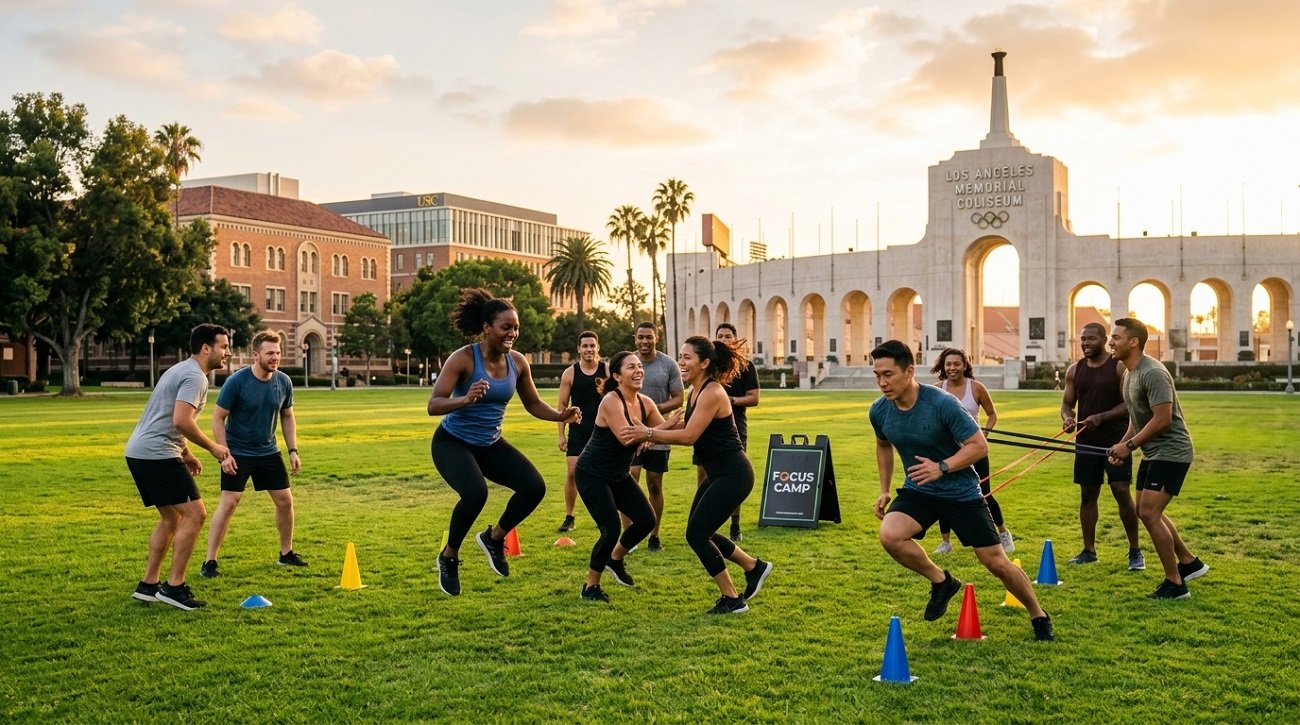
The game-based sessions — volleyball, smash ball, team relays, obstacle challenges — are not filler. They’re not warmups or cool-downs. They’re legitimate training modalities that develop athleticism, coordination, reaction time, lateral movement, and cardiovascular capacity in ways that traditional drills alone can’t replicate. The competitive social element of team games also produces a specific kind of physical intensity that most people can’t manufacture alone: you run harder when someone’s counting on you. That’s not an opinion; it’s well-documented exercise physiology. And it’s one of the reasons our members consistently report that game days are their favorite days — they’re working harder than they would on their own, but it doesn’t feel like work.
Let me give you a concrete example. On a typical Tuesday game session, you might start with a 10-minute dynamic warmup that includes lateral shuffles, high knees, and arm circles. Then the coach divides the group into teams for a series of relay races — not the kind you did in elementary school, but structured athletic relays that include bear crawls, shuttle runs, and medicine ball carries. After that, you might play a 20-minute game of smash ball that has you sprinting, diving, and changing direction constantly. Then there’s a team obstacle course that requires coordination, communication, and physical effort from every member. The whole session runs 60–90 minutes, and by the end, you’ve done more varied athletic movement than most people do in a month of gym sessions — and you had fun doing it. That’s the point.
6. The Full Program Breakdown — Every Session Type, Explained in Detail
The Focus Camp Program is structured around 20 classes per month — five sessions per week, one to two hours each. You can join any session on any day; there’s no assigned cohort or fixed schedule. Here’s a detailed breakdown of every type of session in the program, what it involves, and what it’s designed to produce. I’m going deep on each one because you deserve to know exactly what you’re signing up for.
💪
Strength & Conditioning
Expert-led sessions using functional strength methods — compound lifts, resistance work, loaded movement patterns. Builds muscle, improves posture, increases bone density, and develops the kind of real-world strength that makes everything from carrying groceries to climbing stairs easier and safer. Every exercise is supervised for form. We don’t just count your reps — we watch how you move and correct you in real time. That’s the difference between “working out” and training.
🏃
Cardio & Endurance
Running intervals, functional cardio circuits, agility work, and endurance-based training. Scaled to your current fitness level — never a one-size-fits-all pace. Builds cardiovascular capacity, increases stamina, and develops the aerobic base that supports all other training. If you haven’t run in years, you’ll start with walk-run intervals. If you’re already a runner, we’ll push your intervals harder. The session meets you where you are.
🏆
Team Sports & Outdoor Games
Volleyball, smash ball, tug of war, relay races, team challenges. These aren’t casual activities — they’re legitimate athletic training that develops coordination, speed, explosive power, teamwork, and competitive mindset. And they’re genuinely enjoyable, which is why our members look forward to these sessions most. The social pressure of team competition produces effort levels that solo training simply can’t match.
🧘
Yoga & Flexibility
Guided yoga flows, deep stretching, mobility work, and balance training, conducted outdoors when conditions allow. Improves flexibility, joint health, and range of motion. Also serves as active recovery and provides the mindfulness component that differentiates our program from pure physical training. Tina designs these sessions to complement the harder training days — targeting the muscle groups that were worked most and the movement patterns that need restoration.
🚧
Obstacle & Agility Challenges
Dynamic agility courses, speed drills, lateral movement work, and functional challenge circuits that develop athleticism, body awareness, and problem-solving under physical pressure. These sessions are high-energy and produce improvements in coordination and athletic capability that carry over into daily life. They’re also where you’ll discover physical abilities you didn’t know you had — most adults are genuinely surprised by what they can do when they’re challenged in new ways.
💧
Aqua Training
Low-impact, high-resistance water-based conditioning. Ideal for joint recovery, rehabilitation, and high-performance conditioning without skeletal stress. Particularly valuable for adults returning to exercise, older members, or anyone managing joint concerns. Water resistance engages muscles throughout their full range of motion, and the hydrostatic pressure improves circulation and reduces swelling. This isn’t water aerobics — it’s genuine athletic training in an aquatic environment.
🔄
Group Functional Training
Circuit-based sessions focused on real-life movement patterns — lifting, pulling, pushing, rotating, balancing, stabilizing. HIIT drills, partner workouts, mobility flows. Designed to improve how your body performs in everyday life, not just in a training environment. The movements transfer directly to real-world physical capability. If you’ve ever thrown out your back picking up a child or felt your knees protest on stairs, functional training directly addresses those weaknesses.
🌿
Recovery & Mindfulness
Guided breathing, progressive relaxation, cooldown flows, and restorative practices. These sessions are not optional extras — they’re core programming. Recovery is where physical adaptation actually occurs. And structured mindfulness sessions develop the mental focus and stress resilience that make every other session more effective. Think of it this way: training is the stimulus. Recovery is where the transformation happens. Skip recovery, and you’re just accumulating fatigue.
Sample Weekly Schedule at a Glance
| Day | Session Focus | Type | Duration | Intensity | Est. Calorie Burn |
|---|---|---|---|---|---|
| Monday | Strength & Conditioning — Full Body | Strength | 90 min | Moderate-High | 400–600 |
| Tuesday | Outdoor Games & Team Sports | Games | 60–90 min | High (variable) | 500–800 |
| Wednesday | Yoga, Flexibility & Mindfulness | Recovery | 60 min | Low-Moderate | 150–250 |
| Thursday | Cardio, Agility & Functional Training | Cardio | 90 min | High | 500–700 |
| Friday | Group Circuit & Obstacle Challenge | Functional | 90 min | Moderate-High | 450–650 |
Note: the specific sessions rotate weekly to ensure variety and continued physical adaptation. You attend whichever sessions fit your schedule — there’s no mandatory attendance for specific days. Calorie burn estimates are approximate and vary significantly based on body weight, fitness level, and effort. They’re included here to give you a rough sense of session demands, not as a tracking metric.
If you’re wondering what to expect on your very first day, we’ve written a detailed beginner’s guide to Focus Camp that walks through exactly what happens when you walk in for the first time — what to bring, what the energy is like, and what a real first session looks like in practice.
7. Your First Month at Focus Camp — A Week-by-Week Walkthrough
One of the things that makes people hesitate before joining any fitness program is uncertainty about what the experience will actually feel like. Marketing materials show you the highlight reel — the smiling group, the high-five at the end of a session, the transformation photo. What they don’t show you is the awkward first day, the sore muscles in week two, the moment in week three when you realize you’re doing something you couldn’t do before. I want to show you all of it, because the full picture is what helps you decide whether to start.
| Week | What’s Happening Physically | What’s Happening Mentally | What to Expect |
|---|---|---|---|
| Week 1 | Your body is learning new movement patterns. You’ll likely feel muscle soreness (DOMS) 24–48 hours after sessions, especially if you haven’t exercised regularly. This is completely normal — it means your muscles are adapting. | A mix of excitement and nervousness. You might feel self-conscious, worried about keeping up, or wondering if you made the right decision. Almost everyone feels this way. The group and the coach will help you through it. | Attend 3–4 sessions. Focus on learning the format, meeting people, and not overdoing it. The coach will scale everything to your level. You will not be expected to perform at the level of someone who’s been training for six months. Your only job this week is to show up and move. |
| Week 2 | Soreness starts to decrease as your body adapts. You’ll notice some movements feeling slightly less awkward. Your cardiovascular system is beginning to adjust — stairs might feel a little easier, you might sleep a little deeper. | The novelty is wearing off and the routine is setting in. This is where some people start to feel the pull of old habits — the voice that says “you can skip today.” This is exactly where group accountability starts to earn its keep. | Attend 4–5 sessions. Start pushing slightly beyond your comfort zone on exercises you’re familiar with. The coach will encourage this — not by yelling, but by knowing what you’re capable of and holding you to it. You’ll start recognizing the other people in your sessions. |
| Week 3 | Noticeable improvements in strength and endurance. Weights that felt heavy in week 1 feel manageable. Your recovery between sets is faster. You’re moving with more confidence and less hesitation. Your body is starting to change in ways you can feel even if you can’t see them yet. | This is often the breakthrough week mentally. You start to believe that this might actually work. The sessions feel less like an ordeal and more like something you’re building. The group dynamic is becoming familiar — you know people’s names, you know the rhythm of the sessions. | Attend 4–5 sessions. You’ll start to feel competitive in game sessions — not in a hostile way, but in a “I want to contribute to my team” way. That’s a sign your body and mind are both engaging. This is also when you should have a check-in conversation with Francois about how things are going. |
| Week 4 | By the end of this week, 84% of our members report noticeable improvements in strength, energy, and mood. Your clothes might fit differently. You might notice changes in how you carry yourself. Your resting heart rate may be slightly lower. Your sleep is likely better. | The shift from “I’m trying this out” to “this is part of my life” typically happens around this point. The sessions aren’t something you have to do anymore — they’re something you look forward to. The group isn’t a collection of strangers anymore — it’s your people. | Attend 5 sessions. By now you have a real sense of the program, your capabilities, and the community. This is the point where we ask you to evaluate honestly: is this working for you? For the vast majority of people who get to week 4, the answer is yes — and they stay for much longer. |
Honest Note
Week two is the hardest week for almost everyone. The initial excitement has faded, the soreness is real, and the old habits are pulling hard. If you feel that pull, that’s not a sign that the program isn’t working — it’s a sign that the program is working, because it’s challenging patterns that have been comfortable for a long time. The people who push through week two almost always become long-term members. The people who don’t usually come back three months later and start over. Save yourself the detour. Show up in week two.
8. Nutrition and Recovery: The Missing Piece Most Programs Ignore
Here’s the uncomfortable truth that most fitness programs don’t want to tell you: exercise alone is not enough. If you train hard five days a week but eat poorly, sleep five hours a night, and never give your body time to recover, you will not get the results you want. You might even get worse — more tired, more injured, more frustrated. Training is the stimulus. Nutrition and recovery are where the actual transformation happens. Ignore them, and you’re doing half the work for a quarter of the results.
I’m not going to give you a meal plan or tell you to count macros. That’s not our approach, and honestly, it doesn’t work for most people long-term. What I am going to do is give you practical, evidence-based guidelines that support the training you’ll be doing at Focus Camp — guidelines that are realistic for busy adults who don’t have time to meal-prep every Sunday or weigh their food.
Nutrition Timing for Outdoor Training
| Timing | What Your Body Needs | Practical Examples | Why It Matters |
|---|---|---|---|
| 2–3 hours before session | Moderate complex carbohydrates + lean protein. Low fat and low fiber to avoid GI distress during exercise | Oatmeal with banana and a spoonful of peanut butter. Rice bowl with grilled chicken and vegetables. Toast with eggs and fruit | Your body needs time to digest and convert food to usable energy. Training on a full stomach is uncomfortable; training on empty limits your performance |
| 30–60 min before session | Quick-digesting carbohydrate if you’re hungry. Small amount only | Half a banana. A small handful of pretzels. A date. A small glass of juice | This tops off your glycogen stores without making you feel heavy. Skip this if you’re not hungry — it’s optional |
| During session | Water. Electrolytes if training in heat (above 80F) or for sessions over 60 minutes | Water bottle with a pinch of salt and squeeze of lemon. Or a commercial electrolyte drink diluted 50/50 with water | LA heat is no joke. Dehydration of just 2% body weight impairs performance and cognitive function. Most people underestimate how much they sweat outdoors |
| Within 60 min after session | Protein (20–30g) + carbohydrates. This is your most important nutrition window | Protein shake with a banana. Greek yogurt with berries and granola. Chicken wrap with vegetables. Rice and beans with salsa | Your muscles are most receptive to protein synthesis in the hour after training. This meal determines how much of the session’s stimulus your body actually converts into adaptation |
| Throughout the day | Consistent protein intake (0.7–1g per pound of body weight for active adults). Plenty of vegetables. Adequate healthy fats | Protein at every meal. Half your plate vegetables at lunch and dinner. Olive oil, avocado, nuts for fats | Protein supports muscle repair and growth throughout the day, not just after training. Vegetables provide micronutrients that support recovery. Fats support hormone production |
Recovery: The Work Nobody Sees
Recovery isn’t just “resting.” It’s an active process that includes sleep, nutrition, mobility work, stress management, and strategic rest days. Here’s what we emphasize at Focus Camp:
- Sleep is non-negotiable. If you’re training 5 days a week and sleeping 5 hours a night, you’re not recovering. You’re accumulating fatigue. Aim for 7–9 hours. If that sounds impossible, start by going to bed 30 minutes earlier. The difference between 6 and 7 hours of sleep is enormous for recovery — it’s the difference between your body repairing itself and your body just surviving.
- Rest days are training days. Your body doesn’t get stronger during exercise. It gets stronger during the recovery period after exercise. If you never rest, you never adapt. Our program includes built-in recovery sessions (yoga, mindfulness) and two rest days per week. Use them. Don’t add extra training on rest days thinking you’ll get faster results — you’ll get the opposite.
- Hydration is a daily practice, not a session-time activity. By the time you feel thirsty during a session, you’re already dehydrated. Drink water consistently throughout the day. In LA’s climate, active adults should be consuming at least 3–4 liters daily — more on training days and more in summer.
- Mobility work is not optional. The yoga and flexibility sessions in our program exist for a reason. They maintain the range of motion that strength training and cardio can reduce if left unchecked. Tight hips, stiff shoulders, and limited ankle mobility are the precursors to injury. Ten minutes of daily stretching can prevent months of rehab.
- Stress management is part of fitness. Chronic stress elevates cortisol, impairs recovery, disrupts sleep, and promotes fat storage around the midsection. The mindfulness sessions at Focus Camp aren’t just “nice to have” — they’re a direct intervention against the stress response that undermines your training. If you’re skeptical about mindfulness, try it for two weeks and see how you sleep. That’s usually enough to change most people’s minds.
9. Seasonal Training in LA: How to Train Smart Year-Round
One of the biggest advantages of outdoor training in Los Angeles is that you can do it year-round. But “can” and “should do it the same way” are different things. LA’s climate is generally forgiving, but it has real seasonal variation that affects how you should train, what you should wear, and how you should prepare. Most fitness programs ignore this entirely. We don’t, because ignoring it leads to dehydration in summer, underperformance in the rare cold snaps, and unnecessary discomfort that makes people skip sessions.
| Season | Typical Conditions | Training Adjustments | What to Wear | Key Risks |
|---|---|---|---|---|
| Summer (June–Sept) | 75–95F. Low humidity. Intense UV. Occasional heat advisories. Wildfire smoke possible in late summer/fall | Earlier session times to avoid peak heat. Longer warmups. More frequent water breaks (every 10–15 min). Reduced intensity on extreme heat days. Aqua sessions become especially valuable | Light-colored, moisture-wicking clothing. Hat or visor. Sunglasses. Sunscreen SPF 30+ reapplied every 2 hours. Minimal cotton — it traps heat | Dehydration, heat exhaustion, sunburn, air quality issues during wildfire season. We monitor AQI and adjust session location or format when needed |
| Fall (Oct–Nov) | 65–85F. Warm days, cool mornings. Santa Ana winds possible (dry, hot). Best training weather of the year overall | Peak training season — this is when we push the hardest sessions. Take advantage of the comfortable conditions. Longer sessions possible without heat stress | Layers for early morning sessions. You’ll warm up quickly. Light long-sleeve for wind protection during Santa Ana events | Santa Ana winds can create poor air quality. Wildfire risk is highest in late fall. We communicate any schedule changes via text/email |
| Winter (Dec–Feb) | 50–68F. Occasional rain (rare but it happens). Mornings can be genuinely cold by LA standards. Shorter daylight hours | Longer warmups are essential — cold muscles are more injury-prone. Session times may shift later to accommodate daylight. Rainy day alternatives include covered areas and aqua sessions | Layered clothing you can remove as you warm up. Light jacket or vest for warmup. Long pants or tights on cold mornings. Gloves if you tend to get cold hands | Insufficient warmup leading to muscle strain. Wet surfaces increasing slip risk. We modify sessions for rain and always have a covered alternative |
| Spring (Mar–May) | 55–75F. “June Gloom” can extend into May — overcast mornings that burn off by midday. Occasional wind. Excellent training conditions | Gradual intensity increase as weather improves. Spring is a great time to set new goals and push boundaries. The overcast mornings are actually ideal for high-intensity work — less heat stress | Light layers for morning sessions. The marine layer can make it feel cooler than the temperature suggests. Bring a light layer even on warm days | Overconfidence — the nice weather makes people want to push too hard too fast. Build gradually. Allergies can be an issue for some people in spring |
LA Training Reality Check
People who move to LA from colder climates often assume that because the weather is “always nice,” there’s no seasonal adjustment needed. That’s not quite right. LA’s climate is consistently good, but it’s not uniform. Summer heat is real and demands respect — we’ve seen people push through 95-degree sessions and end up with heat exhaustion that sidelines them for a week. The smart approach is to train with the climate, not against it. We adjust session times, intensity, and format seasonally so you can train hard year-round without burning out or getting hurt.
10. Injury Prevention and Joint Health: Training Safely at Every Age
If you’re over 30, you’ve probably noticed that your body doesn’t bounce back from things the way it used to. And if you’re over 40, you’ve almost certainly had at least one conversation with a friend about knee pain, back stiffness, or shoulder problems. These aren’t signs that you’re falling apart — they’re signs that your body needs a different kind of training than it did when you were 22. And that’s exactly what we provide.
The biggest mistake adults make when returning to exercise is doing too much, too fast, with too little attention to form and recovery. They go from zero to five days a week, ignore the warning signs their body sends them, and then wonder why they’re injured three weeks in. We’ve designed Focus Camp to prevent exactly this pattern.
Age-Specific Training Considerations
| Age Group | Common Physical Changes | Training Focus at Focus Camp | Key Modifications |
|---|---|---|---|
| 20s–30s | Peak muscle mass and recovery capacity. High injury resilience. May have developed poor movement patterns from sedentary work | Building a strong foundation of functional movement, developing strength and cardiovascular fitness, establishing training habits that will last decades | Few modifications needed. Focus on learning proper form before adding load. Address any movement compensations early before they become chronic patterns |
| 30s–40s | Beginning of natural muscle mass decline (sarcopenia starts around 30). Metabolism shifts. First signs of joint wear, especially knees and lower back. Stress levels often peak during these years | Strength training to counteract sarcopenia. Mobility work to maintain joint health. Stress-reducing outdoor sessions. Recovery-focused programming | More emphasis on warmup and cooldown. Progressive loading rather than jumping to heavy weights. Yoga and flexibility sessions become more important. Aqua training for joint-friendly conditioning |
| 40s–50s | Accelerated muscle loss without resistance training. Reduced bone density (especially in women post-menopause). Slower recovery. More pronounced joint issues. Balance begins to decline | Resistance training becomes essential (not optional). Balance and proprioception work. Bone-loading exercises. Extended recovery protocols | Longer warmups (10–15 min). More recovery days. Scaled impact exercises (step-ups instead of jumps, for example). Aqua sessions at least once per week. More attention to sleep and nutrition |
| 50s+ | Significant muscle and bone density loss without intervention. Balance and coordination decline. Chronic joint conditions more common. Recovery is substantially slower | Functional strength for daily living. Fall prevention through balance training. Joint-friendly conditioning. Social engagement and mental health support | All exercises scaled to individual capacity. Aqua training is a primary modality. Longer rest periods between sets. Emphasis on controlled movement over speed. More frequent form checks |
Our article on how to start exercising at 50, 60, or 70 in Los Angeles goes into even more detail for older adults who are starting or restarting their fitness journey.
Our Injury Prevention Framework
Injury prevention at Focus Camp isn’t an afterthought — it’s built into every session through five layers:
- Comprehensive warmup every session. We don’t do “jumping jacks and you’re good.” Our warmups are 10–15 minutes of dynamic movement that prepares the specific joints and muscle groups you’ll use in that session. For a strength day, that means hip openers, thoracic spine mobility, and activation drills. For a game day, that means lateral movement prep, ankle mobility, and progressive sprinting.
- Real-time form correction. With a maximum of 12 people per session, our coaches can actually see how you’re moving and correct problems before they become injuries. In a class of 30, you’re on your own. In a group of 12, someone is watching every rep.
- Progressive scaling, not one-size-fits-all. Every exercise has multiple levels. If full pushups bother your shoulders, you’ll do incline pushups or banded pushups. If running hurts your knees, you’ll do cycling or aqua work. The training stimulus is preserved; the joint stress is reduced.
- Built-in recovery sessions. Yoga, flexibility, and mindfulness sessions give your body the recovery time it needs between harder training days. This isn’t optional — it’s scheduled programming that prevents the overuse injuries that derail most fitness journeys.
- Open communication about pain. We tell every new member: if something hurts in a way that feels wrong, tell the coach immediately. Not after the session. Not the next day. Immediately. We can modify or substitute any exercise on the spot. Training through sharp pain is never the right answer, and we don’t celebrate people who push through injuries — we help them avoid injuries in the first place.
11. How to Track Your Progress (and Why Most People Do It Wrong)
Most people track their fitness progress the same way: they step on a scale and they look in the mirror. If the number goes down, they’re happy. If it doesn’t, they’re frustrated. If the mirror doesn’t show what they want to see fast enough, they quit. This approach is not just unhelpful — it’s actively counterproductive, because it measures the wrong things and ignores the things that actually matter.
Here’s why the scale is a terrible primary metric: when you start strength training, you build muscle. Muscle is denser than fat. This means you can be losing fat, gaining muscle, looking visibly leaner, feeling dramatically better, and the scale might not move at all — or it might even go up. If you’re relying on the scale as your primary measure of progress, you’ll think you’re failing when you’re actually succeeding. That’s not a motivational problem. That’s a measurement problem.
The Focus Camp Progress Framework
| Metric | How to Measure | When to Measure | What Realistic Progress Looks Like |
|---|---|---|---|
| Performance | Track weights lifted, reps completed, running times, and exercise variations you can perform. Your coach helps with this during sessions | Every session (informally). Formal assessment at weeks 4, 8, and 12 | Week 4: noticeable improvement in most exercises. Week 8: significant strength and endurance gains. Week 12: performing exercises that seemed impossible in week 1 |
| Energy and mood | Self-assessment on a 1–10 scale for daily energy, sleep quality, and mood. Takes 30 seconds each morning | Daily. Review weekly patterns | Most members report 2–3 point improvements on a 10-point energy scale within 4 weeks. Sleep quality improvements are typically the first thing people notice |
| Body composition | Clothing fit (most reliable practical measure). Circumference measurements (waist, hips, chest, arms) if you want numbers. Photos monthly in consistent lighting | Monthly. Not more frequently — changes are too gradual to see week-to-week | Clothing fit changes typically noticed by weeks 4–6. Visible body composition changes by weeks 8–12. Remember: muscle weighs more than fat by volume, so the scale may not reflect your actual progress |
| Mobility and function | Can you touch your toes? Reach overhead without pain? Get up from the floor without using your hands? Walk up stairs without getting winded? | Monthly. These are functional markers that matter more than any number on a scale | Improvements in daily functional movement are often the most dramatic early changes. Members frequently report that everyday tasks become noticeably easier within 2–3 weeks |
| Consistency | Simple attendance tracking. How many sessions did you attend this month? What’s your attendance rate? | Monthly. This is the single most important metric, because consistency drives every other metric | Target: 80%+ attendance (16+ of 20 sessions per month). Members who hit this target see dramatically better results than those who attend sporadically. This is not surprising — it’s just consistent with the research |
The Metric That Matters Most
If you remember nothing else from this section, remember this: the single strongest predictor of fitness results is consistency. Not intensity. Not genetics. Not supplements. Consistency. The person who shows up four times a week at moderate effort will dramatically outperform the person who goes twice a week at maximum effort. We track attendance because it’s the metric that drives every other result. If you’re showing up, the rest follows.
12. The People Behind the Program
A program is only as good as the people running it. We want to be transparent about who we are and what we bring, because trust is foundational to the kind of coaching relationship that actually produces results. You’re not hiring a brand. You’re hiring people. You should know who they are.
Francois Frederic Mouflin
Lead Trainer & Program Director
Francois brings years of experience in fitness programming, strength and conditioning, and outdoor training methodology. He is the first point of contact for new members and leads the initial consultation where goals, history, and expectations are discussed. His coaching style combines technical precision with genuine personal investment in each member’s progress. When Francois knows your name, it means he also knows your history, your weak points, and what you’re capable of on a hard day. He’s the kind of coach who will text you if you miss two sessions in a row — not because he’s checking up on you, but because he noticed you weren’t there and wants to make sure you’re okay.
Tina
Yoga, Wellness & Mindfulness Coach
Tina leads the yoga, flexibility, and mindfulness components of the program. Her background in yoga instruction and wellness coaching brings the mental and recovery dimensions to Focus Camp that distinguish it from a pure athletic training program. Her sessions are designed to complement the harder training days — improving flexibility, managing joint stress, and developing the mindfulness practice that makes physical transformation sustainable long-term rather than temporary. Tina has a gift for making people who think they “can’t do yoga” realize that yoga isn’t about touching your toes — it’s about learning to be present in your body, wherever it is right now.
Both Francois and Tina bring a shared philosophy: fitness is a lifestyle, not a transaction. They’re not interested in giving you a quick burst of motivation. They’re interested in teaching you how to build a practice that lasts, that feels good to maintain, and that grows with you over time. That’s a different goal than most coaches have, and it produces different outcomes.
A Note From Francois
“Most of our members come in thinking they need to be fitter before they start. That’s backwards. You come as you are, and we build from there. We’ve worked with people who couldn’t run 200 meters without stopping, and watched them do things that shocked them within eight weeks. The process works. You just have to show up. And I’ll be honest — I take it personally when someone doesn’t show up. Not because it affects our numbers, but because I know what they’re missing. I’ve seen too many people transform to be casual about it.”
13. Who Focus Camp Is Built For — and Who It Isn’t
I believe in being direct about this because it saves everyone time. Focus Camp is genuinely effective for a wide range of adults, but there are some situations where we’re a better fit than others. I’d rather lose a potential member by being honest than gain one by being vague.
You’ll thrive at Focus Camp if any of these describe you:
- You’ve tried gym memberships and stopped using them. You’re not lazy — you’re just not wired for isolated indoor exercise with no structure and no community. A lot of people aren’t. Focus Camp provides both, and that’s why it works for people who’ve failed everywhere else.
- You’re a busy professional, graduate student, or working parent near USC. You have limited time and need every session to be efficient and purposeful. Our sessions are programmed to maximize your hour or ninety minutes — nothing is filler, nothing is wasted. You show up, we have a plan, you execute, you leave better than you arrived.
- You’re over 40 and noticing changes in your body you want to address. Muscle loss, reduced mobility, changes in weight distribution, declining energy — these are all real and addressable. Our program includes strength, mobility, and recovery work that directly counteracts these changes. And we do it in a way that respects where your body is right now, not where it was 20 years ago.
- You’re returning to exercise after a gap. Injury, a new baby, a demanding work period, illness — life happens. We’ve helped many people restart from genuinely low fitness levels and build steadily back to strength. You don’t need to “get in shape first.” That’s like saying you need to learn to swim before you can take swimming lessons.
- You want something that addresses mental health alongside physical fitness. Stress, anxiety, sleep issues, low motivation — our outdoor training combined with yoga and mindfulness is specifically effective for these. See our article on outdoor fitness for mental health in Los Angeles for the research behind this.
- You want community, not just a program. If you’ve ever looked at a gym and thought “these people are all training in the same room but completely alone,” you understand this. At Focus Camp, people know each other. Members ask about each other. The group energy is real. And that energy is one of the most powerful drivers of consistency.
- You’re a couple who wants to train together. We welcome couples and often find that training together significantly improves both members’ adherence and commitment. Our outdoor fitness guide for couples in LA expands on this.
- You’re dealing with chronic stress or burnout. If you’re mentally exhausted, physically depleted, and feeling like you’re running on empty, the combination of outdoor exercise, community, and mindfulness is one of the most effective non-clinical interventions available. Not because it’s a magic cure — because it addresses the root causes: isolation, sedentary behavior, disconnection from nature, and lack of social support.
Focus Camp may not be right for you if:
- You’re training for a specific competitive sport and need sport-specific programming that falls outside our curriculum. We’re a general fitness program, and we’re honest about that. If you need a marathon-specific plan or a powerlifting peaking cycle, we’re not your best option.
- You need purely medical rehabilitation supervised by a licensed physical therapist. (We can work alongside rehab programs, but we’re not a clinical service. If you’re recovering from surgery or managing an acute injury, start with PT and come to us when you’re cleared for exercise.)
- You genuinely prefer solo exercise and have a proven history of sustaining it. Some people are built for solo training and thrive that way. If that’s you, respect it — don’t pay for community you won’t use.
- You’re looking for the cheapest possible fitness option. Focus Camp is a premium program with premium pricing, and we’re transparent about that. If budget is your primary constraint, the EXPO Center and free park access are legitimate alternatives that work for some people.
If you’re not sure which category you fall into, the first step is a conversation with Francois — not a hard sell, just an honest discussion about whether we’re a fit. Book that conversation here.
14. Honest Comparison: Focus Camp vs. Your Other Options Near USC
You have real choices near USC and Exposition Park. Here’s a genuine, detailed comparison. We’ve tried to be fair because your fitness is what matters, not our sales numbers. I’m going to go beyond the usual feature checklist and talk about what each option actually feels like in practice, because that’s what determines whether you’ll stick with it.
| What You’re Evaluating | Big-Box Gym | Free Park / Solo | Generic Boot Camp | Focus Camp |
|---|---|---|---|---|
| Expert coaching every session | Extra cost | None | Varies widely | Always included |
| Outdoor training environment | Indoor only | Yes | Sometimes | Core format |
| Structured progressive program | You plan it | None | Basic structure | 20 classes/month |
| Small group (<12 people) | Open gym | Solo | Often 20–40+ | Capped at 12 |
| Genuine community & accountability | Minimal | None | Some | Core philosophy |
| Variety (games, yoga, aqua, strength) | Equipment-based | Very limited | Usually 1 format | 99+ activities |
| Mental wellness component | Rarely | None | Rarely | Yoga, breathing, mindfulness |
| Private coaching option | Expensive add-on | None | Usually not | Available |
| Flexible scheduling | Open access | Anytime | Fixed class times | Join any session |
| Form correction & injury prevention | Only if trained | None | Varies | Every session |
| Nutrition and recovery guidance | Rarely included | None | Not typically | Included in program |
| Seasonal training adjustments | Climate-controlled | On you | Sometimes | Built into programming |
| Average 6-month dropout rate | 40–70% | Very high | Moderate | 84% improvement in month 1 |
Cost-Per-Session Comparison
Let’s do the actual math, because comparing monthly prices without context is misleading. Here’s what you’re really paying per session at each option:
| Option | Monthly Cost | Sessions/Month You Actually Attend | Effective Cost Per Session | Coaching Quality Per Session |
|---|---|---|---|---|
| Big-box gym | $50–$100 | 4–8 (national average for regular attendees) | $6–$25 | None included. Personal training: $70–$150/session extra |
| Free park/solo | $0 | 4–6 (typical for self-directed adults) | $0 | None. You’re on your own for programming, form, and motivation |
| Generic boot camp | $150–$300 | 8–12 | $12–$38 | Variable. Large groups mean limited individual attention |
| Focus Camp | $3,200 | 16–20 (our average attendance rate) | $160–$200 | Expert coaching every session. Small group (max 12). Individual scaling and form correction |
| Private personal trainer (LA) | $2,000–$4,000 | 8–12 (typical 2–3x/week) | $150–$250 | Full individual attention. No group dynamic or community |
When you break it down this way, Focus Camp costs roughly the same per session as a private personal trainer in Los Angeles — but you also get the group dynamic, the community, the variety of training modalities, and the mental health benefits of outdoor group exercise. That’s not a small difference. That’s the difference between paying for someone to count your reps and paying for a complete training environment.
We’ve also written a detailed head-to-head comparison of private coaching versus LA Fitness membership that goes into the financial math as well as the result quality. And our article on why outdoor group workouts outperform gyms goes deeper into the physiology of these differences if you want the scientific case made in full.
Group Sessions vs. Private Coaching: Which Is Right for You?
This is one of the most common questions we get, and the honest answer depends on where you are and what you need.
Group sessions (Focus Camp Program) are ideal if you want the energy of training with others, the social accountability of a consistent crew, and the variety of a multi-format program. The group cap of 12 means you still get individual attention — you’re never a face in a crowd. The community energy of group training is genuinely irreplaceable for long-term motivation, and the competitive and social elements of our game-based sessions specifically are only possible in a group context.
Private coaching is ideal if you have very specific or complex goals, are dealing with an injury or health condition that requires individualized programming, prefer one-on-one attention, or want a training relationship that is entirely built around your schedule and priorities. Private sessions can include any combination of strength, cardio, mobility, posture correction, and mindset work — all tailored exclusively to you. Many of our members do both: group sessions for the community energy and motivation, private sessions to work on specific weaknesses.
Our in-depth breakdown of group sessions vs. private coaching covers this in more detail, including how to think about which gets you faster results for your specific goals.
15. Corporate and Group Wellness Options
If you’re an employer, HR director, or team lead in the USC/Exposition Park area, you’ve probably noticed something: your employees are stressed, sedentary, and increasingly disengaged from wellness initiatives that feel like corporate checkboxes. The “step challenge” and the “desk yoga video” aren’t cutting it. People need real movement, real community, and real results — and they need it in a format that fits their lives.
Focus Camp offers corporate wellness partnerships that bring the same outdoor group training experience to your team. Here’s what that looks like in practice:
- Dedicated group sessions for your team. We can schedule sessions before work, during lunch, or after hours exclusively for your employees. Same small-group format (max 12), same expert coaching, same variety of training modalities.
- On-site sessions at your location. If you have outdoor space near your office, we can bring the program to you. If not, we use our established outdoor training locations in the neighborhood.
- Flexible commitment levels. From weekly team sessions to full monthly memberships, we can design a package that fits your budget and your team’s availability.
- Measurable outcomes. We track attendance, self-reported energy and mood, and functional fitness improvements — and we provide regular reports so you can see the ROI of your investment.
The research on corporate wellness is clear: companies that invest in genuine fitness programs (not just discounted gym memberships that 90% of employees never use) see reduced absenteeism, improved productivity, better team cohesion, and lower healthcare costs. A 2026 analysis by the Health Fitness Corporation found that companies with structured, coached fitness programs saw an average ROI of $3.27 for every dollar spent, primarily through reduced healthcare utilization and improved productivity. Discounted gym memberships? They saw virtually no ROI because most employees never used them.
If you’re interested in exploring a corporate partnership, reach out to us at info@focuscamp1.com or call (323) 595-3766. We’ll set up a conversation about your team’s needs and design something that actually works.
16. Schedule, Pricing, and How to Join
Program Structure
| Program Feature | Detail |
|---|---|
| Sessions per month | 20 classes (5 per week) |
| Session duration | 1 to 2 hours per session |
| Group size | Maximum 12 members per group session |
| Yoga/mindfulness group | Maximum 10 members per yoga session |
| Scheduling | Flexible — attend any session on any day that fits your week |
| Training environments | Outdoor parks, sports fields, open-air spaces, and aquatic facilities |
| Home base | 1119 Albany Street, Los Angeles, CA 90015 |
| Nutrition guidance | Practical nutrition and recovery guidelines included with membership |
| Progress tracking | Formal assessments at weeks 4, 8, and 12. Ongoing coach feedback every session |
Pricing
| Option | What’s Included | Price | Best For |
|---|---|---|---|
| Monthly Membership | Full access to all 20 group sessions + personalized support + community + nutrition and recovery guidelines + progress tracking | $3,200/mo | Members who want full commitment and maximum results |
| Weekly Option | Access to all sessions that week — ideal for trial or short-term participation | $850/week | People testing the program before committing, or those with variable schedules |
| Private Coaching | Fully personalized one-on-one sessions tailored to your specific goals | Contact us for pricing | Members with specific goals, health conditions, or preference for 1-on-1 coaching |
| Corporate/Team | Dedicated group sessions for your team. Flexible scheduling and commitment levels | Contact us for pricing | Employers and team leads investing in employee wellness |
A Note on Pricing
We understand that $3,200/month is a significant investment, and we want you to understand what it reflects. Focus Camp is not a gym where a coach glances at you across a crowded room. It is a premium, small-group program with expert daily coaching, a fully designed progressive curriculum, and a genuine community that shows up consistently. When you break it down across 20 sessions, you’re paying roughly $160 per expert-coached session — which is below the typical rate for a private personal trainer in Los Angeles. And unlike a personal trainer, you also get the group dynamic, the community, the variety of training modalities, the nutrition guidance, and the mental health benefits of outdoor group exercise. If you’re on the fence about whether you can justify the cost, ask yourself: what has the alternative cost you so far in memberships you didn’t use, results you didn’t get, and time you lost?
How to Join — Step by Step
- Book your initial conversation with Francois through our online booking page. This is a no-pressure conversation about your goals, history, availability, and what you’re hoping to change. It takes about 20–30 minutes. Nothing is sold in this conversation — it’s purely an assessment of fit. Francois will ask you honest questions and give you honest answers, even if the honest answer is “we might not be the right program for you right now.”
- Discuss your goals honestly. The more specific and honest you are about where you’re starting from and what you want, the better Francois can guide you toward the right program format and set realistic expectations for your first month. There’s no judgment here. We’ve heard it all, and we’ve helped people starting from every possible fitness level.
- Complete your registration. If Focus Camp is the right fit, you’ll complete your registration and choose your membership option. Monthly automatic payments are available for convenience.
- Attend your first session. We’ll have you come a few minutes early so you can get oriented, meet the group, and understand what the session structure looks like. You’ll be assigned appropriate scaling for any exercises based on your current fitness level. Nobody expects you to perform at your peak on day one. They just expect you to show up.
- Give it four weeks. We ask every new member to genuinely commit to four weeks before evaluating results. Not because we’re trying to lock you in — but because four weeks is genuinely the minimum time for meaningful physical and psychological adaptation to occur. Almost everyone who gets to four weeks is a member for much longer. The data on this is consistent and clear.
Contact & Location
Address: 1119 Albany Street, Los Angeles, CA 90015
Phone: (323) 595-3766
Email: info@focuscamp1.com
We answer our phone personally. If you call and reach voicemail, we return calls the same day. We also respond to emails within 24 hours. There’s no chatbot, no automated response system, and no sales funnel — just a real conversation with people who care about your results.
17. Frequently Asked Questions
These are the real questions adults in this neighborhood ask when they’re considering Focus Camp. I’ve tried to answer them the way I’d answer them in person — directly and without any sales spin. If your question isn’t here, call us or email us. We answer everything personally.
QI live near USC but I’m not affiliated with the university. Is Focus Camp open to community adults?
Yes, completely. Focus Camp is open to any adult in the Los Angeles community. We have no university affiliation requirement. Our members include USC-affiliated individuals, healthcare workers from nearby hospitals, long-time community residents, and professionals from the broader South Los Angeles area. The neighborhood is our community — the university is just one part of it. You don’t need a student ID, a faculty badge, or any connection to USC to train with us.
QI haven’t exercised seriously in years. Will I be able to keep up in a group session?
Yes. Every exercise in every session is scaled to the individual. “Scaled” means the coach adapts the intensity, weight, range of motion, or duration to match your current capacity. You will not be expected to perform at the level of someone who has been training for two years. What you will be expected to do is show up and work at your level — and your level will improve faster than you think. We’ve worked with members who arrived significantly deconditioned and saw dramatic progress within four to eight weeks. The key is showing up. We handle everything else.
QWhat exactly are the outdoor games and how do they fit into a serious fitness program?
This is a really important question because people sometimes assume “outdoor games” means the training isn’t serious. The opposite is true. Team sports like volleyball, smash ball, and relay-based challenges develop athletic qualities — lateral quickness, reaction time, explosive power, cardiovascular endurance, coordination — that structured drills alone can’t produce with the same efficiency. They also produce a level of physical intensity that most people can’t sustain in isolation: you push harder when you’re competing, when you’re on a team, when the social stakes are real. We include them because they’re effective training, and because they make the program enjoyable enough that our members actually look forward to coming in. That’s not a small thing — it’s what separates a fitness habit from a fitness attempt.
QI’m over 50 and have some joint issues. Is this program appropriate for me?
Yes, with appropriate modification. Many of our members are over 50 and training with joint considerations — knees, hips, shoulders, lower back. Our coaches are experienced in working around these limitations without eliminating the training stimulus. Aqua sessions in particular are excellent for this demographic: high-resistance, low-impact, full-range-of-motion training that produces genuine conditioning gains without skeletal stress. If you have specific concerns, raise them in your initial consultation with Francois and he’ll be direct about what we can accommodate and how. Our article on how to start exercising at 50, 60, or 70 in Los Angeles also addresses many of these concerns in depth.
QWhat’s the difference between Focus Camp and the free EXPO Center near Exposition Park?
The EXPO Center is a genuinely valuable community resource with a pool, courts, and fitness facilities — and it’s free, which makes it accessible to everyone. What it doesn’t offer is a structured program, professional coaching in every session, progressive training design, or the accountability of a small group where you’re individually known and tracked. The EXPO Center gives you access to a space. Focus Camp gives you a program, coaches, a community, and a system designed to produce specific results. They’re solving different problems, and for adults who have tried free or low-cost options and not gotten lasting results, the difference becomes obvious quickly.
QCan my partner or spouse join at the same time as me?
Yes, and we genuinely encourage it. Couples who train together consistently show significantly better adherence than either partner would alone — the shared commitment creates a layer of accountability that extends beyond the training environment. Both partners go through the same initial consultation process and can attend the same group sessions. If your schedules differ, you can also attend different sessions independently. See our outdoor fitness guide for couples for more on how we approach partner training.
QHow do I know if I’ll get results in the first month?
84% of our members report noticeable improvements in strength, energy, and mood within the first month. The 16% who don’t feel dramatic change in month one typically see it by month two — the timeline varies based on starting fitness level, consistency of attendance, and factors like sleep and nutrition outside the program. What we can guarantee is that if you attend consistently and engage genuinely with the sessions, your body will change. The science of exercise adaptation is not uncertain — consistent progressive training produces results in virtually all healthy adults. The only variable is whether you show up. We build the program around making showing up as easy and motivating as possible. The rest follows.
QWhat should I bring to my first session?
Comfortable outdoor athletic wear appropriate for LA weather, a refillable water bottle (this matters — outdoor training in LA heat requires serious hydration), and athletic shoes suitable for varied terrain (not fashion sneakers — you need actual support for lateral movement and varied surfaces). If you’re attending an aqua session, bring a swimsuit and towel. Beyond that, bring an open mindset and realistic expectations for day one: you’re not supposed to perform perfectly in your first session. You’re supposed to show up, learn the environment, and start. Our full guide on what to wear and bring to your first outdoor session in LA covers this in more detail if you want to prepare thoroughly.
QI’ve tried bootcamps before and burned out. How is this different?
Burnout from bootcamps usually comes from one of three things: programs that push maximum intensity every single session without adequate recovery, programs that don’t scale to the individual (so you’re either destroying yourself trying to keep up or bored because it’s too easy), or programs that lack genuine community and feel like performance anxiety instead of a positive experience. Focus Camp addresses all three. Recovery sessions are built into the program. Every exercise is scaled to you, not to a generic standard. And the small group cap of 12 means the environment is supportive and known, not competitive and anonymous. If you’ve burned out before, we’d encourage you to have that specific conversation with Francois at your consultation — because understanding why it didn’t work before is important for designing an experience that will work now.
QWhat happens if I miss a week due to travel or illness?
Life happens, and missing a week doesn’t derail your progress. Your body doesn’t lose significant fitness in one week — research shows that detraining takes 2–3 weeks of complete inactivity to become measurable. When you come back, the coach will ease you back in with appropriate scaling. We don’t penalize missed sessions or make you feel guilty. What we do is notice when you’re not there and check in — because that’s what a real community does. If you know you’ll be away, just let us know. If you’re sick, rest and recover. The program will be here when you’re ready.
QDo you offer any nutrition guidance or meal planning?
We provide practical, evidence-based nutrition guidelines that support your training — things like timing your meals around sessions, hydration strategies for LA’s climate, and recovery nutrition basics. We don’t prescribe specific meal plans or ask you to count macros, because we’ve found that approach isn’t sustainable for most busy adults. Instead, we give you frameworks and principles that you can apply to whatever you already eat. If you need more specialized nutrition support (for a medical condition, for example), we can refer you to a registered dietitian we trust.
QIs there a commitment contract or can I cancel anytime?
We don’t lock people into long-term contracts. The monthly membership renews monthly, and you can cancel with appropriate notice. We believe that if the program is working, you’ll stay because you want to — not because you’re contractually obligated to. That said, we do ask for a genuine four-week commitment when you start, because that’s the minimum time needed to evaluate whether the program is working for you. Quitting after two sessions tells you nothing about whether Focus Camp works — it only tells you that starting something new is uncomfortable, which you already knew.
• • •
If you’ve read this far, you’re not casually curious. You’re genuinely looking for something, and you’ve taken the time to understand whether we might be it. That means something, and we take it seriously. Most people don’t read 30 minutes about a fitness program unless they’re actually thinking about changing something in their life. So let me be direct with you the way I’d be direct with a friend.
We’re not the right program for everyone. But for adults near USC and Exposition Park who are done trying things halfway, who want outdoor training with real coaching and a real community, who want to build both a stronger body and a clearer mind — we’re the most complete program in this neighborhood. That’s not a boast. It’s just what we built, and it’s what our members’ results reflect. Every section of this article exists because we believe you deserve to make this decision with full information, not marketing spin.
The next step is simple: a conversation. Not a commitment, not a hard sell — just twenty or thirty minutes with Francois to find out whether this is the right fit for where you are right now. You can book that conversation here, call us at (323) 595-3766, or email info@focuscamp1.com and we’ll get back to you personally within 24 hours.
We’re at 1119 Albany Street. And we genuinely hope to see you outside soon.
Ready to Train Outside With a Community That Shows Up for You?
Book a no-pressure conversation with Francois. Talk about your goals, ask every question you have, and find out whether Focus Camp is the right fit for you — before committing to anything.
One Response