By François & Tina— Focus Camp, Los Angeles
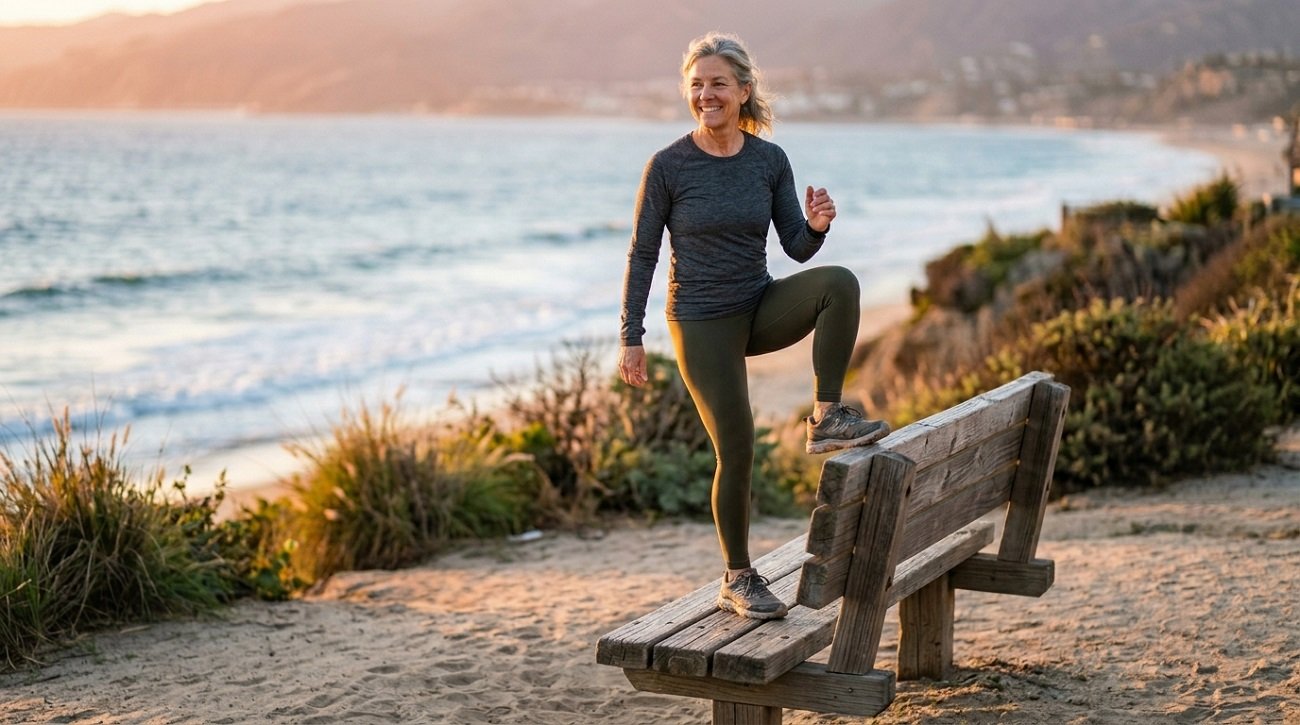
Let me tell you about Maria.
She drove to our training space on Albany Street from her apartment in Koreatown one Thursday morning. Fifty-eight years old. Worked in healthcare administration. And she walked through the door bracing herself — like she was about to hear bad news.
“My right knee hurts when I walk downhill. My left hip aches if I sit more than twenty minutes.” She paused. Then: “I used to love hiking in Griffith Park. Now I can’t even walk to the grocery store without wondering if I’m gonna make it back.”
Another pause. Longer this time.
“My doctor told me to exercise. But every time I try, the pain gets worse. So I stopped. And now I’m stiffer, heavier, and more scared than I was before.”
If you just felt something tighten in your chest reading that — because it sounds a little too familiar — then I need you to read every word of this article. Don’t skim it. Don’t bookmark it for later. Read it now. Because what I’m about to give you is the exact 30-minute outdoor workout plan we use at Focus Camp with adults in Los Angeles who have knee pain, hip pain, or both. And it’s built to make your body feel better — not worse.
I’m François. My partner Tina and I have spent over a decade coaching hundreds of adults right here in LA. People in their 50s, 60s, 70s. People who came to us scared that their best movement years were behind them. They weren’t. And I’m betting yours aren’t either.
Here’s what this guide covers — and I’m warning you now, it’s long, because I’d rather give you too much detail than leave you guessing:
What You’ll Find in This Article
Why Your Knees and Hips Actually Hurt — And Why It’s More Fixable Than You Think
When your knee hurts, what do you think is happening?
Most people say something like “my knee is worn out” or “I’ve got bone-on-bone” or “the cartilage is gone.” And yeah — if you’ve had an X-ray, some of that might be technically true. But it’s not the whole story. And it’s sure as hell not the part that matters most.
Here’s what’s going on. And I want you to really sit with this, because once you get it, every exercise in this plan makes more sense.
Your Joints Aren’t Isolated Parts. They’re Links in a Chain.
Your body is what biomechanists call a kinetic chain. That means your ankle affects your knee. Your knee affects your hip. Your hip affects your lower back. All of it connected. All of it influencing how you move, how you stand, and how much pain you feel.
When your knee hurts, the problem might not actually start at your knee. The cartilage damage might be real — but the reason it’s hurting right now might be that the muscles above and below it aren’t doing their jobs anymore.
The Knee: What’s Really Going On
Your knee is basically a hinge that sits between two much more mobile neighbors — your hip (a ball-and-socket that moves every which way) and your ankle (another hinge with some rotation). The knee itself? It bends. It straightens. It rotates a tiny bit. That’s about it.
For your knee to work without pain, the joints above and below it need to hold up their end of the deal. Your hip needs to keep your thigh bone properly aligned. Your ankle needs enough flexibility that your foot can adapt to whatever you’re walking on.
When your glutes go weak — and they do, slowly, starting in your 30s if you’re not training them — your femur rotates inward when you walk, climb stairs, or stand up. That inward rotation pulls your kneecap off its track, creating uneven pressure on the cartilage underneath. Over months and years, one side of the cartilage wears down faster.
When your ankles stiffen up — from sitting all day, from stiff shoes, from never taking them through their full range — your body compensates. It asks your knee to move in ways it wasn’t built for. Your knee becomes the ankle’s shock absorber. Bad idea.
When your quads get weak — and I mean all four of them, not just the one you can see in the mirror — your kneecap stops tracking properly. There’s a specific muscle, the VMO — that teardrop-shaped one on the inside of your thigh right above your knee — that’s supposed to keep your kneecap centered. When it’s weak, the kneecap drifts outward. Grinds against the side of the groove it’s supposed to glide in. That grinding? That’s the pain you feel walking down stairs or standing up from a low chair.
So yeah — the cartilage thinning on your X-ray is real. But it’s a symptom, not the root cause. The root cause is the muscular weakness and imbalance that’s been loading your knee unevenly for years.
And that’s actually incredible news. Because it means you can do something about it. You can’t regrow cartilage yet — science is working on it. But you absolutely can strengthen the muscles that control how your knee moves. And when those muscles are working right, the cartilage you have left gets loaded evenly and can function well for years. Decades, even.
The Hip: What’s Really Going On
Your hip is the deepest, most stable joint in your body. A ball sitting in a socket, held together by a web of ligaments, tendons, and muscles.
Hip pain in adults usually comes from one of four places:
- Osteoarthritis. The cartilage on the ball and socket thins over time. Most common cause of hip pain in adults over 50. About 1 in 4 people over 55 show hip OA on X-rays — though, importantly, not all of them hurt.
- Gluteal tendinopathy. The tendons attaching your glute muscles to the side of your hip get irritated and start to degenerate. This is the actual diagnosis for most people who’ve been told they have “hip bursitis.” Research shows tendinopathy is way more common than bursitis — and the treatment is different.
- Trochanteric bursitis. Actual inflammation of the bursa on the outside of your hip. Less common than tendinopathy but it does happen.
- Hip flexor strain or tendinitis. Pain in the front of your hip. Super common in people who sit for long stretches.
Same principle: the root cause is almost always muscular. The joint is the victim, not the culprit.
The Finding That Changed How I Think About Joint Pain
A landmark study in Radiology (2015) took MRI scans of 1,083 people who had zero hip pain. The results?
- 73% of people over 50 had visible hip osteoarthritis on their MRI
- 52% of people over 40 had labral tears
- 36% of people in their 20s and 30s already showed cartilage thinning
None of these people were in pain. They had “bad hips” on imaging and had no idea.
Same pattern with knees. A 2020 British Journal of Sports Medicine study: up to 43% of adults over 40 have meniscus tears on MRI with zero knee pain.
What does this mean for you? Your X-ray or MRI results are not your destiny. People with worse imaging than yours are walking around pain-free right now. The difference isn’t their joints — it’s their muscles, their movement, their activity level.
I’m not telling you your pain isn’t real. It is. I’m telling you it’s more changeable than you think. And that might be the most hopeful thing I’ve ever said.
Why Rest Is Making Your Joint Pain Worse
I know. It feels backwards. Something hurts, you want to protect it. Stay off it. Give it time.
That instinct is right for a sprained ankle or a broken bone. But for chronic joint pain — the kind that’s been building for months or years — rest is the worst move you can make.
What Happens to a Joint That Doesn’t Move
Within 24 hours of reduced movement: Synovial fluid production drops. That’s the thick, slippery liquid inside your knee and hip joints — it lubricates the cartilage and feeds it nutrients. No movement? No pumping. Less fluid. Drier, stiffer joints.
Within 1 week: Cartilage starts to soften. It doesn’t have blood vessels — it gets nutrition entirely from synovial fluid soaking into it during movement. No movement means the cartilage literally starves. Muscle strength starts to drop — you can lose 1-3% of muscle strength per day of complete inactivity.
Within 2-4 weeks: Muscle atrophy becomes visible. Connective tissue stiffens. Scar tissue forms. Proprioception drops. Fear of movement grows.
The Vicious Cycle of Rest
| Stage | What Happens | The Result |
|---|---|---|
| 1. Pain | Knee or hip hurts during activity | You avoid the activity — makes sense |
| 2. Rest | You stop or significantly reduce exercise | Pain decreases short-term (feels like the right call) |
| 3. Weakness | Supporting muscles weaken from disuse | Less support for the joint = more load on cartilage |
| 4. Stiffness | Synovial fluid drops, connective tissue tightens | Joint feels worse when you DO move |
| 5. More pain | Movement now hurts MORE than before you rested | Confirms your fear that exercise makes it worse |
| 6. More rest | You rest even more | Muscles weaken further, joint stiffens further |
| 7. Decline | Stairs, walking, standing get harder | Quality of life drops. Fear of movement becomes fear of living. |
What Research Actually Shows
For knee osteoarthritis: A 2019 meta-analysis in the British Journal of Sports Medicine — 52 studies, over 5,000 participants — found exercise therapy produced clinically significant pain reduction comparable to ibuprofen. Without the stomach bleeding, kidney damage, or cardiovascular risk.
For hip osteoarthritis: A 2022 review in Osteoarthritis and Cartilage found exercise produced moderate to large improvements in hip pain and function.
For gluteal tendinopathy: The gold standard treatment is progressive loading — not rest, not cortisone shots. A 2018 BMJ trial found that exercise plus education outperformed corticosteroid injections at both 8 weeks and 52 weeks.
The science is clear. Exercise isn’t optional for joint pain — it’s the primary treatment. The question isn’t whether to exercise. It’s how to exercise without making things worse.
Why Outdoor Workouts Beat the Gym for Joint Pain
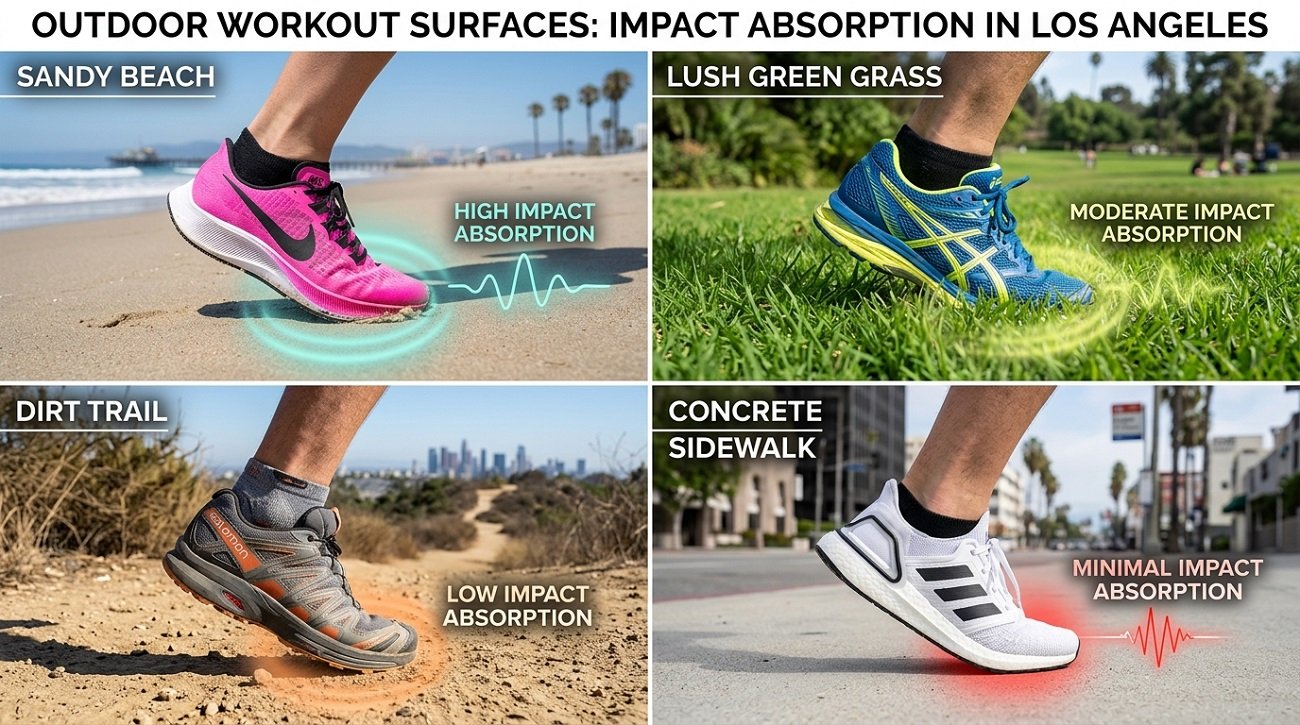
Surface Impact: The Numbers That Matter
| Surface | Impact Absorption | Force Reduction vs. Concrete | Joint Impact | Best Use in This Workout |
|---|---|---|---|---|
| Wet sand (waterline) | Excellent | 40-55% | ★☆☆☆☆ Very Low | Full workout — all exercises |
| Dry loose sand | Excellent but unstable | 50-65% | ★★☆☆☆ Low | Walking warm-up, balance work |
| Well-maintained grass | Very Good | 25-40% | ★☆☆☆☆ Very Low | Full workout — ideal for bridges, clamshells |
| Packed dirt trail | Good | 15-25% | ★★☆☆☆ Low | Walking, supported squats, balance |
| Rubberized track | Moderate | 10-15% | ★★★☆☆ Moderate | Walking warm-up only |
| Treadmill | Moderate | 5-12% | ★★★☆☆ Moderate | Better than pavement, worse than nature |
| Asphalt | Poor | 0-5% | ★★★★☆ High | Avoid |
| Concrete | None | 0% | ★★★★★ Very High | Avoid entirely |
Natural Terrain Trains Things That Gyms Can’t
Flat, even surfaces are unnatural. Your body evolved to walk on uneven ground — dirt, grass, sand. Every step was slightly different, requiring constant micro-adjustments from your ankles, knees, hips, and core.
Treadmill or gym floor? Every step identical. Your body goes on autopilot. The stabilizing muscles that protect your joints get lazy because they’re never challenged.
This is proprioceptive training, and it’s one of the most effective — and most neglected — parts of joint rehab. Our balance and fall prevention exercises for Los Angeles adults go deep on this.
Vitamin D: The Joint Vitamin You’re Probably Missing
Up to 70% of adults with chronic joint pain have insufficient vitamin D. LA gives us roughly 284 sunny days a year. Thirty minutes of outdoor training with your arms and face exposed can produce 2,000-5,000 IU of vitamin D per session. Timing matters — see our guide to the best times for outdoor fitness in LA.
The Psychology: Why Outdoors Breaks the Fear Loop
If you’ve had joint pain for a while, you’ve developed what psychologists call fear-avoidance behavior. Walking into a gym in that state? Brutal. Outdoors? No audience. No mirrors. No machines you can’t figure out. Just you and the ground.
The 7 Rules You Cannot Break
Rule 1: Learn the Difference Between Muscle Effort and Joint Pain
Muscle effort feels like burning in the belly of the muscle, fatigue, or soreness the next day in the muscle belly. Joint pain feels like sharp, stabbing, or pinching IN the joint, grinding with pain, or pain that makes you change your form. Muscle effort → keep going. Joint pain → stop and switch to a modification.
Rule 2: Warm Up. Every Time. No Exceptions.
Increases synovial fluid in your joints. Raises core temperature. Activates proprioception. Skipping the warm-up to save time is like skipping the pre-flight checklist to save time. Works fine until it doesn’t.
Rule 3: Soft Surfaces Only
If you have knee or hip pain, do not do this workout on concrete or asphalt. Find grass, sand, or a dirt trail.
Rule 4: Range of Motion Is Earned, Not Taken
Half the range with perfect form and zero pain is worth ten times what full range with bad form and joint pain is worth.
Rule 5: Strengthen the Muscles That Protect the Joint
Your quads, hamstrings, glutes, hip abductors, and core stabilizers are the shock absorbers and alignment system for your joints. This is the same principle behind our functional fitness training for everyday life.
Rule 6: Consistency Beats Intensity. Always.
| Approach | Typical Result | Long-Term Outcome |
|---|---|---|
| 3×/week, 30 min, moderate | Gradual pain reduction, steady strength | Sustained improvement over months and years |
| 1×/week, 60 min, hard | Short-term soreness, possible flare-up | Inconsistent progress, high injury risk, low adherence |
| 6×/week, 15 min, easy | Slow but steady improvement | Good maintenance, may need more for strength |
| Random, inconsistent | No improvement, frustration | “Exercise doesn’t work for me” → declining function |
Rule 7: Hydrate Like Your Joints Depend on It — Because They Do
Cartilage is roughly 65-80% water. For joint pain, I recommend 16-20 oz before, 4-8 oz every 15 minutes during, and 16-24 oz after. Full nutrition approach: nutrition strategies for outdoor fitness in Los Angeles.
Exercises You Must Avoid With Knee or Hip Pain
| Exercise | Why It’s Bad for Knees | Why It’s Bad for Hips | Do This Instead |
|---|---|---|---|
| Deep squats (below parallel) | Extreme compressive force on kneecap | Max hip flexion under load | Supported squats to chair height |
| Lunges (any kind) | High shear force; eccentric load on patellar tendon | Front hip in deep flexion; rear hip extreme extension | Glute bridges, step-ups to a low step |
| Jumping / plyometrics | 3-5× body weight on landing | Same impact through hip; labral tear risk | Zero-impact cardio: walking on sand, aqua fitness |
| Running on hard surfaces | 2-3× body weight per step, cumulative damage | Same forces through hip; IT band stress | Walking on soft surfaces; aqua jogging |
| Leg extension machine | Massive kneecap compression | N/A | Supported squats, glute bridges |
| Pigeon pose (deep) | N/A | Extreme external rotation + flexion = labral impingement | Seated figure-4 stretch (gentle) |
The Complete 30-Minute Outdoor Workout Plan
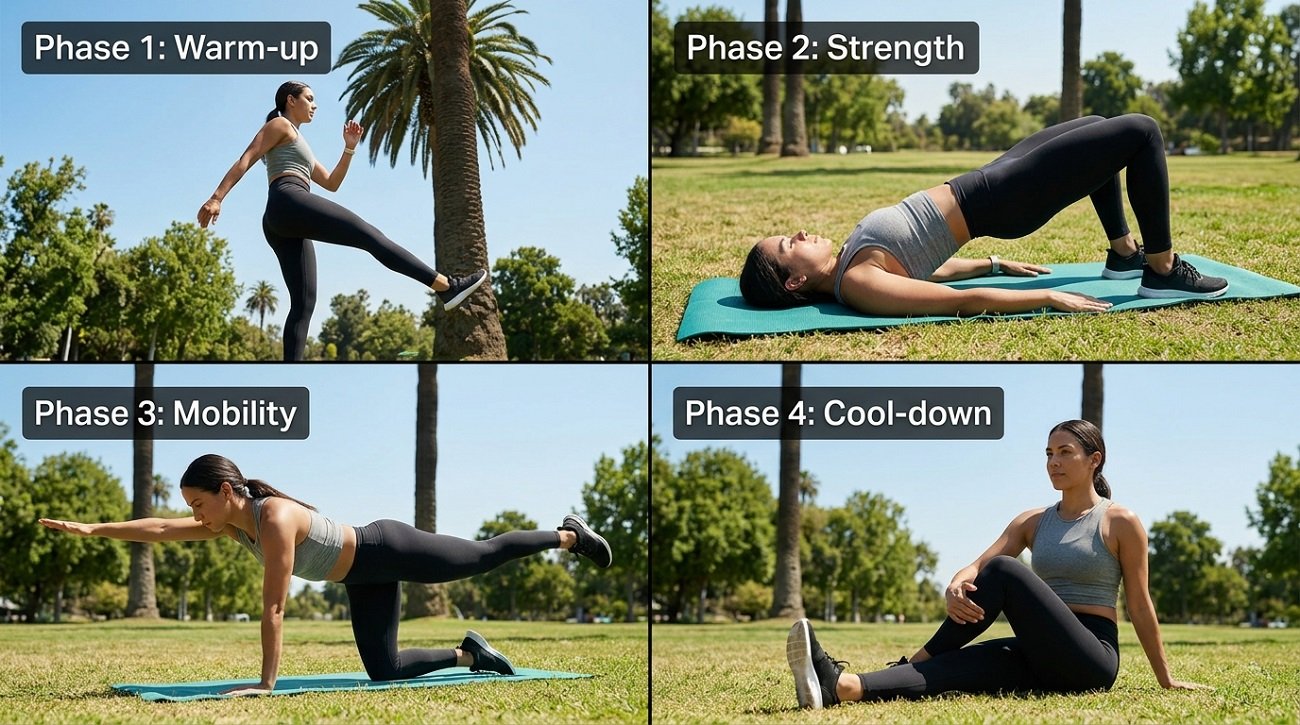
Phase Overview
| Phase | Duration | What It Does for Your Joints | Impact Level |
|---|---|---|---|
| Warm-Up | 5 min | Pumps synovial fluid; raises cartilage temperature | Zero to Very Low |
| Strength Circuit (2 rounds) | 16 min | Stronger quads, glutes, core = better joint alignment | Low |
| Balance & Stability | 4 min | Better proprioception = fewer awkward movements | Very Low |
| Cool-Down | 5 min | Maintains range of motion; reduces muscle guarding | Zero |
The Full Workout
| # | Exercise | Time / Reps | Primary Muscles | Knee Pain Modification | Hip Pain Modification |
|---|---|---|---|---|---|
| 1 | Gentle Walking Warm-Up | 3 min | Full body | Flat surface, short strides, no hills | Short strides, flat surface |
| 2 | Arm Circles + Shoulder Rolls | 2 min | Shoulders, upper back | None needed | None needed |
| 3 | Standing Hip Openers | 45 sec/leg | Hip flexors, rotators, glutes | Hold support firmly; reduce range | Small, slow circles only |
| 4 | Wall/Bench Push-Ups | 10-12 reps | Chest, shoulders, arms, core | None needed | None needed |
| 5 | Supported Squats | 8-10 reps | Quads, glutes, hamstrings, core | Shallow range; tall chair behind you | Narrow stance; stop at 90° flexion |
| 6 | Glute Bridges | 10-12 reps | Glutes, hamstrings, lower back | None needed (supine spares knees) | Reduce height; don’t force extension |
| 7 | Side-Lying Clamshells | 10/side | Gluteus medius, hip abductors | None needed | Reduce range; slow tempo |
| 8 | Standing Calf Raises | 10-12 reps | Calves, ankle stability | Hold support; reduce range | None needed |
| 9 | Single-Leg Balance (Supported) | 30 sec/leg | Ankle/hip stabilizers, core | Hold support; standing leg slightly bent | Standing leg slightly bent |
| 10 | Tandem Walk (Heel-to-Toe) | 20 steps | Balance, coordination, core | Walk beside a wall | Walk beside a wall |
| 11 | Seated Forward Fold | 60 sec | Hamstrings, lower back, hips | Sit on a chair if floor is too low | Legs wider; gentle range |
| 12 | Standing Hip Flexor Stretch | 30 sec/side | Hip flexors, quads | None needed | Shallow lunge; use support |
| 13 | Deep Breathing + Body Scan | 2 min | Nervous system regulation | None needed | None needed |
Deep-Dive Coaching: Every Exercise Explained Like I’m Standing Next to You
Exercise 1: Gentle Walking Warm-Up — 3 Minutes
Where: Flat area on soft ground. Grass is perfect. Packed sand near the waterline is great.
How: Start at a stroll. Not a power walk. Let your arms swing naturally. Focus on rolling through your foot — heel strikes first, then roll through the arch, then push off through the ball of your foot and toes.
Knee pain fix: If even flat walking bothers your knees, try walking in a pool. Our aqua fitness vs gym vs Focus Camp comparison explains why. No pool? Reduce walking to 2 minutes and add 1 minute of seated marching.
Hip pain fix: Shorter strides. Long strides force your hip into extreme extension on the back leg, which irritates arthritic hips.
The #1 mistake: Walking too fast. If you’re breathing hard, slow down.
Exercise 2: Arm Circles + Shoulder Rolls — 2 Minutes
How: Arm circles: Extend both arms out to your sides at shoulder height. Make slow, controlled circles — basketball-sized. 10 forward, 10 backward. Shoulder rolls: Lift shoulders toward ears, roll backward and down. 5 rolls backward, 5 forward.
Why this matters for knee and hip pain: Your upper body posture directly affects your lower body mechanics. Our outdoor posture correction guide goes deep on this connection.
Exercise 5: Supported Squats — 8-10 Reps (The Most Important Exercise)
Setup: Stand in front of a bench, chair, or park table. The seat should be at about knee height or slightly higher.
How: Back to the bench, feet shoulder-width apart. Arms straight out in front. Push your hips back and down — like there’s a chair behind you. Lower slowly (3 seconds). When glutes lightly touch the bench, don’t sit down. Push through your heels to stand. Squeeze glutes at the top.
The coaching points that matter most: Weight in your heels (you should be able to wiggle your toes). Knees track over your second toe. Only go as deep as pain-free allows. Chest up.
Knee Pain Progression — From Easiest to Hardest:
| Level | Setup | Depth | Who It’s For |
|---|---|---|---|
| 1 | Kitchen counter behind you (waist height) | 2-3 inches of hip bend | Severe knee pain; post-surgery; significant fear |
| 2 | Tall chair/stool | 4-6 inches (quarter squat) | Moderate knee pain; just starting |
| 3 | Standard chair | To chair height (half squat) | Mild knee pain; some exercise experience |
| 4 | Low bench | Below chair height | Minimal knee pain; ready for progression |
| 5 | No bench — bodyweight squat | As deep as pain-free allows | No knee pain during movement; advanced |
Hip pain fix: Narrow your stance. If even narrow-stance squats bother your hip, switch to sit-to-stands. This is exactly how we start people in our over 50 and out of shape program.
Exercise 6: Glute Bridges — 10-12 Reps
If I could give you only one exercise for joint pain, this would be it.
How: Lie on your back. Bend knees, feet flat, hip-width apart. Before you lift: squeeze your glutes together. Push through your heels, lift hips until your body forms a straight line from knees to shoulders. Hold 2 seconds at the top. Lower slowly (3 seconds).
The mistakes I correct most: Arching the lower back (fix: tuck tailbone). Pushing through toes (fix: move feet closer). No squeeze at the top (fix: actively clench glutes for 2 full seconds).
This exercise is a staple in our best soft workouts for older people with outdoor private coaching.
Exercise 7: Side-Lying Clamshells — 10 Per Side
Targets your gluteus medius — keeps your pelvis level when you’re standing on one leg (which you do every single step).
How: Lie on your side. Bend both knees to about 45 degrees. Stack feet and hips. Keeping feet together, slowly open your top knee like a clamshell. Only the knee moves. Hold 2 seconds at the top. Slowly close (3 seconds down).
The big mistake: Letting your hips roll backward. Keep your hips stacked, even if your knee only opens a couple inches.
Exercise 9: Single-Leg Balance (Supported) — 30 Seconds Per Leg
Every step you take, you briefly stand on one leg. If single-leg balance is poor, each step is a small stumble your joints absorb. This is a core component of our balance and fall prevention routine for LA adults.
Progression: Week 1: Full hand grip on support. Week 2: Fingertip touch. Week 3: Hand hovering 1 inch above. Week 4: No support.
Diagnosis-Specific Modifications
| Diagnosis | Squats | Glute Bridges | Clamshells | Walking | Key Precautions |
|---|---|---|---|---|---|
| Knee OA (medial) | Shallow only; weight in heels | Standard | Standard | Flat, soft; avoid hills | Avoid deep flexion; avoid rotational loading |
| Knee OA (patellofemoral) | Very shallow (1/4 depth) | Standard | Standard | Avoid downhill; avoid stairs | Avoid loaded flexion past 90° |
| Hip OA | Narrow stance; stop at 80° | Reduce height if pinching | Small range if pain | Short strides; flat surface | Avoid extreme flexion, adduction, rotation |
| Gluteal tendinopathy | Standard if pain-free | Standard | May irritate — reduce reps | Standard | Don’t stretch the tender area aggressively |
| Hip labral tear | Very shallow; narrow stance | Reduce height | Small range; stop if clicking | Short strides; avoid pivoting | Avoid deep flexion + rotation |
| Post-knee replacement (3+ mo) | As directed by PT | Standard | Standard | As tolerated | Avoid high-impact for life |
| Post-hip replacement (3+ mo) | Precautions per approach | Standard | Standard | Standard | Follow hip precautions (posterior: no deep flexion past 90°) |
The 4-Week Progression Plan — Day by Day
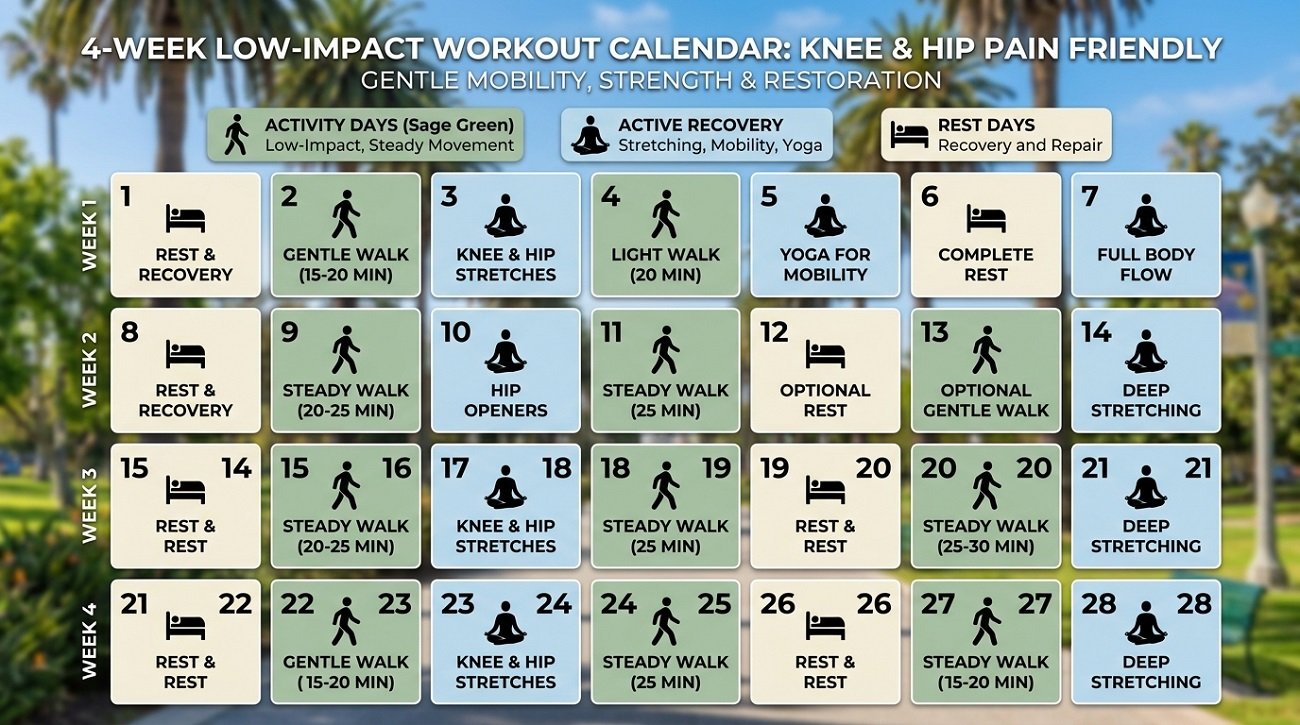
Week 1: Just Show Up
| Day | Activity | Duration | Notes |
|---|---|---|---|
| Monday | Full workout (all modifications) | 30 min | Level 1-2 squats; full hand support for balance |
| Tuesday | Rest or gentle walk on soft ground | 15-20 min | Not a workout — just pleasant movement |
| Wednesday | Full workout (all modifications) | 30 min | Same as Monday; don’t increase anything yet |
| Thursday | Rest | — | Stretch gently if stiff |
| Friday | Full workout (all modifications) | 30 min | Same as Monday and Wednesday |
| Saturday | Gentle walk in a park | 20-30 min | Enjoy being outside. Not exercise. Life. |
| Sunday | Rest | — | Your body is adapting. Let it. |
Week 2: Add a Session; Slightly Increase Range
| Day | Activity | Duration | Notes |
|---|---|---|---|
| Monday | Full workout | 30 min | Try Level 2-3 squats if pain-free |
| Tuesday | Rest or gentle walk | 15-20 min | Notice if walking feels easier than last week |
| Wednesday | Full workout | 30 min | Increase walking warm-up to 4 min if joints feel good |
| Thursday | Rest | — | Pay attention to morning stiffness |
| Friday | Full workout | 30 min | Try holding glute bridge top for 3 seconds instead of 2 |
| Saturday | Full workout (shorter version) | 20 min | Warm-up + 1 round of strength + cool-down only |
| Sunday | Rest | — | Your 4th session is in the books |
Week 3: Increase Depth, Optional 3rd Round
If joints don’t feel noticeably better, DON’T increase. Stay at Week 2 levels another week.
| Day | Activity | Duration | Notes |
|---|---|---|---|
| Monday | Full workout + optional 3rd round | 30-38 min | Try Level 3 squats; fingertip balance support |
| Tuesday | Rest or walk | 20 min | Try a slightly uneven surface if balance has improved |
| Wednesday | Full workout + optional 3rd round | 30-38 min | Add 2 reps to each exercise if pain-free |
| Thursday | Rest | — | Notice if sitting-to-standing feels easier |
| Friday | Full workout + optional 3rd round | 30-38 min | Try 10 seconds unsupported single-leg balance |
| Saturday | Recreational walk | 30-40 min | Somewhere beautiful. This is your reward. |
| Sunday | Rest | — | Think about how far you’ve come in 3 weeks |
Week 4: Moving With Confidence
| Day | Activity | Duration | Notes |
|---|---|---|---|
| Monday | Full workout (3 rounds) | 38 min | Full-depth squats if pain-free; minimal balance support |
| Tuesday | 30-minute walk on mixed terrain | 30 min | Gentle hills if knees and hips tolerate them |
| Wednesday | Full workout (3 rounds) | 38 min | Form quality focus — slow eccentrics, full glute squeezes |
| Thursday | Rest or yoga/stretching | 15-20 min | Check our yoga sessions for guided mobility |
| Friday | Full workout (3 rounds) | 38 min | Should feel strong — you’ve earned it |
| Saturday | Recreational activity | 30-45 min | Hike, swim, garden — move for joy |
| Sunday | Rest | — | Plan Week 5 — consider our walking workout guide |
The Flare-Up Protocol: What to Do on Bad Days
Flare-Up or New Injury?
| Sign | Flare-Up (Keep Moving, Modify) | New Injury (Stop, See Doctor) |
|---|---|---|
| Onset | Gradual increase in familiar pain | Sudden sharp pain during a specific movement |
| Swelling | Mild; familiar pattern | Significant; new or different |
| Joint appearance | Same as always; maybe slightly puffier | Red, hot, or visibly deformed |
| Weight-bearing | Uncomfortable but possible | Impossible or severe pain |
| Duration | Improves with gentle movement and time | Persists or worsens despite rest |
The Flare-Up Day Protocol: Warm-up (5 min gentle walking). Skip the strength circuit. Do 5 minutes of lying-down exercises only (glute bridges, knee-to-chest). Full cool-down (5 min). Total: 15-20 minutes. No improvement in 72 hours? Call your doctor. For days when standing is truly not possible, our chair training program provides a complete seated workout.
Best Los Angeles Locations: The Complete Practical Guide
| Location | Surface | Parking | Best Exercises | Avoid | Best Time |
|---|---|---|---|---|---|
| Venice Beach (hard sand) | Packed damp sand | $8-15 at beach lot; free on side streets | Full workout | Deep dry sand squats | 6:30-8:30 AM |
| Manhattan Beach | Packed sand | $2/hr at pier lot; free on residential streets | Full workout | Deep dry sand | 6:00-8:00 AM |
| Palisades Park, Santa Monica | Grass + concrete path | Free 2-hr on Ocean Ave; $5-10 in lots | Bridges, clamshells, balance on grass | Concrete path for warm-up | 7:00-9:00 AM |
| Exposition Park | Flat grass + paths | Free on weekends; metered weekdays | Full workout on grass | Concrete sections | Weekends 7-9 AM |
| Griffith Park (carousel) | Flat grass + dirt | Free in carousel lot | Walking warm-up on dirt. Grass exercises. | Trails with elevation | 6:30-8:30 AM |
| Centinela Park, Inglewood | Grass + dirt track | Free in park lot | Full workout on grass | Concrete courts | Morning |
What Shoes to Wear: It Matters More Than You Think
| Shoe | Price | Best For | Why |
|---|---|---|---|
| Hoka Bondi 8 | ~$165 | Maximum cushioning for severe knee pain | Most cushioned shoe on the market. #1 I recommend. |
| Brooks Ghost 16 | ~$140 | Good cushioning with moderate stability | Balanced. Good if Hoka feels too “squishy.” |
| New Balance Fresh Foam 1080 | ~$165 | Maximum cushioning, wider fit | Excellent for wider feet. |
| Altra Lone Peak | ~$150 | Zero drop, wide toe box, trail | Best for dirt trail workouts. Zero drop = natural foot position. |
Replace shoes every 300-500 miles or 6-8 months.
Nutrition for Joint Recovery
Anti-Inflammatory Foods That Actually Work
| Food | Active Compound | Effect on Joints | How Much |
|---|---|---|---|
| Fatty fish | Omega-3s (EPA/DHA) | Reduces inflammatory markers; slows cartilage degradation | 2-3 servings/week, or 1000-2000mg fish oil daily |
| Tart cherry juice | Anthocyanins | Reduces inflammatory markers; improves sleep | 8oz daily |
| Turmeric (with black pepper) | Curcumin | Potent anti-inflammatory; comparable to ibuprofen in some OA studies | 500-1000mg curcumin daily |
| Extra virgin olive oil | Oleocanthal | Mimics ibuprofen’s anti-inflammatory mechanism | 2-4 tablespoons daily |
| Leafy greens | Vitamin K, antioxidants | Supports bone health; reduces oxidative stress | Daily — 1 cup cooked or 2 cups raw |
| Berries | Anthocyanins, vitamin C | Reduces inflammation; vitamin C essential for collagen synthesis | 1 cup daily |
Full nutrition approach: nutrition strategies for outdoor fitness in Los Angeles.
How to Track Your Progress
| Benchmark | How to Test | Typical Week 1 | Typical Week 4 | Typical Week 8 |
|---|---|---|---|---|
| Chair Stand Test | Sit in standard chair, arms crossed. Stand-sit as many times as possible in 30 seconds. | 6-8 stands | 10-12 stands | 14+ stands |
| Single-Leg Balance | Stand on one leg, no support, eyes open. Time until foot goes down. | 5-10 seconds | 20-30 seconds | 45+ seconds |
| Timed Walk | Walk 400m at comfortable pace. | Not timed (just completed) | 6-7 minutes | 5-6 minutes |
| Morning Pain Scale | Rate morning joint pain 0-10 when you get out of bed. | 5-7 | 3-5 | 1-3 |
| Stair Comfort | Rate climbing one flight 1-5 (1=can’t, 5=no problem) | 2-3 | 3-4 | 4-5 |
The Psychological Wall: Why Most People Quit at Week 3
Almost everyone hits a wall around Week 2-3. This is completely normal. It doesn’t mean you’re lazy or that this doesn’t work. It means you’re a human being building a new habit.
| Strategy | Why It Works | How to Do It |
|---|---|---|
| The 5-Minute Rule | Starting is the hardest part. Once you start, you usually finish. | Tell yourself you’ll just do the warm-up. If you want to stop after 5 min, you can. |
| Never Miss Twice | One missed session is a slip. Two is a new (bad) habit. | Miss a day? Next day is non-negotiable. |
| Link to an Existing Habit | Habit stacking beats willpower. | Always exercise after morning coffee. The cue triggers the behavior. |
| Tell Someone | External accountability is powerful. | Tell a friend your plan. Ask them to check in weekly. |
| Focus on How You’ll Feel After | Anticipated reward motivates more than delayed. | “In 30 minutes I’ll feel looser, less stiff, and better about myself.” |
When to See a Doctor: Red Flags
Stop exercising and see a doctor if you notice:
- Sudden, severe joint pain not triggered by a specific movement
- Inability to bear weight on the affected leg
- Joint that’s hot, red, and swollen
- Joint locking (gets stuck and won’t move)
- Joint giving way (leg suddenly buckles)
- Numbness, tingling, or loss of sensation in leg or foot
- Pain that wakes you from sleep
- Recent trauma (fall, accident) — get imaging first
- Fever accompanying joint pain
- Pain that’s progressively worsening despite modification
How Focus Camp Makes This Real
You can do this plan on your own. I believe that. But here’s what I also know after a decade of coaching: Most people who try to exercise alone with joint pain don’t succeed. Not because they can’t. Because the margin for error is thin and the obstacles are real.
84% of our members report noticeable improvements in strength, energy, and mood within the first month. Not magic. Just the right exercises, delivered by coaches who pay attention, in an environment that makes you feel safe.
Our Training Options
| Program | Format | Frequency | Best For |
|---|---|---|---|
| Private Coaching | 1-on-1 with François or Tina | 2-3x/week | Significant joint pain needing close supervision |
| Focus Camp Program | Small group (max 8), 20+ classes/month | 4-5x/week | Variety, community, expert coaching at manageable cost |
| Aqua Fitness | Small group pool sessions | 2-3x/week | Severe joint pain; post-surgery rehab |
| Yoga & Mobility | Small group outdoor sessions | 1-2x/week | Flexibility, breathing, stress reduction alongside strength |
Specialized Programs
- Women navigating menopause — hormone-balancing outdoor fitness for women
- Women concerned about bone density — bone density workouts for women over 50 in LA
- Completely deconditioned adults — how to start exercising at 50, 60, or 70 in Los Angeles and our over 50 and out of shape program
Ready to Move Better?
Book a no-pressure conversation with me or Tina. We’ll talk about your specific pain, your goals, your fears, and whether Focus Camp is the right fit. No hard sell. No obligation.
📞 Call: (323) 595-3766 | ✉️ Email: info@focuscamp1.com | 📍 Visit: 1119 Albany Street, Los Angeles, CA
Frequently Asked Questions
Can I exercise with osteoarthritis? Won’t it wear out my joints?
No. Exercise doesn’t wear out arthritic joints. The “wear and tear” model is outdated. Current science views OA as a whole-joint disease — and exercise positively affects all the tissues involved. Every major medical guideline lists exercise as a first-line treatment.
How long before I notice improvement?
Morning stiffness often eases within the first week. Noticeable pain reduction during daily activities: 2-4 weeks. Meaningful functional improvement: 4-8 weeks. Assuming consistent exercise 3-5 times per week.
What if exercise makes my pain worse during the session?
Stop that specific exercise. Switch to a modification. If the modification also causes joint pain, skip that exercise for the day. One painful exercise doesn’t mean the whole workout is wrong.
Should I take pain medication before exercising?
Ask your doctor. A 2021 Journal of Pain study found pre-exercise acetaminophen improved tolerance in knee OA patients without masking harmful pain. Never take strong pain medication that masks pain perception before exercising.
Is walking enough, or do I need the strength exercises too?
Walking is great for joint lubrication, but not sufficient on its own. You need targeted strength training for the muscles that support your joints. Walking + strength = best results.
Can I do this workout every day?
Not at first. Start with 3 days/week. Build to 4-5 over 4 weeks. Muscles need recovery between strength sessions.
I’ve been told I need a joint replacement. Is it too late for exercise?
No. Pre-operative exercise (“prehabilitation”) significantly improves surgical outcomes. Even if you need surgery, being stronger going in means recovering faster.
What about aqua fitness?
Outstanding for joint pain. Water supports up to 90% of body weight. Gold standard for severe joint pain. Full comparison: aqua fitness vs gym vs Focus Camp.
Is it normal to be sore the next day?
Muscle soreness (in the muscle belly) is normal — especially weeks 1-2. Joint pain that’s worse the next day is NOT normal — reduce volume or depth.
What’s the best time of day?
Most adults with joint pain do best mid-morning (9-11 AM). Full breakdown: best times for outdoor fitness in LA.
Can my knee pain be coming from my hip?
Yes. Referred pain from the hip is commonly felt at the knee — especially the inner side. This is why the exercises in this plan target both joints.
I’m scared. What if I make it worse?
You’re already in pain. The thing you’re afraid of? It’s already happening. The question is whether you’ll do something that has a strong chance of making it better, or continue doing nothing and watch it gradually get worse. This plan is built with your fear in mind. You don’t have to be brave. You just have to show up.
Your Next Step
The 30-minute plan above is yours. Start this week. Find a park or beach near your home. Take it slow. Use every modification. Respect the progression. Give it at least 4 consistent weeks.
And when you’re ready — tomorrow, next month, or after you’ve tried it on your own — we’re here.
Your knees and hips have been telling you something for a long time. That’s not just physical pain. That’s your life shrinking. And you deserve better. Let’s get you moving again.
One Response