By François & Tina — Focus Camp, Los Angeles
Hey friend,
Let me ask you something honest: when was the last time you moved your body outside and actually enjoyed it?
Not out of guilt. Not because a doctor told you to. But because it felt good — because your body thanked you, because the fresh air and the sunlight lifted your mood, and because you finished feeling stronger and more capable than when you started.
If that feels like a distant memory, you’re not alone. I’ve worked with hundreds of older adults right here in Los Angeles — men and women in their 60s, 70s, even 80s — who came to us feeling stiff, tired, and honestly a little afraid. Afraid of injury. Afraid of looking silly in a gym full of 25-year-olds. Afraid that their body had just… given up.
Here’s what I always tell them: your body has not given up. It just needs a smarter approach.
At Focus Camp, Tina and I have designed our entire program around one truth that modern sports science confirms over and over again: gentle, consistent, low-impact movement — especially done outdoors with professional guidance — is one of the most powerful things an older adult can do for their health, longevity, quality of life, and happiness.
This article is everything I’d tell a new client on day one. It’s long because I respect your time too much to give you vague advice. I’m going to walk you through the exact soft exercises we use, how to do each one properly, the safest schedule, warm-up and cool-down protocols, how to avoid the most common mistakes, and — most importantly — why having an expert outdoor private coach changes the entire equation.
By the end, you’ll have a complete, practical, beginner-friendly fitness plan you can start this week. And if you decide you’d like a real human to guide you through it in person, outdoors, here in Los Angeles — well, that’s exactly why Focus Camp exists.
Let’s get into it.
1. Why “Soft Workouts” Are Actually the Smartest Workouts for Older Adults
First, let me clear something up: “soft” or “gentle” does not mean “easy” and it absolutely does not mean “ineffective.”
Soft workouts — also called low-impact, joint-friendly, or gentle-intensity exercises — are movements that:
- Keep at least one foot on the ground at all times (reducing landing impact on joints)
- Minimize high-force compression on the knees, hips, spine, and ankles
- Prioritize controlled, smooth movement patterns over explosive or ballistic actions
- Allow the cardiovascular and muscular systems to be challenged without traumatizing connective tissue
For older adults, soft workouts are not a consolation prize. They are the optimal strategy. Here’s why:
After the age of 50, and especially after 60, several physiological changes make high-impact exercise — running, jumping, heavy powerlifting with poor form — increasingly risky and often counterproductive. Cartilage in the knees and hips thins. Tendons and ligaments lose some elasticity. Bone density decreases. Recovery from micro-trauma (which intense exercise creates) takes significantly longer. The hormonal environment that speeds repair in younger athletes is less active.
Meanwhile, the research on low-impact exercise for older adults is overwhelmingly positive. Studies published in journals like the Journal of Aging and Physical Activity, British Journal of Sports Medicine, and The Lancet consistently show that regular, moderate-intensity, low-impact movement produces:
- Significant improvements in muscle mass and strength (yes, even in your 70s)
- Better bone density (especially weight-bearing gentle exercises)
- Dramatically reduced fall risk
- Improved cardiovascular health comparable to moderate-intensity cardio
- Reduced joint inflammation and arthritis symptoms
- Enhanced cognitive function and reduced dementia risk
- Better sleep quality
- Reduced anxiety, depression, and loneliness
- Longer overall lifespan
The outdoor component adds another dimension entirely. Research from Stanford University and the University of Michigan confirms that exercising in natural environments — parks, beaches, tree-lined trails — reduces cortisol (stress hormone) levels more effectively than indoor exercise, improves mood more reliably, and increases exercise adherence. People who train outdoors simply keep going longer than people who exercise in gyms.
And private coaching? That’s the multiplier. I’ll explain that in depth later, but for now: one-on-one expert attention ensures that every movement you make is correct, safe, and optimally effective for your specific body, your specific history, your specific goals.
When you combine soft/low-impact exercise + outdoors + expert private coaching, you have the most powerful fitness formula available to any older adult anywhere. That is exactly what we do at Focus Camp’s Private Coaching program.
2. What Happens to the Body After 60 — and What Exercise Actually Fixes
Before we look at the exercises, I want to give you a quick, honest picture of what’s happening in your body — because understanding it will make you far more committed to moving consistently. This isn’t meant to alarm you. It’s meant to empower you.
Muscle Mass Loss (Sarcopenia)
After 30, we lose about 3–5% of muscle mass per decade. After 60, this accelerates. Untreated, sarcopenia leads to weakness, fatigue, difficulty carrying groceries, problems climbing stairs, and significantly increased fall risk. The fix: Gentle resistance training — even bodyweight — is one of the most effective interventions known to science. You can rebuild and maintain muscle mass at any age.
Bone Density Decline (Osteopenia / Osteoporosis)
Bones thin with age, especially in women post-menopause. This makes fractures more dangerous and slower to heal. The fix: Weight-bearing exercises (walking, gentle squats, standing balance work) mechanically stimulate bone remodeling and genuinely improve bone density.
Joint Cartilage Changes
Cartilage wears down gradually, contributing to stiffness and osteoarthritis. The fix: Low-impact movement actually nourishes cartilage by pumping synovial fluid through the joint. Movement is medicine. Sitting still makes arthritis worse.
Balance and Coordination Decline
The vestibular system, proprioceptors, and neural pathways involved in balance become less efficient with age, dramatically increasing fall risk (falls are a leading cause of death in people over 65). The fix: Specific balance and stability exercises — like the ones in this article — are remarkably effective at restoring and maintaining balance.
Cardiovascular Deconditioning
Heart efficiency and lung capacity decline without regular aerobic stimulus. The fix: Even light walking and gentle cardio movements improve VO2 max, reduce resting heart rate, and protect against heart disease.
Flexibility and Mobility Loss
Tendons and fascia stiffen. Range of motion decreases. The fix: Consistent, gentle stretching and mobility work — especially yoga-based movements — restores functional flexibility and reduces everyday pain.
The bottom line: every single age-related physical decline listed above responds positively to regular, appropriate exercise. This is not theory. This is one of the most well-supported findings in all of medicine. Exercise is the single most effective anti-aging intervention available — more powerful than any supplement, any medication, any procedure.
You just need to do it correctly. That’s what this guide is here for.
3. The Complete List of Best Soft/Low-Impact Exercises for Older Adults
Here is our master list — ranked not by difficulty but by versatility and how well they pair with outdoor private coaching in a place like Los Angeles.
| # | Exercise / Activity | Impact Level | Primary Benefits | Ideal Environment | Best for Beginners? |
|---|---|---|---|---|---|
| 1 | Brisk Walking | Very Low | Cardio, mood, joints, bone density | Outdoors — beach, park, trail | ✅ Excellent |
| 2 | Seated Chair Exercises | Zero | Flexibility, upper body, core | Anywhere | ✅ Perfect start |
| 3 | Standing Balance Exercises | Very Low | Fall prevention, coordination, core | Outdoors (grass, trail) | ✅ Yes |
| 4 | Gentle Bodyweight Squats | Low | Leg strength, glutes, daily function | Anywhere | ✅ With modification |
| 5 | Wall Push-Ups | Zero impact | Upper body, chest, arms, posture | Any wall | ✅ Yes |
| 6 | Resistance Band Training | Low | Full body strength, posture, muscle | Outdoors, any open space | ✅ With guidance |
| 7 | Tai Chi / Slow Flow | Very Low | Balance, coordination, mental calm | Outdoors, park | ✅ Excellent |
| 8 | Gentle Yoga / Chair Yoga | Zero–Low | Flexibility, breathing, stress relief | Outdoors on mat | ✅ With guidance |
| 9 | Aqua / Water Exercises | Near Zero | Joints, full body strength, confidence | Pool | ✅ Excellent |
| 10 | Seated or Standing Stretching | Zero | Flexibility, tension release, posture | Anywhere | ✅ Yes |
| 11 | Glute Bridges | Zero impact | Lower back protection, hip strength | Mat on ground outdoors | ✅ Yes |
| 12 | Calf Raises (standing) | Very Low | Ankle strength, circulation, balance | Standing at park bench | ✅ Yes |
| 13 | Marching in Place | Low | Cardio warmup, hip flexors, coordination | Anywhere | ✅ Yes |
| 14 | Shoulder Rolls & Neck Circles | Zero | Posture, tension release, mobility | Anywhere | ✅ Yes |
| 15 | Deep Breathing & Breathwork | Zero | Nervous system, stress, energy, focus | Outdoors for maximum benefit | ✅ Excellent |
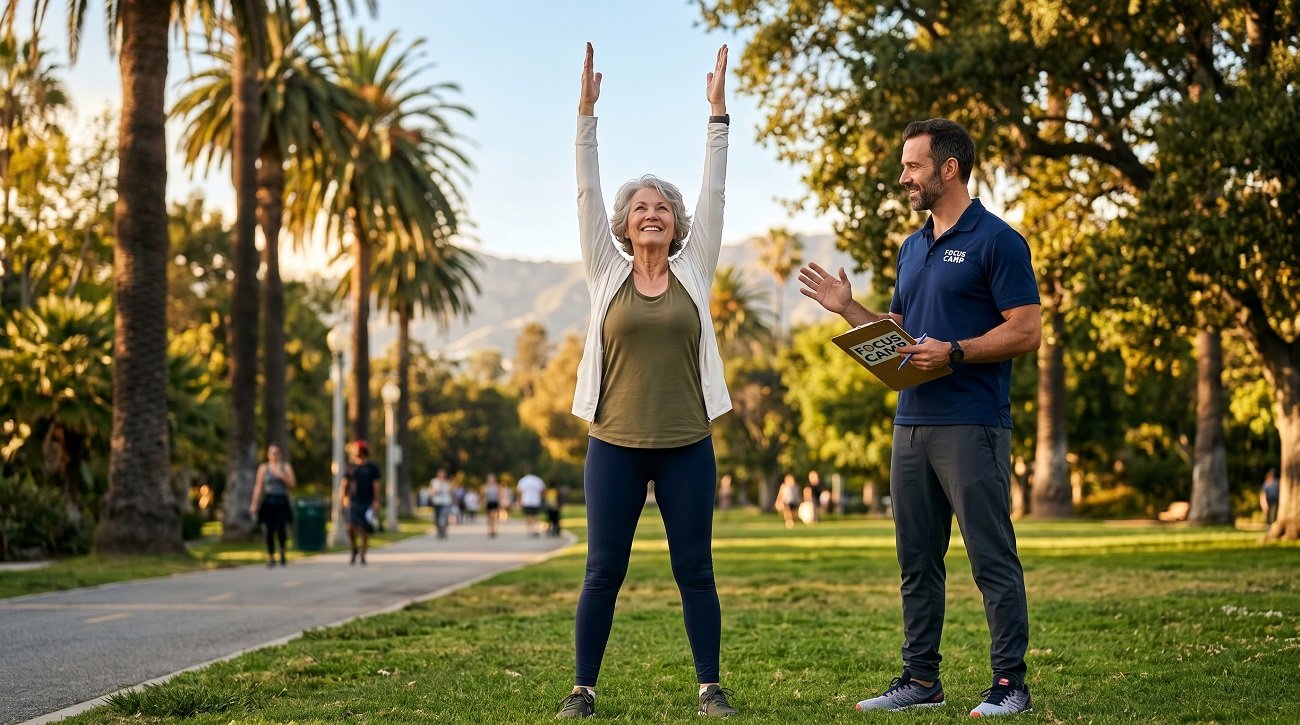
Each of these exercises can be done outdoors — and that’s exactly what we do in Focus Camp’s outdoor workout sessions. Being outside in the LA morning air transforms these movements from “exercises” into something you genuinely look forward to doing every single day.
4. Step-by-Step Instructions for Every Exercise
This is the most detailed section of this guide, and I want you to read it carefully. Most older adults I meet have never been taught how to do these movements properly. They’ve seen them demonstrated quickly in a video or read vague descriptions. That’s not good enough. Correct form is everything — it’s the difference between results and injury.
Let me walk you through each exercise exactly as I would in a private coaching session.
???? Exercise 1: Brisk Walking
What it is: Purposeful, upright, rhythmic walking at a pace that makes talking slightly effortful (not gasping, but not strolling either).
Why it’s powerful: Walking is the single most underrated exercise in existence. Research from the New England Journal of Medicine shows that 30 minutes of brisk walking five days a week reduces cardiovascular disease risk by up to 35%, reduces dementia risk, helps manage diabetes, reduces depression, improves bone density, and extends lifespan.
Step-by-Step Form:
- Start position: Stand tall. Shoulders back and down — not hunched. Chin parallel to the ground, not tucked or lifted. Arms relaxed at your sides.
- Head and neck: Look 10–15 feet ahead of you, not down at the ground. This keeps your spine in natural alignment and protects your neck.
- Posture: Engage your core very gently — imagine drawing your navel slightly toward your spine. This stabilizes the low back and protects it throughout the walk.
- Arms: Bend elbows to approximately 90 degrees. Let arms swing naturally and loosely in opposition to your legs — right arm forward as left foot steps forward. Do not cross the midline with your arms.
- Stride: Don’t over-stride (landing heel far in front of the body creates impact). Land with a soft heel strike, roll through the middle of the foot, and push off through the toes.
- Pace: Build to a pace where you can hold a full conversation but feel warmth in your chest and notice your breathing is slightly elevated. This is your “aerobic zone” — the optimal fat-burning and cardiovascular-training zone for older adults.
- Breathing: Breathe in through the nose for 3–4 counts, out through the mouth for 3–4 counts. Never hold your breath.
Progression:
- Week 1–2: 10–15 minutes
- Week 3–4: 20 minutes
- Week 5–6: 25–30 minutes
- Month 2+: 30–45 minutes, 5 days per week
Outdoor tip for LA: The Santa Monica beachfront path, Kenneth Hahn State Recreation Area, and the flat paths around Elysian Park are perfect. Sand walking on a dry beach burns approximately 1.8x more calories than pavement walking because every step requires stabilizing muscles to engage deeply — a brilliant low-impact bonus.
???? Exercise 2: Seated Chair Exercises
What they are: A collection of upper body, core, and lower body movements performed while seated in a sturdy, armless chair. Ideal for complete beginners, those with severe joint issues, or as a warm-up sequence.
Why they matter: Chair exercises maintain strength and range of motion in people who cannot safely stand for extended periods. They’re also phenomenal for people who are nervous about balance.
Step-by-Step Form for Key Chair Exercises:
2A: Seated Marching
- Sit upright on the front half of the chair — do not lean into the back support.
- Place hands flat on your thighs or hold gently to the sides of the seat.
- Slowly lift the right knee toward the ceiling as far as comfortable, hold 1 second, lower.
- Repeat on the left side.
- Alternate sides continuously, increasing pace gradually.
- Reps: 20 total (10 per side). Sets: 2–3.
- Form tip: Keep your back straight throughout. Do not round the lower back.
2B: Seated Shoulder Press (with light dumbbells or water bottles)
- Hold weights at shoulder height, palms facing forward, elbows at 90 degrees.
- Press both arms overhead until fully extended (do not lock elbows hard).
- Lower slowly — 3 counts down is ideal.
- Reps: 10–12. Sets: 2–3.
- Form tip: Exhale as you press up, inhale as you lower. Never hold your breath.
2C: Seated Calf Raises
- Both feet flat on the floor, hip-width apart.
- Slowly raise both heels as high as possible, squeezing calf muscles.
- Hold at the top for 1–2 seconds, lower slowly.
- Reps: 15. Sets: 2–3.
- Form tip: Move only through the ankle — don’t rock the whole leg.
2D: Seated Torso Twist (for spine mobility)
- Sit tall with feet flat, arms crossed over the chest or hands on shoulders.
- Slowly rotate your entire upper body to the right — leading with the chest, not just the shoulders.
- Hold 2–3 seconds, feel the gentle stretch in your mid-back.
- Return to center and rotate left.
- Reps: 8 each side. Sets: 2.
- Form tip: The movement should feel like a gentle massage for your spine — never force rotation.
⚖️ Exercise 3: Standing Balance Exercises
Why they’re critical: Falls are the leading cause of injury-related death in adults over 65 in the United States. Most falls happen not because someone is weak, but because their balance system has become undertrained. Balance is a skill — and like any skill, it dramatically improves with regular, specific practice.
Step-by-Step Form:
3A: Single-Leg Stand
- Stand near a wall, counter, or sturdy chair — use it lightly with one or two fingers if needed (do not grip, just touch for safety).
- Shift your weight onto your right foot.
- Slowly lift your left foot just 1–2 inches off the ground. Hold.
- Keep your standing knee slightly soft (never locked).
- Focus your gaze on a fixed point straight ahead — this is called a “drishti” in yoga and it dramatically improves balance.
- Hold: 10 seconds to start. Build to 30–45 seconds over weeks.
- Sets: 3 per side.
- Progression: When comfortable, try without touching the wall. Then try with eyes closed (only with coach supervision or near a wall).
3B: Heel-to-Toe Walk (Tandem Walk)
- Stand with feet together. Find a straight line on the ground or imagine one.
- Place your right foot directly in front of the left, so the heel of the right foot touches the toe of the left.
- Step with the left foot, placing it in front of the right in the same heel-to-toe fashion.
- Walk 10–20 steps, arms extended for balance if needed.
- Sets: 3–5 passes.
- Form tip: Look forward, not down. Slow is perfect.
3C: Standing Hip Circles
- Stand with feet hip-width, hands on hips, slight softness in the knees.
- Slowly rotate hips in a large, controlled circle — 5 circles clockwise, 5 counterclockwise.
- Keep shoulders relatively still. The movement is in the hips and lower spine.
- Sets: 2–3.
- Form tip: This also lubricates the hip joint with synovial fluid, reducing stiffness.
???? Exercise 4: Gentle Bodyweight Squats
Why older adults need them: The squat pattern — sitting down and standing up — is used dozens of times a day. Strong quads and glutes are essential for independence, fall prevention, and protecting the knees. A well-executed gentle squat is one of the safest and most functional exercises there is.
Step-by-Step Form:
- Starting position: Stand with feet shoulder-width apart, toes pointing slightly outward (10–15 degrees) — this naturally accommodates the hip socket.
- Initiate with the hips: Begin by pushing your hips backward — think “sit back toward a chair,” not “bend knees forward.” This is the most important cue for protecting knees.
- Depth: Lower until thighs are roughly parallel to the floor, or as low as is comfortable without pain. If you cannot go that low, half-squats are perfectly effective.
- Knees: Track your knees in the same direction as your toes — they should never cave inward. If they do, widen your stance slightly or place hands on knees lightly to guide them.
- Chest and spine: Keep chest up and spine neutral throughout. Do not round the lower back at the bottom. Imagine you’re proud — chest wide, shoulders back.
- Weight: 70–80% of your weight should be in your heels at the bottom. You should be able to wiggle your toes.
- Stand: Drive through the heels to stand. Squeeze glutes at the top. Exhale as you rise.
- Breathing: Inhale on the way down, exhale on the way up.
- Modification: Place a sturdy chair behind you. Lower toward it slowly — touch the seat lightly and stand back up without fully sitting. This gives confidence and a defined range of motion.
Reps/Sets: 8–12 reps, 2–3 sets.
???? Exercise 5: Wall Push-Ups
Why: Wall push-ups build chest, shoulder, tricep, and core strength with zero joint impact. They’re the perfect upper body exercise for anyone who finds floor push-ups painful or impossible.
Step-by-Step Form:
- Stand arm’s length from a wall — approximately 2–3 feet back.
- Place both palms flat on the wall at shoulder height and shoulder width.
- Step your feet back slightly so your body is at a gentle diagonal angle.
- Engage your core — don’t let the belly sag or the hips pike upward. Your body should be in a single, straight line from head to heels.
- Lower: Bend elbows at a 45-degree angle from the body (not flared out at 90 degrees — that stresses the shoulder) and slowly bring your chest toward the wall.
- Stop when your nose is 2–3 inches from the wall.
- Push: Press through both palms evenly and straighten arms — without locking the elbows at full extension.
- Breathing: Inhale on the way in, exhale as you push away.
- Tempo: 3 seconds down, 1 second pause, 2 seconds back. Slow and controlled.
Reps/Sets: 8–12 reps, 2–3 sets.
Progression: As wall push-ups become easy, move to incline push-ups (hands on a bench outdoors). Then to knee push-ups on a mat. Form always comes before increasing difficulty.
????️ Exercise 6: Resistance Band Training
Why bands are perfect for older adults: Resistance bands are one of the most underutilized and most brilliant tools for senior fitness. They provide consistent resistance throughout the full range of motion, are gentle on joints, are inexpensive, portable, and allow infinite progression. They’re ideal for outdoor coaching sessions.
At Focus Camp, we use resistance bands extensively in our private coaching sessions with older clients.
Step-by-Step for Key Band Exercises:
6A: Seated Rows with Band
- Sit on a chair or the ground with legs extended.
- Loop the band around both feet. Hold one end in each hand.
- Start with arms extended forward, palms facing inward.
- Pull both hands toward your lower ribcage, squeezing shoulder blades together.
- Hold 1–2 seconds at the peak contraction.
- Slowly return to start. Inhale to extend, exhale to pull.
- Reps: 10–12. Sets: 2–3.
- Form tip: Do not shrug shoulders. Keep them down and back throughout.
6B: Standing Band Bicep Curl
- Stand on the center of the band with feet hip-width.
- Hold one end in each hand, palms facing forward.
- Curl both hands toward your shoulders — keep elbows pinned to your sides throughout.
- Lower slowly — 3 count on the way down.
- Reps: 12. Sets: 2–3.
- Form tip: Avoid leaning backward to complete the curl. That’s your back cheating — reduce resistance.
6C: Band Side Steps (Lateral Walk)
- Place the band around both ankles (or just above the knees if ankles are uncomfortable).
- Stand with a slight squat position — knees slightly bent, core engaged.
- Step to the right 10–15 steps, then back to the left.
- Keep constant tension on the band — do not let feet come fully together.
- Reps: 3 lengths each direction.
- Form tip: This is one of the best exercises for hip abductor and glute medius strength — critical for knee stability and fall prevention.
???? Exercise 7: Tai Chi-Inspired Slow Flow Movements
What it is: Tai Chi is an ancient Chinese practice that consists of slow, flowing, deliberate movements done in sequence. It is widely studied in Western medicine for its benefits in older adult populations.
Research note: A Harvard Medical School study found that 12 weeks of Tai Chi significantly reduced fall frequency in older adults by up to 45%. Other studies demonstrate improvements in blood pressure, arthritis pain, depression, and sleep quality.
Step-by-Step for Beginners (Simplified Tai Chi Sequence):
Opening Move — “Gathering Energy”
- Stand with feet shoulder-width, arms relaxed at sides, eyes soft and gaze forward.
- Slowly inhale and raise both arms in front of you, palms facing down, until they reach shoulder height.
- Pause for 2 seconds — feel your breath.
- Exhale and slowly lower arms back to starting position.
- Repeat 4–6 times. Move with the breath — never faster than your breathing.
“Cloud Hands” (Upper Body Flow)
- Stand with feet slightly wider than shoulder-width.
- Start with your right hand at hip level and left hand raised to chest level, both palms facing your body.
- Slowly shift weight to the left foot as you move your right hand upward and your left hand downward — as if moving energy between them.
- Simultaneously rotate gently to the left, allowing your gaze and torso to follow.
- Shift weight right and reverse the hand positions, rotating back to center and gently to the right.
- Duration: 3–5 minutes of continuous flow.
- Key principle: There are no sharp movements in Tai Chi. Every transition flows smoothly from one to the next, like slow motion.
Outdoor setting: Tai Chi is best practiced outdoors on grass or a soft surface, with shoes off if comfortable, facing the morning sun. The meditative quality of natural surroundings amplifies every benefit.
???? Exercise 8: Gentle Yoga Poses for Older Adults
What to know: Yoga for seniors does not mean contorting into pretzel positions. It means using breath-synchronized movement to increase flexibility, reduce tension, build gentle strength, and train the mind-body connection. We incorporate yoga principles into our outdoor yoga sessions at Focus Camp.
Step-by-Step for Key Senior-Friendly Yoga Poses:
8A: Mountain Pose (Tadasana) — Foundation of All Standing Poses
- Stand with feet hip-width apart, big toes parallel.
- Spread all ten toes and press them gently into the ground — feel your three-point foundation (ball of foot, pinky side, heel).
- Engage thighs gently without locking knees.
- Tilt your tailbone very slightly down to engage lower abs and protect the low back.
- Roll shoulders back and down. Let arms hang naturally with palms facing forward.
- Lengthen the crown of your head toward the sky — as if a string gently lifts you from the top.
- Hold: 5–10 deep breaths. This is a deceptively powerful pose for posture and body awareness.
8B: Seated Forward Fold (Chair Modification)
- Sit at the edge of a sturdy chair, feet flat on the ground hip-width.
- Inhale and lengthen the spine — sit tall.
- Exhale and slowly hinge forward from the hips (not the waist) — keep the back as flat as possible.
- Lower hands toward the floor or shins.
- Let the head drop gently. Hold for 5 deep breaths.
- Inhale and slowly rise back to upright.
- Key tip: This pose gently lengthens the hamstrings and decompresses the lumbar spine — incredibly beneficial for people who sit a lot or have lower back tension.
8C: Cat-Cow Stretch (Spinal Mobility)
- Start on all fours (or seated on a chair with hands on knees for an easier version).
- Cow: Inhale and let your belly drop toward the floor, lift your chest and tailbone — gentle backbend. Hold 2 seconds.
- Cat: Exhale and round your spine toward the ceiling, tucking chin to chest and tailbone under. Hold 2 seconds.
- Flow between these two positions with the breath: inhale for cow, exhale for cat.
- Reps: 8–10 full breath cycles.
- Why: The spine is designed to flex and extend. This movement pumps fluid through the spinal discs and is one of the most effective exercises for reducing morning stiffness and back pain.
8D: Legs Up the Wall (Viparita Karani)
- Sit sideways against a wall or fence outdoors. Lie back and swing both legs up the wall.
- Scoot close enough that the legs rest comfortably straight.
- Let both arms rest at your sides, palms up.
- Close your eyes. Breathe naturally.
- Hold: 5–10 minutes.
- Why: This passive pose reverses blood pooling in the lower legs, reduces swelling, calms the nervous system, and is profoundly restorative for tired or achy legs.
???? Exercise 9: Water/Aqua Exercises
Why aqua exercise is extraordinary for older adults: Water reduces the effective body weight by up to 90%, eliminating virtually all joint impact while still providing significant resistance — water is approximately 800 times denser than air, meaning every movement strengthens muscles meaningfully.
We’ve written about this in detail in our Aqua Fitness vs. Gym vs. Focus Camp comparison, but here are the core movements:
9A: Water Walking
Walk back and forth in the shallow end. Focus on driving your arms through the water with each step. The water provides resistance that strengthens legs and hips while the buoyancy protects joints completely.
9B: Standing Water Leg Swings
Hold pool edge with one hand. Swing the outside leg forward and backward in a controlled arc — 15 swings each direction, then switch sides. This improves hip mobility and strengthens the hip flexors and glutes.
9C: Water Arm Circles
Stand in shoulder-depth water. Extend both arms to the sides just below the water surface. Make slow, large circles forward (20) then backward (20). The water resistance builds shoulder and upper back strength more safely than most gym exercises.
???? Exercise 10: Deep Breathing and Breathwork
Why breathing is exercise: Most people breathe incorrectly — shallow, chest-based breathing that keeps the nervous system in a mild state of chronic stress. Teaching older adults to breathe correctly is one of the first things we do at Focus Camp, and the results often surprise people.
Step-by-Step: Diaphragmatic Breathing
- Sit comfortably or lie on a mat outdoors.
- Place one hand on your chest and one on your belly.
- Inhale slowly through the nose for 4 counts — the belly hand should rise, the chest hand should remain relatively still. This is diaphragmatic (belly) breathing.
- Hold the breath gently for 1–2 counts.
- Exhale through the mouth or nose for 6–8 counts — belly falls.
- The exhale should be longer than the inhale. This activates the parasympathetic nervous system (rest and repair mode).
- Practice: 10 breath cycles before exercise, 10 after as cool-down.
Box Breathing (for focus and stress):
- Inhale 4 counts. Hold 4 counts. Exhale 4 counts. Hold empty 4 counts.
- Repeat 4–6 rounds.
???? Exercise 11: Glute Bridges
Why: The glutes are the largest and most powerful muscles in the human body. In most older adults, they are chronically weak — largely from years of prolonged sitting. Weak glutes lead directly to lower back pain, knee pain, hip instability, and poor posture. Glute bridges are the safest, most accessible exercise to address this.
Step-by-Step Form:
- Lie on your back on a mat (outdoors on grass is perfect — bring a yoga mat).
- Bend both knees, place feet flat on the ground hip-width apart, approximately 12 inches from your hips. Arms resting at your sides, palms down.
- Press through both heels and both palms. Engage glutes consciously — squeeze as if you’re holding a coin between your cheeks.
- Lift your hips off the ground smoothly until there’s a straight line from your knees to your hips to your shoulders.
- Hold at the top for 2–3 seconds, actively squeezing.
- Lower slowly — 3–4 seconds down — until your tailbone just touches and immediately rise again. Do not fully rest at the bottom between reps.
- Breathing: Exhale as you lift, inhale as you lower.
- Reps: 10–15. Sets: 2–3.
- Common error: Hyperextending the low back at the top — you should feel this in the glutes and hamstrings, not the lower spine. If you feel it in your back, squeeze glutes harder and don’t go as high.
???? Exercise 12: Calf Raises (Standing)
Why: Calf strength is directly correlated with ankle stability, circulation (the calves are often called the “second heart” because they pump blood back up the legs), balance, and reduced risk of varicose veins. Calf raises are deceptively powerful.
Step-by-Step Form:
- Stand behind a sturdy park bench or chair, feet hip-width apart, fingertips lightly resting on the surface for balance (do not lean on it — just touch).
- Press through the balls of all ten toes evenly.
- Rise as high as possible onto the tips of the toes.
- Hold at the top for 1–2 seconds — feel the full contraction in the calf muscles.
- Lower slowly — 3 counts — back to flat foot.
- Reps: 15–20. Sets: 2–3.
- Progression: When easy, try single-leg calf raises — hold balance with one finger on the bench, raise on one foot only.
5. The Best Timing for Your Workouts
One of the most common questions I get from new older adult clients: “When should I actually exercise? Morning? Evening? Does it matter?”
The honest answer is: the best time is the time you will actually do it consistently. Consistency beats optimization every single time. But timing does have real physiological implications, and in a city like Los Angeles, it matters practically too.
Morning Exercise (6 AM – 9 AM): The Optimal Window for Most Older Adults
Why morning is generally best:
- Cortisol levels naturally peak in the early morning, which means your body is already primed for physical activity.
- Research published in the British Journal of Sports Medicine found that morning exercise improves executive function and short-term memory for the rest of the day.
- In Los Angeles, morning is genuinely cooler — especially in the summer — and air quality is at its best before traffic peaks.
- The LA morning “golden hour” (just after sunrise) provides the most beautiful, serene environment for outdoor training. There is something deeply motivating about training as the city wakes up.
- Morning exercise also regulates the circadian rhythm, leading to better sleep quality at night — a significant benefit for older adults who often struggle with sleep.
The caveat for seniors: Some older adults experience joint stiffness in the morning, particularly those with arthritis. If this applies to you, the warm-up routine (Section 6) becomes even more critical. Spend extra time warming up — 8–10 minutes — before any demanding movement.
Midday Exercise (10 AM – 12 PM): A Strong Second Option
- Body temperature and joint flexibility reach their daily peak by mid-morning.
- Muscle strength and coordination are typically at their best between 10 AM and 2 PM.
- In summer, Los Angeles midday heat (especially inland) can make outdoor exercise uncomfortable or even dangerous — stay in shaded parks or near the beach breeze.
- Excellent for people whose mornings are taken up by caregiving or medication routines.
Afternoon/Evening Exercise (3 PM – 6 PM):
- Some research suggests peak athletic performance occurs in the late afternoon when body temperature, muscle strength, and flexibility are all optimal.
- However, vigorous evening exercise can disrupt sleep for some older adults, as it elevates cortisol and adrenaline.
- Recommendation for older adults: If you exercise in the evening, keep intensity gentle — evening yoga, stretching, or a slow walk are ideal. Save more vigorous work for morning or midday.
Los Angeles Seasonal Timing Guide
| Season | Best Time Outdoors | Special Notes |
|---|---|---|
| Spring (Mar–May) | 7 AM – 10 AM or 4 PM – 6 PM | Perfect weather — take advantage |
| Summer (Jun–Sep) | 6 AM – 8:30 AM only | Heat risk is real after 9 AM inland |
| Fall (Oct–Nov) | 7 AM – 11 AM or 3 PM – 6 PM | Second-best season for outdoor fitness |
| Winter (Dec–Feb) | 8 AM – 12 PM | Cooler and often overcast — still great |
| Santa Ana Wind Days | Avoid prolonged outdoor activity | Poor air quality from dry winds |
How Many Days Per Week?
The American College of Sports Medicine and World Health Organization both recommend older adults aim for:
- 150 minutes of moderate-intensity aerobic activity per week (e.g., brisk walking)
- Plus 2–3 days of muscle-strengthening activity
In practice, I recommend our older adult private coaching clients follow a 5-day active schedule with 2 rest or very gentle recovery days. This is perfectly achievable and the structure that produces the most consistent long-term results.
6. Warm-Up Routine (Never Skip This — Here’s Why)
I cannot overstate how important the warm-up is for older adults. A proper warm-up:
- Gradually raises body temperature, making muscles more pliable and less injury-prone
- Increases synovial fluid production in the joints, reducing friction
- Primes the nervous system for coordinated movement
- Psychologically prepares you for the session — this matters more than most people realize
- Dramatically reduces the risk of muscle strains, ligament sprains, and other soft tissue injuries
The Complete 8-Minute Warm-Up Sequence (Do This Every Single Session)
| Step | Exercise | Duration | Notes |
|---|---|---|---|
| 1 | Diaphragmatic Breathing | 1 min | Seated or standing; 4-count inhale, 6-count exhale |
| 2 | Shoulder Rolls | 1 min | 10 forward, 10 backward — slow and full range |
| 3 | Neck Rotations | 30 sec | Slow side-to-side; NO full circles backward |
| 4 | Ankle Circles | 1 min | Seated; 10 clockwise and 10 counterclockwise each ankle |
| 5 | Marching in Place | 1.5 min | Moderate pace, high knee lifts, arms swinging |
| 6 | Arm Swings (Crisscross) | 30 sec | Arms swing across body, opening and crossing |
| 7 | Torso Rotations | 1 min | Hands on hips or arms extended, rotate left/right |
| 8 | Gentle Hip Circles | 1 min | Hands on hips, large slow circles |
| 9 | 5 Slow Bodyweight Squats | 30 sec | Very controlled, full breath on each |
Result: After 8 minutes, your heart rate is mildly elevated, your joints are lubricated, your muscles are warm, and your body is ready to train safely and effectively.
7. Complete Weekly Beginner Workout Plan
This is the exact beginner schedule we build for new older adult clients in our private coaching program. It is specifically designed to:
- Avoid overtraining and burnout
- Progressively build capacity without soreness or injury
- Balance strength, cardiovascular health, and flexibility
- Be genuinely achievable for someone starting from zero
Week 1–2: Foundation Phase (Building the Habit)
| Day | Session Type | Duration | What You’ll Do |
|---|---|---|---|
| Monday | Strength (Lower Body) | 25 min | Warm-up → Gentle Squats (2×8) → Glute Bridges (2×10) → Calf Raises (2×12) → Cool-down stretch |
| Tuesday | Cardio (Walking) | 15 min | Brisk walk, flat terrain, comfortable pace. Focus on posture and breathing. |
| Wednesday | Rest or Gentle Yoga | 15–20 min | 5 yoga poses, breathing, legs up the wall |
| Thursday | Strength (Upper Body + Core) | 25 min | Warm-up → Wall Push-Ups (2×8) → Seated Rows with Band (2×10) → Standing Balance (2×30 sec) → Cool-down |
| Friday | Cardio (Walking) | 20 min | Brisk walk, same or slightly longer route |
| Saturday | Active Recovery | 20–30 min | Leisurely nature walk, beach stroll, or gentle stretching outdoors |
| Sunday | Full Rest | — | Rest, light housework, pleasant social activity |
Week 3–4: Building Phase (Adding Volume)
| Day | Session Type | Duration | What You’ll Do |
|---|---|---|---|
| Monday | Strength (Full Body) | 30 min | Warm-up → Squats (3×10) → Glute Bridges (3×12) → Wall Push-Ups (3×10) → Calf Raises (3×15) → Cool-down |
| Tuesday | Cardio (Walking) | 20 min | Increase pace slightly — breathing slightly harder |
| Wednesday | Balance + Yoga Flow | 25 min | Single-leg stand (3×20 sec) → Heel-to-toe walk → Cat-Cow → Forward Fold → Breathing |
| Thursday | Strength (Upper + Resistance Bands) | 30 min | Warm-up → Band Bicep Curls (3×12) → Seated Rows (3×12) → Band Side Steps (3×10 steps each) → Cool-down |
| Friday | Cardio (Walking) | 25 min | Add a gentle incline if possible — use park hills |
| Saturday | Longer Outdoor Activity | 30–40 min | Scenic park walk, beach path, or beginner hike |
| Sunday | Full Rest | — | Rest and recovery |
Month 2: Progression Phase
By month 2, you should be noticeably stronger, more flexible, and more energized than when you started. Adjust the plan:
- Add 1–2 extra reps per exercise each week
- Increase walking time by 5 minutes
- Add one more exercise to each session
- Begin adding resistance band exercises to your lower body days
Progressive Overload Table for Months 1–3
| Exercise | Week 1 | Week 4 | Week 8 | Week 12 |
|---|---|---|---|---|
| Squats | 2×8 | 3×10 | 3×12 | 3×15 |
| Glute Bridges | 2×10 (hold 1 sec) | 3×12 (hold 2 sec) | 3×15 (hold 3 sec) | 3×15 (single leg attempt) |
| Wall Push-Ups | 2×8 | 3×10 | 3×12 | Move to incline push-ups |
| Calf Raises | 2×12 | 3×15 | 3×20 | Try single-leg |
| Walking | 15 min | 20 min | 30 min | 30–40 min |
| Balance Hold | 10 sec each | 20 sec each | 30 sec each | 45 sec eyes closed |
8. Cool-Down & Flexibility Routine
The cool-down is just as important as the warm-up and vastly underestimated. Post-exercise, your muscles are warm, pliable, and receptive to lengthening — this is the perfect window to build flexibility. Skipping the cool-down leads to increased muscle soreness, tightness accumulation over time, and a missed opportunity to train flexibility.
The Complete 10-Minute Cool-Down (Do After Every Session)
| Step | Stretch / Exercise | Duration | Execution |
|---|---|---|---|
| 1 | Standing Quad Stretch | 30 sec each side | Hold ankle behind, stand tall, slight forward lean. Use wall for balance. |
| 2 | Standing Hamstring Stretch | 30 sec each side | Place one heel on a low surface (bench, step), lean forward from hips — flat back |
| 3 | Hip Flexor Lunge Stretch | 30 sec each side | Step one foot forward, drop back knee toward ground gently. Upright posture. |
| 4 | Chest Opener / Shoulder Stretch | 1 min | Clasp hands behind back, lift chest and gently pull shoulders back. Breathe deeply. |
| 5 | Seated Spinal Twist | 30 sec each side | Seated, cross one leg, rotate toward it. Or chair version: seated rotation. |
| 6 | Child’s Pose (or Seated Forward Fold) | 1 min | From knees, extend arms forward and lower chest. Deeply relaxing for low back. |
| 7 | Supine Knee Hug | 30 sec each side | Lie on back, hug one knee to chest — releases hip and low back |
| 8 | Supine Figure-4 Stretch | 45 sec each side | Lie on back, cross one ankle over opposite knee, draw both toward chest — hip opener |
| 9 | Legs Up the Wall | 3–5 min | Restorative. Legs elevated against wall or fence. Eyes closed. Breathing. |
| 10 | Final Breathing | 1 min | 5 slow diaphragmatic breaths. Let the body integrate the session. |
A word on holding stretches: Hold each stretch for at least 30 seconds — never fewer. It takes approximately 15–20 seconds for the stretch reflex to release and for the muscle to genuinely lengthen. Bouncing in stretches — “ballistic stretching” — is contraindicated for older adults and increases injury risk.
9. Safety Tips: Injury Prevention, Posture & Breathing
This section is one I consider essential for every older adult starting a new fitness program. Most injuries in senior fitness are completely preventable. Here’s exactly how to protect yourself.
Before You Start: Medical Clearance
If you are over 65, or have any history of heart disease, osteoporosis, diabetes, hypertension, recent surgery, or known orthopedic issues — please consult your physician before beginning this or any exercise program. This is not a liability disclaimer; this is genuinely important advice. A 10-minute conversation with your doctor is worth months of safe, effective training.
Most physicians will enthusiastically support a gentle, coach-supervised outdoor exercise program — often recommending it.
The 10 Cardinal Safety Rules for Older Adult Exercise
Rule 1 — Warm up. Always. No exceptions. Cold muscles tear. We covered this in Section 6. Eight minutes is all it takes.
Rule 2 — Never train through sharp or joint pain. There is a critical difference between:
- Muscular effort (burning, fatigue — perfectly normal and desirable): Train through this.
- Joint pain, sharp pain, pinching, or popping with pain: STOP. This is your body’s emergency signal. Rest, apply ice if swollen, and consult a professional.
Rule 3 — Breathe constantly. Never hold your breath during any exercise. This is called the Valsalva maneuver and it dangerously spikes blood pressure — particularly risky for older adults. If you need to hold your breath to complete a movement, the movement is too heavy or too difficult.
Rule 4 — Posture is protection. The vast majority of exercise injuries come from poor alignment and form, not from the exercise itself. When in doubt: chest up, shoulders back and down, core gently braced, knees tracking over toes, spine neutral (not excessively arched or rounded).
Rule 5 — Hydrate aggressively. Older adults have reduced thirst sensitivity — you are often significantly dehydrated before you feel thirsty. In Los Angeles, especially in summer: drink 12–16 oz of water before your outdoor session. Sip every 10–15 minutes during. Drink 8–12 oz afterward. Add a pinch of sea salt or an electrolyte tab for sessions over 45 minutes.
Rule 6 — Know the Heat Index in LA. When temperatures exceed 90°F (32°C) and humidity is high, outdoor exercise for older adults becomes risky. Shift morning workouts even earlier (6 AM) or move to shaded areas. Watch for signs of heat exhaustion: excessive sweating, dizziness, nausea, pale skin, weakness. If you experience these, stop, get to shade, sit, drink cool water.
Rule 7 — Use supportive footwear. Inappropriate footwear is a shockingly common cause of falls and joint pain in older adults. Wear athletic shoes with:
- A non-slip sole
- Adequate arch support
- A firm heel counter
- Enough toe box width to not compress the toes Old, worn-out shoes with compressed midsoles offer almost no protection. Replace exercise shoes every 300–500 miles of use.
Rule 8 — Progress slowly and deliberately. The most common cause of injury in beginners of any age is progressing too quickly. The 10% rule is well-established: never increase total weekly exercise volume by more than 10% from one week to the next. Your connective tissue (tendons and ligaments) adapts to training stress significantly slower than your cardiovascular system and muscles.
Rule 9 — Rest and recovery are part of training. Muscle growth, strength adaptation, and tissue repair all happen during rest — not during the workout. The workout is the stimulus. Sleep is when the magic happens. Never exercise a muscle group intensely for more than two consecutive days.
Rule 10 — Listen to your body, not your ego. On days when your body feels genuinely tired, achy, or unwell — reduce intensity or rest. Missing one session is inconsequential. Pushing through genuine illness or fatigue and getting injured means missing weeks or months.
Posture Checklist for All Standing Exercises
| Body Part | What Correct Looks Like | Common Error to Avoid |
|---|---|---|
| Head | Chin parallel to floor, eyes forward | Chin tucked or head forward |
| Neck | Natural curve, relaxed | Tension, rigidity, jutting forward |
| Shoulders | Back and DOWN away from ears | Shrugged or rounded forward |
| Chest | Wide and open, “proud” | Collapsed, caved inward |
| Core | Gently braced (20–30% tension) | Fully relaxed OR excessively sucked in |
| Lower Back | Natural neutral curve — slight lordosis | Excessively arched OR flat/rounded |
| Hips | Level, neutral — not tilted forward | Anterior tilt (belly forward) |
| Knees | Soft, tracking over second toe | Locked OR caving inward |
| Feet | Hip-width, toes slightly out | Turned far in or parallel and stiff |
10. Equipment You May Need
One of the most liberating things about soft workouts is how little equipment you actually need — especially for outdoor training. Here’s a complete breakdown:
Truly Essential (Under $20 Total)
| Item | Purpose | Approximate Cost |
|---|---|---|
| Yoga Mat (non-slip) | Ground exercises, stretching, cool-down | $15–30 |
| Resistance Band Set | Strength training (multiple resistance levels) | $10–20 |
| Water Bottle (insulated) | Hydration — non-negotiable in LA heat | $15–25 |
| Athletic Footwear | Fall prevention, joint support | Already owned or $60–100 |
Highly Recommended
| Item | Purpose | Approximate Cost |
|---|---|---|
| Lightweight Dumbbells (2–5 lb) | Seated shoulder press, bicep curls | $10–20 |
| Foam Roller | Post-workout muscle recovery | $15–25 |
| Resistance Loop Bands | Hip and glute activation work | $8–15 |
| Sunscreen SPF 50+ | Critical for outdoor exercise in LA | $10–15 |
| Fitness Gloves | Grip support for bands and weights | $10–15 |
| Fitness Tracker / Watch | Step count, heart rate monitoring | Optional, $30–150 |
What You Absolutely Do NOT Need
- A gym membership
- Expensive equipment
- Weights heavier than 5–8 lb for most soft workout purposes
- Any machines whatsoever
At Focus Camp’s private outdoor coaching sessions, your coach arrives with all necessary equipment for the session — bands, mats, and any tools needed. You just bring yourself, your water, and your willingness to move.
11. The Real Benefits of an Outdoor Private Coach for Older Adults
This is where I want to speak directly to you, because this is the part that actually changes everything.
You can read every exercise guide online. You can follow YouTube videos. You can try to piece together a program from Instagram. And for some people, that works — for a while.
But here’s what I’ve watched happen with hundreds of older adults over the years: the ones who try to do it alone plateau fast, form errors creep in and slowly create pain, motivation wobbles and disappears within 6–8 weeks, and they end up back at square one feeling discouraged.
The ones who work with a qualified outdoor private coach? They don’t just get fit. They transform.
Here’s exactly why private coaching for older adults — especially outdoors — is in a completely different category than any other fitness option:
✅ 1. Exercise Selection Is Personalized to YOUR Body
No two 65-year-old bodies are alike. One client has a replaced left hip. Another has mild osteoporosis. One has heart disease managed by medication. Another is completely healthy but extremely deconditioned. A private coach assesses YOUR specific situation in the first session and builds a program that works with your body’s reality — not a generic template.
At Focus Camp, every private client starts with a movement assessment — we watch you walk, stand, squat, reach. We identify your strengths, your restrictions, your imbalances. Then we build around them. This alone prevents the majority of common exercise injuries.
✅ 2. Real-Time Form Correction Prevents Injury Before It Happens
You can feel like you’re doing an exercise correctly and be completely wrong. Without feedback, form errors become ingrained habits that, over weeks and months, create cumulative stress on joints. A private coach watching every rep catches these in real time — often after just 2–3 reps — and gives you the exact verbal or physical cue you need to correct it.
This is the single biggest safety advantage of private coaching for older adults.
✅ 3. Accountability Creates Consistency — and Consistency Creates Results
Accountability is not just a motivational buzzword. It’s a behavioral science reality. Research published in the American Journal of Health Behavior found that people working with a personal trainer exercised significantly more consistently — and for longer periods — than those exercising alone. When you have a session booked with a real person who is showing up to meet you, you show up too. Session after session. Month after month. That’s how bodies change.
✅ 4. Progressive Overload Is Managed Expertly
Progression is the engine of physical improvement. Without it, you adapt to what you’re doing and stop making gains. But too much progression too fast leads to injury. A qualified coach knows exactly when to add a rep, when to increase resistance, when to introduce a new movement — and when to back off because your body needs more time. This balance is what produces continuous improvement safely.
✅ 5. The Outdoor Environment Multiplies Every Benefit
Training outdoors with a private coach is categorically different from gym-based training in two ways:
Mental health benefits are dramatically amplified. Nature exposure reduces cortisol and increases serotonin independently of exercise. When you combine the two, the mood-improving effect is compounded.
Movement variety is virtually unlimited. A park, beach, or trail offers terrain variation, natural obstacles, space for walking lunges, hills for incline walking, benches for tricep dips and step-ups, open grass for yoga and balance work. The variety maintains motivation and challenges more muscle groups than a static gym environment.
At Focus Camp, we use Los Angeles itself — the beaches, parks, and paths of this extraordinary city — as our training facility. And it is the best one in the world for what we do.
✅ 6. Emotional Support and Genuine Human Connection
This one is real and often underestimated. Many older adults feel isolated, especially post-retirement or post-loss. Working with a coach who genuinely knows your name, your goals, your history, who asks how your grandkids are doing — that relationship has real mental health value. Our clients often say the coaching sessions are highlights of their week — not because of the exercise, but because of the connection.
✅ 7. Coach-Supervised Exercise Is Medically Safer for Older Adults with Conditions
For clients with hypertension, diabetes, heart disease, or post-surgical conditions, a trained coach can monitor exertion levels, watch for warning signs, and know exactly how to modify any exercise at any moment. This level of safety cannot be replicated by solo training or group classes.
12. What Qualifications & Experience Should You Look for in a Senior Fitness Coach
Not every personal trainer is qualified to work safely and effectively with older adults. This is a population with specific physiological considerations, common health conditions, and psychological needs. Here’s what to verify before hiring any private coach:
Essential Qualifications
| Credential | What It Means | Why It Matters for Seniors |
|---|---|---|
| NASM, ACE, or NSCA Certification | Nationally accredited personal training certification | Ensures foundational exercise science knowledge |
| Specialty in Senior / Older Adult Fitness | Additional certification (e.g., NASM-SEN, ACE Senior Fitness Specialist) | Training older adults requires specific skills |
| First Aid & CPR/AED Certification | Certified in emergency response | Non-negotiable for outdoor training |
| Experience (3+ years) working with 60+ clients | Real-world knowledge that textbooks cannot provide | Older bodies are different — experience matters |
| Liability Insurance | Coach is insured for professional practice | Protects you as the client |
What to Ask in the First Consultation
- “Can you describe your experience working with clients over 60?”
- “How do you assess a client’s movement and fitness level before designing a program?”
- “What modifications do you have for clients with [your specific condition]?”
- “How do you track and measure my progress over time?”
- “What does a typical session with you look like?”
- “What are your credentials and can I see your certifications?”
A great coach answers all of these with confidence and specificity. Vague answers are a red flag.
About François and Tina at Focus Camp
At Focus Camp, both our trainers, François and Tina, bring years of hands-on experience specifically with fitness programs designed for all fitness levels and ages — including older adults who are starting from a gentle foundation. Our approach combines physical training with mental focus and mindful movement principles, ensuring every client receives not just a workout program but a complete wellness strategy.
Tina’s expertise in yoga, mindfulness, and gentle movement therapy makes her an exceptional resource for older adults who need special attention to flexibility, breathing, and stress-informed training. François’s background in functional training, strength coaching, and outdoor conditioning means clients receive expert programming that builds real-world capability — not just gym performance.
Together, our approach is built on one promise: every person who works with us is treated as an individual, not a program. Our success stories include men and women in their 60s, 70s, and older who came to us feeling physically defeated and left feeling stronger, more confident, and genuinely excited about their bodies again.
You can learn more about our private coaching services here and book your first session here.
13. Common Mistakes Older Adults Make When Starting to Exercise
I see these patterns constantly. They’re completely understandable — and completely fixable with the right guidance.
❌ Mistake 1: Doing Too Much Too Soon
I call this “enthusiasm overload.” You feel motivated on week one, push hard every day, feel terrible by day 5, and quit by week 2. The body — especially after years of inactivity — needs gradual reintroduction to stress. Follow the beginner schedule in Section 7 exactly. It feels deceptively easy in week 1. That’s the point.
❌ Mistake 2: Skipping the Warm-Up to Save Time
Saving 8 minutes on the warm-up is absolutely not worth the weeks it can cost you if you pull a muscle or strain a tendon. Warm muscles stretch. Cold muscles tear. This is not rhetoric — it is anatomy.
❌ Mistake 3: Comparing Yourself to Your Younger Self — or Anyone Else
This one is purely psychological but enormously damaging to motivation. Your 68-year-old body is not supposed to do what your 35-year-old body did. The comparison is meaningless. The relevant comparison is: your body last month vs. your body this month. Focus on that gap. That’s where the progress lives.
❌ Mistake 4: Holding Your Breath During Effort
Covered in the safety tips, but worth repeating: always breathe. Exhale on exertion (the hard part). If you catch yourself holding your breath, the weight or resistance is too heavy.
❌ Mistake 5: Ignoring Hydration
Dehydration during outdoor LA exercise — especially for older adults — can range from uncomfortable to dangerous. The reduced thirst reflex after 60 means dehydration sneaks up on you. Pre-hydrate before your session and hydrate consistently throughout.
❌ Mistake 6: Avoiding Strength Training Out of Fear
“I don’t want to bulk up” is something I hear often from older women. This is a myth — building large, bulky muscle requires a very specific combination of extremely heavy loads, high volume, and hormonal conditions that older adults simply don’t have. Gentle resistance training builds lean, functional strength and tone, not bulk. It also dramatically protects bones, joints, and metabolic health.
❌ Mistake 7: Treating Every Rest Day as a Guilt Day
Rest is not failure. Rest days are when your body does the actual work of adaptation and repair. Honor them.
❌ Mistake 8: Quitting When Motivation Dips (Relying on Motivation)
Motivation is not reliable. It comes and goes for everyone — professional athletes included. The solution is building a structure — a schedule, a coach, an appointment that is harder to skip than to keep — so that exercise happens even on days when you don’t feel like it. That consistency, over time, is what produces dramatic results.
14. Tips for Staying Consistent — The Real Long Game
Fitness is not a sprint. It’s not even a marathon. It’s a daily practice that compounds over months and years into a completely transformed quality of life. Consistency — not intensity — is the most important variable.
Here are the strategies that actually work for older adults staying consistent with a fitness program:
???? Tip 1: Anchor Exercise to an Existing Habit
James Clear’s research on habit formation (Atomic Habits) shows that new behaviors are easiest to maintain when they’re attached to already-established routines. “After I have my morning coffee, I put on my shoes and go for my walk” works far better than “I’ll exercise sometime today.”
???? Tip 2: Set Process Goals, Not Just Outcome Goals
“I want to lose 15 pounds” is an outcome goal — and it takes weeks to show measurable progress, making it a poor motivator on a Tuesday morning. “I will take a 20-minute walk five days this week” is a process goal. You can succeed or fail at it daily. This daily feedback loop is powerfully motivating.
???? Tip 3: Track Consistency Visually
Use a paper calendar. Put an X on every day you exercise. After two weeks, you have a chain. The psychological resistance to breaking the chain — what Jerry Seinfeld calls “don’t break the chain” — is a genuine motivator.
???? Tip 4: Make It Social
Exercise with a friend, family member, or partner when possible. Social accountability dramatically increases adherence. This is also why our group outdoor sessions and Focus Camp programs are so effective — community is a powerful motivator.
???? Tip 5: Celebrate Every Session
Not just the results — the act of showing up. You exercised today when you could have not. That decision matters. Acknowledge it. After every session, take 60 seconds to appreciate what your body just did for you. This builds positive emotional association with exercise — making the next session easier to start.
???? Tip 6: Work with a Coach
Private coaching is, by a significant margin, the most effective accountability structure that exists. When you have a session scheduled with a real person who is driving to meet you — who has prepared a session specifically for you — the psychological barrier to skipping is enormous. This is why our private coaching clients achieve far more consistent attendance than any other format.
???? Tip 7: Rest Without Guilt
Missing a session or taking an extra rest day is not a failure. It becomes a failure only if you use it as a reason to quit entirely. The rule: if you miss one session, move on. Two sessions missed in a row? Get back the very next day, no matter what. Never let it become three.
???? Tip 8: Revisit Your “Why” Regularly
Write down your reason for exercising — something specific and personal. “I want to play on the ground with my grandchildren without my knees hurting.” “I want to walk the Camino de Santiago at 70.” “I want to go hiking with my daughter.” Read this every morning. The “why” is what keeps you going when motivation evaporates.
15. Frequently Asked Questions
Q: I haven’t exercised in years. Is it safe to start at 65 or 70?
Absolutely — and this is actually the most important time in your life to start. Research is unambiguous: beginning regular exercise at any age, including 70s and 80s, produces measurable improvements in strength, balance, cardiovascular health, and cognition. The key is starting gently — which is exactly what this guide is for. We highly recommend a check-in with your doctor first, and then working with a coach who specializes in older adult fitness.
Q: What if I have arthritis or joint replacements? Can I still do these exercises?
Yes — many people with arthritis, knee replacements, or hip replacements exercise regularly and report significant improvements in pain and function. The key is which exercises and what intensity. Several exercises in this guide are specifically beneficial for arthritic joints (water exercise, gentle yoga, chair exercises). Your private coach will modify any movement for your specific situation. We deal with this regularly at Focus Camp.
Q: How soon will I see or feel results?
Most people notice improved energy levels, better sleep quality, and reduced stiffness within the first 2–3 weeks. Visible changes in strength and body composition typically take 8–12 weeks of consistent effort. Balance improvements are often noticed within 4–6 weeks. Mood improvements can happen after a single session and accumulate meaningfully within days to weeks.
Q: Is walking enough, or do I need to do strength training too?
Walking alone is beneficial and far better than nothing. But research is clear that the combination of aerobic exercise (like walking) AND resistance training is dramatically more effective than either alone — especially for older adults. Strength training prevents muscle loss, protects joints, improves bone density, and makes everything else you do easier. We recommend at least 2 strength sessions per week.
Q: How do I know if my form is correct without a coach watching me?
Honestly? You often don’t — especially as a beginner. This is the most compelling argument for at least starting with a private coach who can establish correct movement patterns from the beginning. Once your form is solid, you can exercise independently with confidence. It’s an investment in your safety. Learn more about private coaching at Focus Camp.
Q: Can I exercise if I’m on blood pressure or heart medications?
In most cases, yes — but with your doctor’s specific guidance. Some blood pressure medications affect heart rate response, which changes how you should monitor exercise intensity. Avoid using heart rate as your only guide if you’re on beta-blockers; use the “talk test” (moderate conversation = appropriate intensity) instead. Always disclose all medications in your first coaching consultation.
Q: What makes outdoor training better than just exercising at home?
Several things: the natural environment reduces stress hormones and elevates mood beyond what indoor exercise achieves. Fresh air and sunlight (vitamin D synthesis) are genuinely therapeutic. Terrain variation engages more stabilizer muscles than flat indoor surfaces. And the psychological novelty of outdoor environments keeps motivation consistently higher — which means you do it more consistently.
16. Ready to Start? Here’s Your Next Step
You’ve just read one of the most detailed, practical guides to soft outdoor fitness for older adults on the internet. That alone puts you ahead of 90% of people who click on articles like this and close the tab.
But information alone doesn’t transform bodies. Movement does.
Here’s what I want you to do right now, today:
Step 1: Print or bookmark this guide. Come back to Section 7 (the weekly plan) and circle Week 1.
Step 2: Put on your shoes. Walk outside for 15 minutes. That’s it. That is your first session.
Step 3: If you want real results — faster, safer, and more enjoyable than doing it alone — book a private coaching consultation with us at Focus Camp. Your first session is a chance for us to learn about your body, your history, your goals, and design a plan specifically for you. No one has ever regretted starting.
→ Explore all our services and programs → See our full Focus Camp Program → Book your first session here → Contact us with any questions
You have more strength in you than you know. Your body is not done growing. And you don’t have to figure this out alone.
We’ll see you outside.
— François & Tina Focus Camp — Los Angeles Outdoor Fitness & Wellness
???? 1119 Albany Street, Los Angeles, CA ???? (323) 595-3766 ???? info@focuscamp1.com
2 Responses