By François & Tina — Focus Camp, Los Angeles
Hey friend,
Let me be straight with you: if someone told you ten years ago that you’d be reading about boxing today, you probably would have laughed. Boxing? At my age? With my knees? My shoulders? That thing where people get punched in the face?
I get it. I’ve heard that reaction hundreds of times from clients right here in Los Angeles — men and women in their 60s, 70s, even early 80s — who walked into Focus Camp convinced that boxing was a young person’s sport. Something they watched on TV. Something their grandkids did. Definitely not something for someone with a replaced hip, arthritic knuckles, or a spine that protests every time they pick up a sock from the floor.
Here’s what happened next: they tried it. Not competitive sparring. Not getting hit. Not anything dangerous. Just the movements of boxing — the footwork, the punches, the defensive slips, the rhythm — adapted specifically for older bodies by someone who understands what those bodies need.
And everything changed.
Their posture improved. Their balance got sharper. Their confidence — the kind of quiet, steady confidence that comes from knowing you can protect yourself if you had to — went through the roof. Their doctors noticed improvements in bone density, cardiovascular markers, and cognitive function. Their partners noticed they stood taller, moved quicker, smiled more.
Boxing, done correctly and adapted for older adults, is one of the most powerful fitness tools on the planet. And today, Tina and I are going to show you exactly how to do it — safely, effectively, and in a way that actually makes you want to keep showing up.
This isn’t a quick listicle. This is the complete guide we’d give a new client on their first day. We’ll cover the science, the techniques, the workouts, the gear, the safety protocols, the recovery strategies, and the self-defense applications that matter most. We’ll answer every question you’re probably Googling right now.
By the end, you’ll have a practical, step-by-step boxing program you can start this week — whether you train with us outdoors in LA or in your own living room.
Let’s get into it.
1. The Science: What Boxing Actually Does to an Aging Body
I don’t want to give you vague claims. Let me walk you through exactly what the research says about boxing and older adults — system by system.
Cardiovascular Health
Boxing is one of the highest-intensity interval activities you can do — and interval training is the gold standard for cardiovascular improvement in older adults. Even at low-impact levels, the alternating bursts of punching with active recovery periods mimic the exact pattern that cardiologists recommend for improving VO2 max (your body’s ability to use oxygen), reducing resting heart rate, and lowering blood pressure.
A 2025 meta-analysis in Frontiers in Public Health reviewing multiple boxing intervention studies found that boxing exercise programs produced meaningful improvements in cardiovascular endurance among older adults, comparable to traditional aerobic programs — but with significantly higher adherence rates because participants found boxing more enjoyable.
What this means for you: Your heart gets stronger. Your blood pressure drops. Your endurance for daily activities — climbing stairs, walking distances, playing with grandchildren — improves noticeably within 6–8 weeks.
Bone Density
Every punch you throw creates a force chain that travels from your fist through your wrist, forearm, shoulder, spine, hips, and down to your feet. This mechanical loading is exactly the stimulus your bones need to maintain and increase density. Research from the Journal of Aging and Physical Activity consistently shows that weight-bearing, impact-loading exercises — even gentle ones — are among the most effective interventions for preventing and slowing osteoporosis.
Boxing, even at beginner levels with just air punches and light pad work, provides more varied multi-directional loading than walking alone. Your bones respond to forces they’re not used to — and boxing provides forces in every plane of motion.
What this means for you: Stronger bones. Reduced fracture risk. The confidence to move without the constant fear of a fall breaking something.
Balance and Fall Prevention
This is where boxing truly separates itself from other exercise modalities. Every boxing movement requires balance. The stance itself — feet shoulder-width apart, knees slightly bent, weight distributed 50/50 — is a balance exercise. Throwing a jab requires you to stabilize on your feet. Throwing a cross requires hip rotation while maintaining your base. Footwork drills require you to move in multiple directions without losing your center of gravity.
A study published in Archives of Gerontology and Geriatrics found that Thai boxing dance exercises significantly improved balance and functional fitness in community-dwelling seniors at risk of falling. The researchers noted that the combination of rhythmic movement, weight shifting, and reactive adjustments made boxing-based exercise particularly effective for fall prevention.
What this means for you: Fewer falls. Fewer fractures. More confidence walking on uneven surfaces, in low light, or in crowded spaces.
Cognitive Function and Memory
I mentioned neuroplasticity earlier, but it’s worth going deeper. Boxing requires you to learn sequences (combinations), remember them, execute them in order, and then modify them on the fly. This is working memory training in real-time. Add footwork patterns and defensive movements, and you’re now training spatial awareness, reaction time, and executive function simultaneously.
Research from the American Parkinson Disease Association (APDA) and multiple clinical trials have demonstrated that boxing-based exercise programs produce measurable improvements in cognitive processing speed, attention, and executive function in older adults — including those with neurodegenerative conditions.
What this means for you: Sharper thinking. Better memory. Reduced risk of cognitive decline. The feeling that your mind is as active as your body.
Mental Health and Emotional Well-Being
There’s a reason therapists sometimes recommend boxing for anxiety and depression. The physical exertion releases endorphins and reduces cortisol. The focus required acts as a form of moving meditation — you can’t worry about your bills when you’re concentrating on a jab-cross-hook-slip combination. The sense of accomplishment after a session produces genuine, lasting mood improvements.
For older adults who may experience isolation, loss of purpose, or reduced self-confidence — all incredibly common and completely understandable — boxing provides a sense of agency. You’re learning a skill. You’re getting better at something. You’re building a capability you didn’t have before. That feeling is priceless.
What this means for you: Better mood. Less anxiety. More confidence. A genuine sense of accomplishment that carries into every other area of your life.
Strength and Muscle Maintenance
After 50, we lose approximately 1–2% of muscle mass per year. After 60, this accelerates. Boxing — particularly the resistance of throwing punches against air, pads, or a heavy bag — engages the fast-twitch muscle fibers in your shoulders, back, core, and legs that are most vulnerable to age-related loss. It also triggers the hormonal response (growth hormone, testosterone) that supports muscle maintenance and repair.
Combined with adequate protein intake, boxing helps preserve and even rebuild lean muscle mass in older adults.
What this means for you: Stronger arms, shoulders, back, and core. Better posture. Easier daily tasks. A body that feels capable instead of fragile.
Here’s a summary of what the science tells us:
| Body System | What Boxing Does | Timeframe to Notice Benefits |
|---|---|---|
| Heart & Lungs | Improves VO2 max, lowers resting heart rate, reduces blood pressure | 4–8 weeks |
| Bones | Increases mechanical loading, stimulates bone density | 3–6 months |
| Balance & Coordination | Trains multi-directional stability, reaction time, proprioception | 2–6 weeks |
| Brain & Cognition | Enhances neuroplasticity, working memory, executive function | 4–12 weeks |
| Mental Health | Reduces cortisol, releases endorphins, builds confidence | 1–4 weeks |
| Muscles | Engages fast-twitch fibers, preserves lean mass, builds functional strength | 4–10 weeks |
| Joints | Promotes synovial fluid circulation, improves range of motion | 2–6 weeks |
| Posture | Strengthens posterior chain, counteracts forward-hunch patterns | 3–8 weeks |
If you’d like to understand how these benefits fit into a complete fitness program, our outdoor workout sessions combine boxing-inspired training with the full-body approach that makes Focus Camp different.
2. Essential Boxing Gear for Older Adults (What to Buy and What to Skip)
You don’t need much to start boxing training. But the gear you do use matters — especially for older adults, where the wrong equipment can actually increase injury risk. Here’s exactly what I recommend, what I’d skip, and why.
The Essentials (Buy These)
1. Hand Wraps
Hand wraps are non-negotiable. They protect the small, fragile bones in your hands and wrists, stabilize your wrist joint, and prevent the kind of wrist sprains and metacarpal fractures that sideline older adults for weeks.
- What to look for: Semi-elastic wraps, 180 inches long. The longer length gives you more material to wrap around your wrist, thumb, and knuckles — critical for older hands that may have arthritis or reduced bone density.
- Recommended brands: Ringside, Everlast Pro, Sanabul.
- Price range: $10–$20 per pair.
- Pro tip: Buy two pairs so you always have a clean set while the other is drying.
2. Boxing Gloves (Bag Gloves for Training)
For pad work and bag work, you need proper boxing gloves. They protect your hands, distribute impact force, and make training comfortable.
- What to look for: 12–16 oz gloves for bag/pad work. The heavier the glove, the more padding and protection. For older adults, I recommend 14–16 oz for extra cushioning.
- Closure type: Velcro (hook-and-loop) closures. Lace-up gloves are more secure but require someone else to tie them. Velcro lets you put them on and take them off independently — important for older adults who may have reduced dexterity.
- Padding: Look for multi-layer foam padding. Gel-padded gloves are also excellent for impact absorption.
- Recommended brands: Ringside Apex, Title Boxing, Everlast PowerLock, Venum.
- Price range: $40–$100. Don’t go cheap here — your hands are worth the investment.
- Pro tip: If you have arthritis in your hands, look for gloves with a wider hand compartment and extra knuckle padding. Some brands make “training” or “fitness” models specifically designed for comfort over competition.
3. Comfortable Athletic Shoes
Boxing requires footwork — pivoting, stepping, shifting weight. Doing this in worn-out sneakers or sandals is a recipe for a twisted ankle.
- What to look for: Flat-soled shoes with good ankle support. Cross-training shoes work well. Dedicated boxing shoes are even better but not necessary for beginners.
- Avoid: Running shoes (the thick, curved sole makes pivoting unstable), open-toed shoes, or going barefoot.
- Recommended brands: Nike Metcon, New Balance Minimus, or any flat cross-trainer.
- Price range: $50–$100.
4. Moisture-Wicking Athletic Clothing
You’ll sweat. Older adults may not realize how much a boxing workout raises body temperature until they’re in it. Wear breathable, moisture-wicking fabrics that keep you cool and dry.
- What to look for: Lightweight, loose-fitting tops and bottoms that allow full range of motion. Avoid cotton (it absorbs sweat and stays wet).
- Pro tip: Dress in layers so you can adjust as your body warms up.
Nice to Have (Consider These)
5. Focus Mitts (if training with a partner)
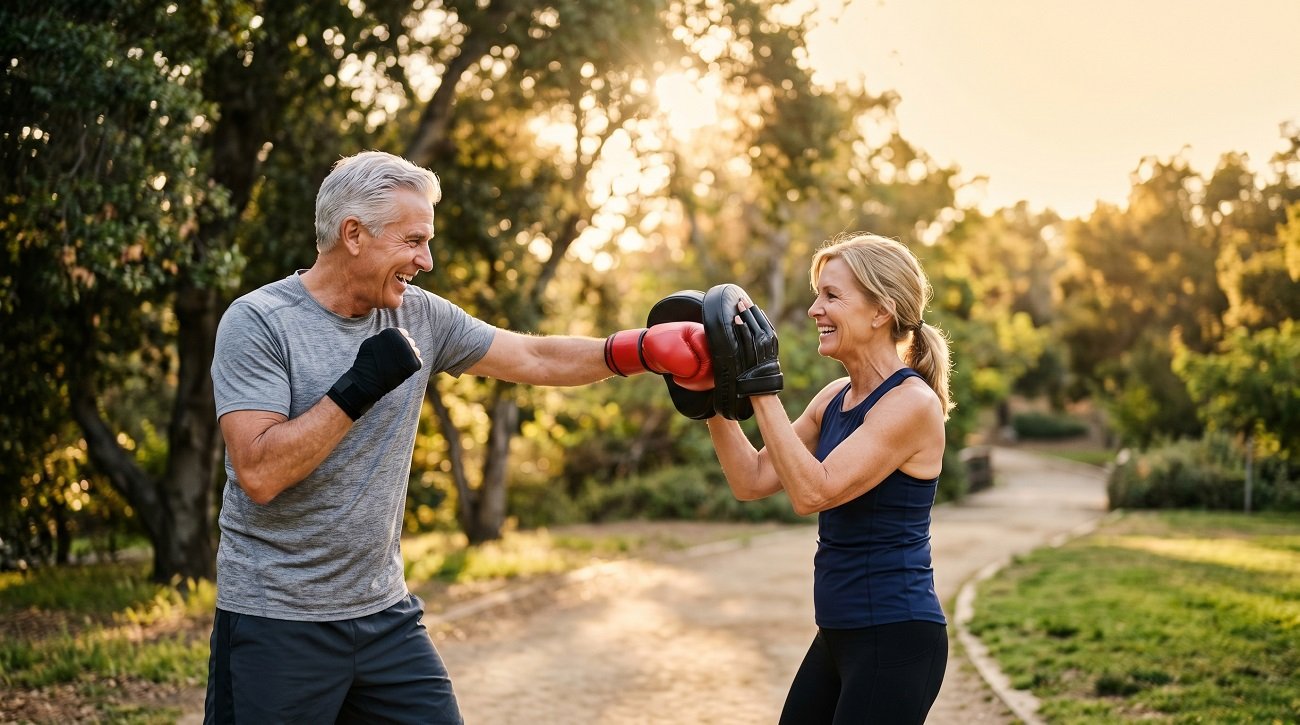
If you have a spouse, friend, or trainer to work with, focus mitts transform boxing from a solo activity into a dynamic, interactive workout. The mitt holder calls combinations, the boxer responds, and both people stay engaged.
- What to look for: Curved mitts with good wrist support. Lighter is better for the holder’s endurance.
- Recommended brands: Ringside, Title Boxing, Fairtex.
- Price range: $30–$70 per pair.
6. A Light Punching Bag (for home training)
A freestanding punching bag or a light heavy bag (40–70 lbs) gives you something to hit at home. The resistance of the bag builds more strength and endurance than air-punching alone.
- What to look for for seniors: Freestanding bags (no ceiling mount needed) with a weighted base. Choose a lighter bag — 40–70 lbs — so the impact doesn’t jar your joints.
- Recommended brands: Century Wavemaster, Ringside Fitness.
- Price range: $100–$250.
7. A Heart Rate Monitor
For older adults managing cardiovascular conditions, a heart rate monitor provides real-time feedback so you stay in your safe training zone. Most smartwatches (Apple Watch, Fitbit, Garmin) include this feature.
- Target heart rate zone for seniors: Generally 50–70% of your maximum heart rate (220 minus your age). Your doctor can give you a more specific target.
What to Skip (For Now)
- Speed bags: These are fun but require specific technique and can be frustrating for beginners. Add these later once your fundamentals are solid.
- Full sparring gear: You don’t need headgear, mouthguards, or groin protectors for fitness and self-defense training. Those are for competitive sparring, which is not appropriate for most older adults.
- Heavy competition gloves (8–10 oz): These have less padding and are designed for competition, not training. Stick with 14–16 oz for safety.
Here’s a quick reference:
| Gear Item | Priority | Est. Cost | Key Feature to Look For |
|---|---|---|---|
| Hand Wraps (180″) | Essential | $10–$20 | Semi-elastic, long enough for full wrap |
| Boxing Gloves (14–16 oz) | Essential | $40–$100 | Velcro closure, multi-layer foam padding |
| Athletic Shoes | Essential | $50–$100 | Flat sole, good ankle support |
| Moisture-Wicking Clothing | Essential | $20–$50 | Lightweight, breathable, full range of motion |
| Focus Mitts | Nice to Have | $30–$70 | Curved, good wrist support |
| Freestanding Punching Bag | Nice to Have | $100–$250 | 40–70 lbs, weighted base |
| Heart Rate Monitor | Nice to Have | $50–$300 | Chest strap or wrist-based optical sensor |
If you’re not sure what to buy or want to try equipment before purchasing, bring your questions to Focus Camp — we’re happy to help you figure out exactly what you need based on your situation.
3. Safety Guidelines Before You Start (Medical Clearance, Warm-Up, and Red Flags)
Before we get into the actual techniques and workouts, I need to lay down some ground rules. These aren’t suggestions — they’re the difference between a safe, enjoyable experience and an injury that sets you back months.
Rule 1: Get Medical Clearance First
I covered this above, but it bears repeating. See your doctor. Tell them you’re starting a boxing-based fitness program. Get cleared for cardiovascular exercise, upper body weight-bearing activity, and balance-challenging movements. If you have any of the following conditions, medical clearance is absolutely mandatory:
- Heart disease, arrhythmia, or history of heart attack/stroke
- High or low blood pressure (uncontrolled)
- Osteoporosis or osteopenia
- Recent surgery (within 6 months)
- Joint replacements (hip, knee, shoulder)
- Diabetes (especially Type 1, to manage blood sugar during exercise)
- Parkinson’s disease or other neurological conditions
- Glaucoma or retinal issues (impact can increase intraocular pressure)
- Any condition affecting balance, coordination, or reaction time
Rule 2: Never Skip the Warm-Up
Cold muscles, tendons, and joints are injury-prone muscles, tendons, and joints. For older adults, the warm-up isn’t optional — it’s the foundation of the entire session. We’ll cover the exact warm-up routine in Section 7, but the principle is simple: 8–12 minutes of gentle, progressive movement that raises your body temperature, lubricates your joints, and primes your nervous system before you throw a single punch.
Rule 3: Learn Proper Form Before Adding Speed or Power
This is the most common mistake I see — and it’s the most dangerous. People get excited, start throwing punches hard and fast before they’ve learned the correct movement pattern, and end up with wrist injuries, shoulder strains, or worse.
Every new technique must be learned at 30–50% speed and power first. Master the form. Build the muscle memory. Only then — over days and weeks, not minutes — should you gradually increase intensity.
Rule 4: Know the Red Flags (Stop Immediately If You Experience These)
During any boxing workout, stop immediately and rest if you experience:
- Sharp pain in any joint (shoulder, wrist, elbow, knee, hip)
- Chest pain, tightness, or pressure
- Dizziness, lightheadedness, or feeling faint
- Sudden shortness of breath beyond normal exertion
- Numbness or tingling in your hands, arms, or legs
- Visual disturbances (blurred vision, seeing spots)
- Nausea or vomiting
- A “popping” sensation in any joint
If any of these symptoms persist, seek medical attention. Do not “push through” pain. Pain is your body’s alarm system — listen to it.
Rule 5: Stay Hydrated
Older adults have a reduced thirst response — you may not feel thirsty even when you’re significantly dehydrated. Drink water before, during, and after every session. In Los Angeles heat, this is even more critical. Aim for 8–16 oz of water 30 minutes before training, sips throughout, and another 8–16 oz after.
Rule 6: Train in a Safe Environment
Clear your training space of obstacles. If you’re outdoors (which I highly recommend — LA has incredible outdoor training spaces), choose flat, even ground. Avoid concrete if possible — grass, turf, or rubber surfaces are more forgiving. If training indoors, make sure you have enough room to extend your arms fully in every direction without hitting walls, furniture, or ceiling fans.
4. The Complete Warm-Up Routine: Low-Impact Mobility Exercises for Seniors
This is the warm-up we use at Focus Camp for every boxing session involving older adults. It takes 10–12 minutes, requires no equipment, and prepares every joint and muscle group you’ll use during the workout. Do not skip any part of this.
Phase 1: General Blood Flow (3 minutes)
The goal here is simple: get blood moving. Raise your core temperature slightly. Feel your body wake up.
Exercise 1: Marching in Place — 90 seconds
- Stand tall, feet hip-width apart
- March in place, lifting your knees to a comfortable height (not necessarily waist-high — whatever feels natural)
- Swing your arms gently and naturally in opposition to your legs
- Breathe normally — in through your nose, out through your mouth
- After 60 seconds, increase the pace slightly — still comfortable, but more purposeful
Exercise 2: Arm Swings — 60 seconds
- Stand with feet shoulder-width apart
- Extend both arms out to your sides at shoulder height
- Swing both arms forward until they cross in front of your chest (right over left), then swing them back to the starting position
- Alternate which arm crosses on top with each swing
- Keep the movement smooth and rhythmic
- After 30 seconds, switch to vertical arm swings: swing both arms up overhead, then down to your sides
Exercise 3: Shoulder Circles — 30 seconds
- Stand tall, arms relaxed at your sides
- Lift your shoulders up toward your ears, then roll them backward in large circles
- 10 circles backward, then 10 forward
- Make the circles as large and smooth as possible
Phase 2: Joint Mobilization (5 minutes)
Now we take each major joint through its full range of motion, gently and progressively.
Exercise 4: Neck Mobility — 60 seconds
- Stand tall, shoulders relaxed
- Slowly turn your head to the right (look over your right shoulder), hold 2 seconds, return to center
- Slowly turn your head to the left, hold 2 seconds, return to center
- 5 turns each direction
- Then: tilt your right ear toward your right shoulder (don’t lift the shoulder), hold 2 seconds, return to center. Repeat left. 5 tilts each direction
- Move slowly. Never force your neck. Never roll your neck in full circles — this compresses the cervical vertebrae
Exercise 5: Wrist and Forearm Circles — 60 seconds
- Extend both arms in front of you at chest height
- Make fists, then circle your wrists: 10 circles clockwise, 10 counterclockwise
- Open your hands, spread your fingers wide, then make fists again — repeat 10 times
- Shake your hands gently for 10 seconds
This is critical for boxing — your wrists will be under load during every punch, and they need to be warm and mobile.
Exercise 6: Hip Circles — 60 seconds
- Stand with feet shoulder-width apart, hands on your hips
- Circle your hips clockwise in large, smooth circles — 10 circles
- Reverse direction — 10 circles counterclockwise
- Keep your upper body as stable as possible; the movement comes from your hips
Exercise 7: Ankle Circles — 60 seconds
- Stand on your left foot (hold a wall or chair for balance if needed)
- Lift your right foot slightly off the ground
- Circle your right ankle: 10 circles clockwise, 10 counterclockwise
- Switch feet and repeat on the left ankle
- This reduces ankle sprain risk and prepares your feet for footwork
Exercise 8: Gentle Torso Rotation — 60 seconds
- Stand with feet shoulder-width apart, arms relaxed
- Rotate your torso to the right, letting your arms swing naturally — don’t force the range
- Rotate to the left
- 15–20 gentle rotations, gradually increasing range as you feel your spine loosen
- This directly prepares your core for the rotational demands of punching
Phase 3: Boxing-Specific Activation (3 minutes)
Now we activate the exact muscles and movement patterns you’ll use during boxing.
Exercise 9: Shadowboxing Warm-Up — 60 seconds (at 20% speed)
- Take your boxing stance (we’ll teach you the exact stance in Section 8)
- Throw very slow, very gentle jabs — just the arm motion, no power, no speed
- 10 jabs with the left hand, 10 with the right
- Focus on feeling the shoulder engage, the core rotate slightly, and the wrist stay straight
Exercise 10: Defensive Slip Drill — 60 seconds
- Stand in your boxing stance
- Slowly shift your head and upper body to the left (as if slipping a punch), return to center
- Slowly shift to the right, return to center
- 10 slips each direction
- Keep your feet planted — the movement comes from your knees and hips, not stepping
Exercise 11: Footwork Shuffles — 60 seconds
- In your boxing stance, take two small steps forward, two small steps back
- Then two steps to the left, two steps to the right
- Keep your feet roughly the same distance apart throughout — don’t bring your feet together
- Light, bouncy steps — like you’re walking on hot sand
- 4 rounds of forward-back, 4 rounds of side-to-side
You’re now warm. Your joints are lubricated, your muscles are activated, your nervous system is primed. You’re ready to train.
| Warm-Up Phase | Duration | Purpose |
|---|---|---|
| Phase 1: General Blood Flow | 3 minutes | Raise core temperature, get blood moving |
| Phase 2: Joint Mobilization | 5 minutes | Full range of motion for every major joint |
| Phase 3: Boxing-Specific Activation | 3 minutes | Activate punching muscles, practice basic movements |
| Total | 11 minutes | Fully prepared for safe, effective training |
5. Basic Boxing Techniques Every Older Adult Must Learn First
Before you throw a single combination, you need to master four foundational elements. These are the building blocks of everything in boxing — and getting them right is what makes boxing safe and effective instead of risky.
The Boxing Stance
Your stance is your foundation. Get this wrong and everything else falls apart — your balance, your power, your ability to defend yourself.
How to stand (for right-handed people — “orthodox” stance):
- Stand with your feet shoulder-width apart
- Take a small step back with your right foot (about 12–18 inches)
- Angle your rear (right) foot outward at about 45 degrees
- Keep your lead (left) foot pointing roughly toward your target
- Bend both knees slightly — not a deep squat, just a soft, athletic bend
- Distribute your weight approximately 50/50 between both feet
- Lift your hands up: left hand at cheekbone height, 6–8 inches from your face; right hand near your chin, elbow tucked against your ribs
- Tuck your chin slightly — look at your target through your eyebrows, not over your hands
- Keep your shoulders relaxed and slightly rounded forward — not tense, not shrugged
For left-handed people (“southpaw” stance): Mirror everything — right foot forward, left foot back, right hand lead.
Common mistakes to avoid:
- Standing too upright (makes you off-balance and limits your power)
- Standing with feet too close together (unstable base)
- Holding your hands too low (exposes your face)
- Locking your knees (reduces mobility and increases joint stress)
- Leaning forward (puts weight on your front foot, makes you vulnerable)
The Jab (Lead Hand Punch)
The jab is the most important punch in boxing. It’s your range-finder, your setup punch, your defensive tool, and your primary self-defense weapon. It’s also the safest punch to throw because it requires the least rotation and puts the least stress on your joints.
Step-by-step technique:
- Start in your boxing stance
- Push off the ball of your rear (right) foot for stability
- Extend your lead (left) hand straight toward the target — fist traveling in a straight line from your cheek to the target
- As you extend, rotate your fist so your palm faces the ground at the point of contact (this protects your wrist)
- Your shoulder should rise slightly to protect your chin
- Don’t lock your elbow — keep a very slight bend at full extension
- Snap your hand back to your cheek immediately after the punch — don’t leave it hanging out there
- Your rear hand stays glued to your chin throughout
Power source: The jab generates most of its power from the shoulder and arm, with a very slight forward push from the rear foot. It’s not a power punch — it’s a speed and precision punch.
Common mistakes for seniors:
- Overextending the arm (hyperextends the elbow — keep that slight bend)
- Dropping the rear hand (leaves your chin exposed)
- Not retracting quickly (leaves your arm vulnerable)
- Punching “from the shoulder” without engaging the core at all (weakens the punch and increases shoulder strain)
The Cross (Rear Hand Punch)
The cross is your power punch. It travels from your rear hand across your body to the target, using your hips and core to generate significantly more force than the jab.
Step-by-step technique:
- Start in your boxing stance
- Push off your rear (right) foot, pivoting on the ball of that foot — your heel should lift and your hip should rotate forward
- As your hip rotates, your right hand drives forward from your chin toward the target in a straight line
- Rotate your fist so your palm faces the ground at contact
- Your lead (left) hand stays at your cheek, protecting your chin
- Your hips and torso do most of the work — the arm is just the delivery system
- Snap your hand back to your chin
- Return to your boxing stance
Power source: The cross generates power from the ground up — foot pivot → hip rotation → core rotation → shoulder → arm → fist. This chain is what makes it powerful, and it’s also what makes it safe: the force is distributed across your entire body rather than concentrated in your shoulder or wrist.
Common mistakes for seniors:
- Not pivoting the rear foot (takes all the power out and stresses the shoulder)
- Rotating too far (loses balance — stop when your shoulders are roughly square to the target)
- Dropping the lead hand during the punch (leaves you open)
- “Pushing” the punch instead of “snapping” it (tires you out and reduces speed)
The Hook (Lead Hand)
The hook is a short-range power punch that comes around the side. It’s excellent for self-defense because it targets the side of the head or the body — areas that are hard to defend with a straight-arm guard.
Step-by-step technique:
- Start in your boxing stance
- Pivot on your lead (left) foot, rotating your left hip forward
- Lift your left elbow to shoulder height, arm bent at approximately 90 degrees
- Swing your left fist in a tight horizontal arc toward the target — imagine drawing a small circle in the air with your fist
- Your fist should make contact with the target at the same height as your elbow — don’t drop or raise the elbow during the punch
- Your rear hand stays at your chin
- Snap the hand back immediately
Power source: The hook’s power comes almost entirely from hip and core rotation. The arm is just the delivery mechanism. If you’re swinging with your arm alone, you’re doing it wrong — and you’re putting unnecessary stress on your shoulder.
Common mistakes for seniors:
- Swinging the arm wide (telegraphs the punch and increases shoulder injury risk)
- Not keeping the elbow at shoulder height (reduces power and increases wrist strain)
- Over-rotating the hips (throws you off balance)
- Throwing hooks before mastering jabs and crosses (the hook requires more skill and body coordination)
The Guard Position (Defensive Shell)
The guard is how you protect yourself. It’s not just about holding your hands up — it’s an active defensive position that allows you to block, deflect, and counter.
How to hold the guard:
- Hands up: lead hand at cheekbone height, rear hand at chin height
- Elbows tucked close to your ribs — don’t flare them out
- Chin tucked behind your lead shoulder
- Forearms forming a “wall” in front of your face and torso
- Look through the gap between your gloves — don’t look at the floor
- Stay relaxed — a tense guard tires you out quickly and reduces your reaction speed
From the guard, you can:
- Block straight punches by meeting them with your gloves
- Block hooks by connecting your glove to your temple/elbow to your ribs
- Slip punches by moving your head off the center line
- Parry punches by deflecting them with your lead hand
- Counter-punch immediately after any defensive movement
Here’s a summary of the four foundational techniques:
| Technique | Hand | Primary Power Source | Difficulty | Injury Risk | Self-Defense Value |
|---|---|---|---|---|---|
| Jab | Lead (front) | Shoulder + slight rear foot push | Low | Low | High — creates distance, range-finder |
| Cross | Rear (back) | Foot pivot + hip rotation + core | Medium | Low–Medium | High — powerful deterrent |
| Hook | Lead (front) | Hip rotation + core rotation | Medium–High | Medium | Very High — targets side of head/body |
| Guard | Both | N/A (defensive position) | Low | Very Low | Essential — foundation of self-defense |
Take time with these fundamentals. Spend at least your first 2–3 sessions just working on stance, jab, cross, and guard before adding anything else. Quality over speed. Quality over power. Quality over everything.
If you’d like hands-on guidance to ensure your form is correct from day one, our private coaching sessions give you real-time feedback from experienced trainers who understand older bodies.
6. Proper Form and Posture Tips That Prevent Injury
The difference between safe boxing and injury-prone boxing is almost entirely about form. Here are the specific form cues that matter most for older adults — the details that separate a protective, empowering workout from a trip to the orthopedist.
Wrist Alignment
The rule: Your wrist must be straight — a straight line from your knuckles through your forearm — at the moment of every punch.
Why it matters: A bent wrist under impact force is a sprained or fractured wrist. Older adults often have reduced bone density in the small hand and wrist bones, making proper alignment even more critical.
How to check: Throw a slow-motion jab at the air. Look at your wrist from the side. Is it perfectly straight? Or is it bent up, down, or to the side? If it’s bent, adjust your fist position until the line is straight. Practice this at slow speed until the alignment is automatic.
Common error: Letting the wrist bend backward on impact. This happens when people “reach” for the target with a fully extended arm. Keep a slight bend in your elbow at full extension — this prevents hyperextension and protects both your wrist and elbow.
Shoulder Position
The rule: Your shoulder should rise slightly to protect your chin when you jab, but you should never shrug it up toward your ear or overextend it forward.
Why it matters: The shoulder joint is the most mobile joint in your body — and the most vulnerable to injury. Boxing places significant demands on the rotator cuff, and poor shoulder position is the number one cause of boxing-related shoulder injuries in older adults.
How to check: After throwing a jab, your shoulder should feel engaged but not strained. If you feel pinching, clicking, or sharp pain in the front or top of your shoulder, you’re overextending. Pull your punches back 2–3 inches and see if the discomfort disappears.
Core Engagement
The rule: Your core — the muscles around your abdomen and lower back — should be gently engaged throughout every boxing movement. Think of it as “bracing” — as if someone were about to give you a light tap on the stomach.
Why it matters: Your core is the bridge between your lower body (where your power comes from) and your upper body (where your punches originate). A weak or disengaged core means your lower back absorbs forces it wasn’t designed to handle. This is how back injuries happen.
How to check: Place one hand on your stomach while shadowboxing. You should feel your abdominal muscles activating with every punch. If your stomach is completely relaxed, you’re punching with your arms alone — and putting unnecessary stress on your spine.
Foot Position and Weight Distribution
The rule: Keep your weight balanced between both feet (approximately 50/50 at rest, shifting slightly with each punch). Never put all your weight on your front foot or lean forward past your front toes.
Why it matters: Leaning forward makes you off-balance (a fall risk) and puts excessive pressure on your lead knee. It also reduces your ability to retract punches and defend yourself.
How to check: Have someone gently push your shoulder during your boxing stance. If you stumble forward, your weight is too far forward. Adjust until a light push doesn’t knock you off balance.
Breathing
The rule: Exhale sharply through your nose (a short, controlled burst — like a “tsst” sound) with every punch. Inhale between punches.
Why it matters: Holding your breath during exertion (the Valsalva maneuver) dramatically increases blood pressure — dangerous for anyone with hypertension or cardiovascular risk. Proper breathing also engages your core and helps maintain rhythm.
How to check: You should hear a short, sharp exhale with each punch. If you’re silent while punching, you’re holding your breath. If you’re gasping, you’re working too hard — slow down.
Head Position
The rule: Keep your chin slightly tucked, your eyes looking forward through or just over your gloves, and your head centered over your spine — not jutting forward.
Why it matters: A forward-jutting head (very common in people who spend time at computers or looking at phones) puts enormous strain on the cervical spine. Boxing with this posture amplifies that strain with every rotation. Tucking your chin also naturally protects your neck and throat.
The Summary Table of Form Cues
| Body Part | Correct Position | Common Error | Consequence of Error |
|---|---|---|---|
| Wrist | Straight line from knuckles to forearm | Bent wrist on impact | Wrist sprain or fracture |
| Shoulder | Engaged, slightly raised to protect chin | Overextended or shrugged | Rotator cuff strain, impingement |
| Core | Gently braced throughout | Disengaged / relaxed | Lower back strain, reduced power |
| Feet | Weight 50/50, balanced over both feet | Leaning forward, weight on front foot | Fall risk, knee stress |
| Chin | Slightly tucked behind lead shoulder | Head jutting forward | Neck strain, exposed chin |
| Breathing | Sharp exhale with each punch | Holding breath | Dangerous blood pressure spike |
| Elbows | Slightly bent at full extension | Fully locked out | Elbow hyperextension, joint stress |
7. Beginner Self-Defense Drills Adapted for Older Adults
These drills teach practical self-defense skills using boxing fundamentals. They’re designed specifically for older adults — no contact, no sparring, no risk of injury. Just the movements and reactions that could protect you in a real situation.
Drill 1: The Defensive Push (Creating Distance)
Purpose: If someone gets too close, you need to create space immediately. This drill teaches you to push an attacker away and reset to a safe distance.
How to do it:
- Stand in your boxing stance, facing a wall or a sturdy pad held by a partner
- From your guard, extend both hands forward in a sharp, explosive push — palms open, arms extended about 80% (don’t lock elbows)
- As you push, step backward with your rear foot — creating distance
- Immediately return to your boxing stance, hands up
- Repeat 10 times, then switch lead foot and repeat
Key points:
- The push comes from your hips and legs, not just your arms
- Step backward as you push — you’re creating space, not just pushing someone in place
- Practice this until the push-then-step-back becomes automatic
Drill 2: The Escape Step (Moving Off the Line)
Purpose: If someone approaches aggressively, you need to move off the direct line of approach — not stand there like a target.
How to do it:
- Stand in your boxing stance
- Imagine an attacker approaching from your front
- Take a quick, sharp step to your left (at a 45-degree angle) — pivoting on your lead foot
- As you step, turn your body to face where the attacker was (you’re now at their side)
- Hands stay up in guard throughout
- Return to starting position
- Repeat 10 times, then practice stepping to the right
Key points:
- The step should be quick and decisive — not a casual shuffle
- Always end up facing the threat — never turn your back
- Practice both directions — you may need to escape to either side
Drill 3: The Verbal Boundary (Using Voice as Self-Defense)
Purpose: The most effective self-defense tool is your voice. Predators rely on silence and compliance. A loud, commanding voice attracts attention and disrupts their plan.
How to do it:
- Stand in your boxing stance, hands up in guard
- In a deep, loud, commanding voice, say: “STOP. BACK AWAY. I DON’T WANT TROUBLE.”
- Practice this at full volume — not shouting, but projecting from your diaphragm
- Combine with the defensive push: verbal command → push → escape step
- Repeat until the combination feels natural
Key points:
- Your voice is your most powerful weapon. Use it.
- Practice at full volume — whispering “stop” won’t help in a real situation
- The combination of a loud voice + confident stance + physical readiness is extremely effective at deterring most attackers
Drill 4: The Quick Jab Response (Defensive Strike)
Purpose: If distance creation and verbal commands fail, a quick, sharp jab to the nose or eyes creates the moment you need to escape.
How to do it:
- Stand in your boxing stance, hands in guard
- On a verbal cue (partner says “NOW!” or you tap your own thigh as a trigger), throw a quick, sharp jab to a pad or the air at nose/eye height
- Immediately step backward and return to guard
- Repeat 10 times
Key points:
- Speed matters more than power. A fast, accurate jab to the nose is disorienting regardless of how strong you are
- This is a last resort — use it only when you cannot escape, create distance, or de-escalate
- Always step backward after the jab — your goal is to escape, not to fight
These drills form the foundation of our self-defense approach at Focus Camp. We integrate them into our private coaching sessions so that every client — regardless of age — feels confident in their ability to protect themselves.
8. The Complete Shadowboxing Routine for Seniors
Shadowboxing — throwing punches and moving in the air without a bag or pads — is the purest form of boxing training. It develops technique, coordination, cardiovascular fitness, and muscle memory simultaneously. It’s also the safest form of boxing because there’s no impact at all.
Here’s a complete 15-minute shadowboxing routine designed specifically for older adults. Do this 3–4 times per week.
Round 1: Jab Focus (3 minutes)
Minutes 0:00–1:00: Slow jabs only. Focus on perfect form. One jab at a time, reset to guard, jab again. 10 jabs per minute.
Minutes 1:00–2:00: Double jabs. Jab-jab, reset. Jab-jab, reset. Slightly faster than Round 1.
Minutes 2:00–3:00: Jab with forward step. Step forward with your lead foot as you jab, then step back to your starting position. 10 step-jabs per minute.
Rest 30 seconds. March in place. Shake your arms out.
Round 2: Cross and Combination Focus (3 minutes)
Minutes 0:00–1:00: Jab-cross combination. Jab with the lead hand, then cross with the rear hand, return to guard. Slow and controlled. 8 combinations per minute.
Minutes 1:00–2:00: Jab-cross-jab. Three punches: jab, cross, jab. Return to guard after each combination. Slightly faster. 6 combinations per minute.
Minutes 2:00–3:00: Jab-cross-hook. Three punches: jab, cross, lead hook. Return to guard. 5 combinations per minute. This is the most complex combination — go slow and prioritize form.
Rest 30 seconds. March in place. Breathe deeply.
Round 3: Defensive Movement (3 minutes)
Minutes 0:00–1:00: Jab-slip. Throw a jab, then slip to the right (move your head off the center line). Return to guard. 8 per minute.
Minutes 1:00–2:00: Jab-cross-slip-slip. Throw jab-cross, then slip left, then slip right. Return to guard. 6 per minute.
Minutes 2:00–3:00: Jab-cross-roll. Throw jab-cross, then perform a defensive roll (bend your knees and rotate your torso in a U-shape under an imaginary punch). 4 per minute.
Rest 30 seconds. Hip circles. Wrist circles.
Round 4: Footwork and Movement (3 minutes)
Minutes 0:00–1:00: Step-and-jab. Move forward two steps while jabbing, then move backward two steps while jabbing. Continuous movement.
Minutes 1:00–2:00: Lateral movement. Step to the left and jab, step to the right and jab. Keep your feet roughly shoulder-width apart throughout — don’t bring your feet together.
Minutes 2:00–3:00: Circle movement. Move in a circle (imagine you’re circling around an opponent). Jab as you move. Switch directions halfway through.
Rest 30 seconds. March in place. Prepare for the final round.
Round 5: Free Flow (3 minutes)
This is your round. Throw whatever combinations feel natural. Mix jabs, crosses, hooks, and defensive movements. Move in any direction. Focus on staying relaxed, breathing properly, and maintaining good form. Don’t try to go fast — try to flow.
This round is where the cognitive benefits peak — you’re improvising, making decisions in real-time, and coordinating your entire body without a script.
After the Final Round
Walk in place for 60 seconds. Let your heart rate come down naturally. Then proceed to the cool-down routine in Section 15.
| Round | Focus | Duration | Intensity | Key Technique |
|---|---|---|---|---|
| 1 | Jab | 3 min | Low | Straight punches, single and double |
| 2 | Cross & Combinations | 3 min | Low–Medium | Jab-cross, jab-cross-jab, jab-cross-hook |
| 3 | Defensive Movement | 3 min | Medium | Slips, rolls, head movement |
| 4 | Footwork & Movement | 3 min | Medium | Forward, backward, lateral, circular steps |
| 5 | Free Flow | 3 min | Low–Medium | Improvised combinations and movement |
| Total | Full boxing training | 15 min + rests | Controlled | All fundamental skills |
9. Balance and Coordination Exercises That Use Boxing Principles
Balance is the single most important physical attribute for preventing falls in older adults. Boxing naturally trains balance — but these specific drills amplify that benefit dramatically.
Exercise 1: Single-Leg Jab Balance
- Stand in your boxing stance
- Lift your rear foot slightly off the ground (just 1–2 inches)
- Throw 5 slow jabs while balancing on your lead foot
- Switch feet and repeat
- If you lose balance, put your foot down and try again — no shame in that
Why it works: Balancing on one leg while performing a coordinated upper-body movement forces your proprioceptive system (your body’s internal balance sensor) to work overtime. This is exactly the kind of challenge that builds fall-resistant balance.
Exercise 2: Stance Shift Balance Drill
- Stand with feet together
- Step into your boxing stance with your left foot forward
- Hold for 3 seconds
- Step back to feet together
- Step into boxing stance with your right foot forward
- Hold for 3 seconds
- Repeat 10 times each side
Why it works: This trains your ability to establish a stable base quickly — essential for both boxing and real-world balance recovery.
Exercise 3: Clock Step Boxing
- Stand in your boxing stance, imagining you’re standing in the center of a clock face
- Step forward to 12 o’clock, throw a jab, return to center
- Step to 3 o’clock (your right), throw a jab, return to center
- Step to 6 o’clock (backward), throw a jab, return to center
- Step to 9 o’clock (your left), throw a jab, return to center
- Complete the full clock, then reverse direction
Why it works: Multi-directional movement with a stable upper body trains the complex balance skills needed for real-world situations — dodging obstacles, recovering from stumbles, moving through crowds.
Exercise 4: Tandem Stance Cross
- Stand with one foot directly in front of the other (heel to toe), as if standing on a tightrope
- Throw 5 slow crosses while maintaining this narrow stance
- Switch which foot is in front and repeat
- Hold a wall or chair if needed — reduce the challenge as you build skill
Why it works: The narrow base makes balance significantly harder, forcing deep stabilizer muscles in your ankles, knees, and hips to activate.
| Balance Exercise | Difficulty | Equipment Needed | Primary Benefit |
|---|---|---|---|
| Single-Leg Jab | Medium | None | Proprioception, ankle stability |
| Stance Shift | Easy | None | Quick base establishment |
| Clock Step | Medium | None | Multi-directional stability |
| Tandem Stance Cross | Hard | Wall/chair for support | Deep stabilizer activation |
10. Low-Impact Modifications for Every Boxing Movement
Not every older adult can perform standard boxing movements right away. Here are specific modifications for the most common limitations:
For Limited Shoulder Mobility (Frozen Shoulder, Rotator Cuff Issues, Arthritis)
Modification: Reduce the height and range of your punches. Instead of punching at face height, punch at chest height. Instead of full arm extension, punch to 60–70% extension. This reduces shoulder stress while still training the movement pattern and engaging the core.
Progression: As mobility improves over weeks, gradually raise punch height and increase extension.
For Wrist Pain or Arthritis
Modification: Use lighter gloves with extra padding. Wrap your wrists more thoroughly — an extra loop around the wrist joint. Consider using palm strikes (open hand, striking with the heel of your palm) instead of closed-fist punches for air work. Palm strikes train the same movement pattern without the wrist flexion that causes pain.
Progression: As wrist strength and flexibility improve, transition to standard fist position with wraps.
For Knee Pain or Replacements
Modification: Reduce the depth of your boxing stance — don’t bend your knees as deeply. Minimize lateral (side-to-side) footwork initially. Focus on upper-body boxing technique while standing in a comfortable, natural stance. Add footwork gradually as knee comfort allows.
Progression: Over weeks, deepen the stance and add gentle lateral movement.
For Lower Back Pain
Modification: Reduce the amount of hip rotation in your punches. Focus on arm and shoulder technique initially, adding core rotation gradually. Avoid leaning forward — keep your weight centered. Consider performing some drills seated in a sturdy chair to completely eliminate spinal load while still training upper body technique.
Progression: As back strength improves, add more rotation and transition to standing drills.
For Balance Issues or Fear of Falling
Modification: Perform all drills near a wall, sturdy chair, or countertop that you can grab if needed. Reduce footwork to minimal steps. Focus on stationary punching and defensive movements initially. Consider boxing while seated until confidence builds.
Progression: Gradually move away from the support surface. Add footwork as balance improves.
For Reduced Grip Strength (Common with Arthritis)
Modification: Use gloves with a pre-curved design that reduces the need to make a tight fist. Some gloves have an ergonomic hand pocket that holds your hand in the correct position without requiring strong grip. Also consider gloves with a wider hand compartment for arthritic knuckles.
Modification Summary Table
| Limitation | Modification | Equipment Adjustment | Progression Path |
|---|---|---|---|
| Shoulder mobility | Lower punch height, shorter extension | None | Gradually raise height and extend range |
| Wrist pain | Palm strikes, extra wrapping | Lighter gloves, more padding | Transition to fists as pain decreases |
| Knee pain | Shallower stance, less footwork | Supportive shoes | Deepen stance, add lateral movement |
| Lower back pain | Reduce rotation, consider seated drills | Chair or bench | Add rotation, transition to standing |
| Balance issues | Near-wall drills, minimal footwork | Wall/chair nearby | Gradually reduce support dependence |
| Grip strength | Pre-curved gloves, wider compartment | Ergonomic gloves | Standard gloves as grip improves |
11. Common Boxing Injuries in Older Adults and Exactly How to Avoid Them
Let me be direct: boxing injuries in older adults are almost always preventable. They result from doing too much too soon, using poor form, skipping warm-ups, or ignoring pain signals. Here’s every common injury, why it happens, and exactly how to prevent it.
Injury 1: Wrist Sprain or Strain
What it feels like: Pain on the inside or outside of the wrist, especially when bending it or gripping. Swelling may occur.
Why it happens: Punching with a bent wrist. Not wrapping hands properly. Using gloves with insufficient padding. Hitting a heavy bag too hard before building wrist strength.
How to prevent it:
- Always wrap your hands before any boxing session — no exceptions
- Check wrist alignment on every punch during the first few weeks
- Start with air punching (shadowboxing) before progressing to pads or bags
- Use 14–16 oz gloves with multi-layer padding
- Strengthen wrists separately with wrist curls and grip exercises
Injury 2: Shoulder Impingement or Rotator Cuff Strain
What it feels like: Pain at the top or front of the shoulder, especially when raising your arm overhead or reaching behind you. May feel like a “pinching” sensation.
Why it happens: Overextending punches (arm fully locked, shoulder reaching too far forward). Punching too hard without proper shoulder conditioning. Poor posture (rounded shoulders) limiting the space in the shoulder joint.
How to prevent it:
- Keep a slight bend in your elbow at full extension
- Don’t “reach” for targets — move your feet closer instead
- Strengthen your rotator cuff with external rotation exercises (using a light resistance band)
- Warm up your shoulders thoroughly before every session
- Reduce punch power if you feel any pinching
Injury 3: Lower Back Strain
What it feels like: Aching or sharp pain in the lower back, especially during or after twisting movements. May radiate into the buttocks or upper thigh.
Why it happens: Rotating from the lower back instead of the hips. Weak core muscles failing to stabilize the spine. Leaning forward during punches.
How to prevent it:
- Engage your core throughout every boxing movement
- Rotate from your hips, not your lower back
- Don’t lean forward — keep your weight centered over your feet
- Strengthen your core separately with planks, bird-dogs, and dead bugs
- Stretch your hip flexors daily — tight hip flexors force the lower back to compensate
Injury 4: Elbow Hyperextension
What it feels like: Sharp pain at the back of the elbow when straightening the arm. May feel a “pop” at the moment of injury.
Why it happens: Throwing punches with a completely straight arm. “Punching through” the target with full lockout.
How to prevent it:
- Never fully lock your elbow — always maintain a slight bend at full extension
- Think of “snapping” your punches rather than “pushing” them
- Practice at slow speed until the correct extension point becomes automatic
Injury 5: Ankle Sprain (During Footwork)
What it feels like: Pain and swelling on the outside of the ankle after rolling or twisting it.
Why it happens: Stepping on uneven surfaces. Bringing feet too close together during footwork. Wearing shoes with poor ankle support.
How to prevent it:
- Wear flat-soled shoes with good ankle support
- Keep feet roughly shoulder-width apart throughout footwork
- Train on flat, even surfaces
- Strengthen ankles with the ankle circle exercises from the warm-up
- Don’t rush footwork — slow, controlled steps first
Injury Prevention Summary
| Injury | Root Cause | Prevention Strategy | Warning Signs |
|---|---|---|---|
| Wrist sprain | Bent wrist on impact | Proper wrapping, alignment checks, gradual progression | Pain in wrist during/after punches |
| Shoulder impingement | Overextension, poor conditioning | Slight elbow bend, rotator cuff strengthening | Pinching at top of shoulder |
| Lower back strain | Poor rotation mechanics, weak core | Core engagement, hip rotation, posture awareness | Aching during or after twisting |
| Elbow hyperextension | Fully locked arm | Never lock elbow, snap don’t push | Sharp pain at back of elbow |
| Ankle sprain | Uneven surface, narrow footwork | Flat surface, proper shoes, wide stance | Rolling or twisting during steps |
12. The Complete Cool-Down and Stretching Routine
The cool-down is just as important as the warm-up — maybe more so for older adults. It gradually brings your heart rate down, prevents blood pooling (which can cause dizziness), reduces post-exercise muscle soreness, and maintains the flexibility you’ve worked hard to build.
Spend 10–12 minutes on this routine after every boxing session.
Phase 1: Active Recovery (3 minutes)
Walking in Place — 2 minutes
After your last boxing round, don’t sit down immediately. Walk in place at a slow, comfortable pace for 2 minutes. Let your breathing return to normal. Swing your arms gently.
Deep Breathing — 1 minute
Stand with feet hip-width apart. Inhale slowly through your nose for 4 counts, filling your lungs completely. Hold for 2 counts. Exhale slowly through your mouth for 6 counts. Repeat 5 times. This activates your parasympathetic nervous system (the “rest and digest” system) and begins the recovery process.
Phase 2: Upper Body Stretches (4 minutes)
Chest and Shoulder Stretch — 60 seconds
Stand in a doorway. Place both forearms on the door frame at shoulder height, elbows at 90 degrees. Step gently forward through the doorway until you feel a stretch across your chest and the front of your shoulders. Hold for 30 seconds. Breathe deeply. Release, shake your arms out, repeat once.
Tricep Stretch — 30 seconds per arm
Raise your right arm overhead, bend at the elbow, and let your right hand drop behind your head toward your left shoulder blade. Use your left hand to gently press your right elbow further back. Hold 30 seconds. Switch arms.
Forearm and Wrist Stretch — 60 seconds
Extend your right arm in front of you, palm facing up. Use your left hand to gently pull your right fingers downward toward the floor. Hold 15 seconds. Then flip your right palm to face down and gently pull your fingers toward your body. Hold 15 seconds. Switch arms and repeat.
This stretch is essential after boxing — your forearms and wrists have been working hard.
Neck Stretches — 60 seconds
Stand tall, shoulders relaxed. Tilt your right ear toward your right shoulder — don’t lift the shoulder. Hold 15 seconds. You should feel a gentle stretch on the left side of your neck. Return to center. Tilt left ear toward left shoulder. Hold 15 seconds. Then gently tuck your chin toward your chest and hold 15 seconds. Finally, look up toward the ceiling (gently — don’t force it) and hold 15 seconds.
Phase 3: Lower Body Stretches (4 minutes)
Standing Quad Stretch — 30 seconds per leg
Stand on your left foot (hold a wall for balance). Bend your right knee and bring your right heel toward your buttock. Grasp your right ankle with your right hand and gently pull it closer. You should feel a stretch in the front of your right thigh. Hold 30 seconds. Switch legs.
Standing Hamstring Stretch — 30 seconds per leg
Place your right heel on a low step, bench, or curb in front of you. Keep your right leg straight (slight bend is fine). Hinge forward from your hips — not your waist — until you feel a stretch in the back of your right thigh. Keep your back straight. Hold 30 seconds. Switch legs.
Calf Stretch — 30 seconds per leg
Stand facing a wall, about arm’s length away. Place your right foot behind you, toes pointing forward, heel on the ground. Lean into the wall, bending your front knee, until you feel a stretch in your right calf. Hold 30 seconds. Switch legs.
Hip Flexor Stretch — 30 seconds per side
Step your right foot forward into a lunge position (hold a wall for balance). Lower your hips gently toward the floor — you should feel a stretch in the front of your left hip. Keep your torso upright. Hold 30 seconds. Switch sides.
Hip Circles (gentle) — 30 seconds
Stand with feet hip-width apart. Make small, gentle circles with your hips — 5 clockwise, 5 counterclockwise. These should be slow, relaxed, and feel good.
Phase 4: Final Relaxation (1 minute)
Stand with feet hip-width apart, arms relaxed at your sides. Close your eyes. Take 5 deep breaths — in through your nose for 4 counts, out through your mouth for 6 counts. With each exhale, consciously relax your shoulders, your hands, your jaw. Notice how your body feels. You just completed a boxing workout. Be proud of that.
| Cool-Down Phase | Duration | Purpose |
|---|---|---|
| Phase 1: Active Recovery | 3 minutes | Gradual heart rate reduction, prevent dizziness |
| Phase 2: Upper Body Stretches | 4 minutes | Shoulder, wrist, forearm, and neck flexibility |
| Phase 3: Lower Body Stretches | 4 minutes | Quad, hamstring, calf, and hip flexibility |
| Phase 4: Final Relaxation | 1 minute | Nervous system reset, mindfulness |
| Total | 12 minutes | Complete recovery and flexibility maintenance |
13. Recovery Tips: Rest, Hydration, Nutrition, and Sleep
Training is the stimulus. Recovery is when your body actually adapts and gets stronger. For older adults, recovery is not optional — it’s where the real results happen.
Rest Days
How many rest days per week? For older adults starting boxing, I recommend 2–3 rest days per week. Your body needs 48–72 hours to fully recover from a boxing session, especially in the first few weeks when your muscles, tendons, and joints are adapting to new movement patterns.
What counts as rest? Rest doesn’t mean sitting on the couch all day. Active recovery — gentle walking, light stretching, easy swimming — actually speeds recovery by promoting blood flow to damaged tissues without creating new damage.
Signs you need more rest:
- Persistent muscle soreness that doesn’t improve within 48 hours
- Unusual fatigue or lack of motivation
- Elevated resting heart rate (check it first thing in the morning)
- Poor sleep quality
- Irritability or mood changes
- Joint pain (not muscle soreness — joint pain is a red flag)
Hydration
Daily intake: Aim for 64–80 oz of water per day on non-training days. On training days, add 16–24 oz for every 30 minutes of exercise.
During training: Sip water every 10–15 minutes. Don’t wait until you’re thirsty — by the time you feel thirsty, you’re already mildly dehydrated.
Electrolytes: If you’re training in LA heat or sweating heavily, consider adding an electrolyte supplement (sodium, potassium, magnesium) to your water. Coconut water is a natural option.
Signs of dehydration: Dark yellow urine, dry mouth, headache, dizziness, muscle cramps.
Nutrition for Recovery
Protein: This is the most important macronutrient for older adults doing resistance training. Aim for 20–30g of protein within 2 hours of every boxing session. Good sources: eggs, Greek yogurt, chicken, fish, tofu, legumes, or a protein shake.
Why protein matters more after 50: Older adults experience “anabolic resistance” — their muscles are less responsive to protein than younger adults. This means you need more protein, not less, to trigger muscle repair and growth.
Daily protein target: 1.0–1.2g per kilogram of body weight per day (higher than the standard 0.8g recommendation). For a 150-lb (68 kg) adult, that’s 68–82g of protein daily.
Anti-inflammatory foods: Boxing creates controlled inflammation (a good thing — it’s how your body adapts). Support this process with anti-inflammatory foods: fatty fish (salmon, sardines), berries, leafy greens, turmeric, ginger, olive oil, and nuts.
Foods to minimize: Processed sugar, excessive alcohol, and highly processed foods increase inflammation and slow recovery.
Sleep
How much? 7–9 hours per night. Sleep is when your body releases growth hormone, repairs muscle tissue, consolidates motor learning (the boxing skills you practiced), and reduces inflammation.
Sleep quality tips for older adults:
- Maintain a consistent sleep schedule (same bedtime and wake time, even on weekends)
- Avoid screens for 60 minutes before bed (blue light suppresses melatonin)
- Keep your bedroom cool (65–68°F is optimal)
- Avoid caffeine after 2 PM
- Consider a brief afternoon nap (20–30 minutes) if you feel tired — it actually improves nighttime sleep quality, not reduces it
- Stretch gently before bed — the cool-down routine above can double as a pre-bed stretching session
Recovery Summary
| Recovery Factor | Recommendation | Why It Matters for Seniors |
|---|---|---|
| Rest days | 2–3 per week | Longer tissue repair time after 50 |
| Water intake | 64–80 oz daily + 16–24 oz per training session | Reduced thirst response with age |
| Protein | 20–30g within 2 hours post-workout; 1.0–1.2g/kg daily | Anabolic resistance requires higher intake |
| Anti-inflammatory diet | Fish, berries, greens, turmeric, olive oil | Supports controlled training inflammation |
| Sleep | 7–9 hours nightly | Growth hormone release, motor learning consolidation |
| Active recovery | Walking, gentle stretching on rest days | Promotes blood flow without creating new damage |
For a deeper dive into recovery strategies, check out our guide on recovery techniques for active people in Los Angeles.
14. Boxing for Parkinson’s Disease, Arthritis, and Other Conditions
One of the most remarkable things about boxing is its therapeutic potential for specific medical conditions that affect older adults. Let me share what the research shows — and what we’ve seen firsthand at Focus Camp.
Boxing and Parkinson’s Disease
This is where the research is most compelling. Multiple clinical trials have demonstrated that boxing-based exercise programs produce significant improvements in people with Parkinson’s disease — including improvements in balance, gait speed, mobility, and quality of life.
A 2025 meta-analysis published in Frontiers in Public Health reviewed boxing intervention studies and found consistent improvements in lower extremity strength, balance, and functional mobility among older adults. The researchers specifically noted that boxing’s combination of rhythmic movement, cognitive challenge, and multi-directional balance demands makes it uniquely suited for Parkinson’s rehabilitation.
Rock Steady Boxing, a program specifically designed for Parkinson’s patients, has reported improvements in:
- Gait speed and stride length
- Balance and reduced fall frequency
- Postural stability
- Hand-eye coordination
- Voice volume (many boxing drills involve verbal cues and loud counting)
- Quality of life and mood
Important note: Boxing for Parkinson’s should always be supervised by a trainer who understands the condition and its medication cycles. Timing sessions around medication effectiveness (when dopamine levels are highest) produces significantly better results.
Boxing and Arthritis
Counterintuitively, boxing is one of the best exercises for people with arthritis. Here’s why:
- Joint movement promotes cartilage health: The controlled range-of-motion involved in boxing movements pumps synovial fluid through the joints, nourishing cartilage and reducing stiffness.
- Strengthening muscles around joints reduces arthritis pain: Stronger muscles absorb more force, reducing the load on arthritic joints.
- Boxing is low-impact: Unlike running or jumping, boxing involves minimal joint compression. You’re moving and rotating, not landing.
- Reduces inflammation markers: Regular moderate exercise reduces systemic inflammation, which is the underlying driver of arthritis progression.
The Arthritis Foundation specifically recommends boxing-style exercises for people with osteoarthritis and rheumatoid arthritis — emphasizing the importance of proper form and gradual progression.
Boxing and Diabetes
Regular exercise is one of the most effective tools for managing Type 2 diabetes. Boxing, with its combination of aerobic and resistance elements, improves insulin sensitivity, helps manage blood glucose levels, and supports healthy weight management.
For older adults with diabetes, boxing offers the added benefit of being engaging enough to sustain long-term — which is critical for chronic disease management. One important precaution: monitor blood sugar before and after training, especially if you’re on insulin or sulfonylureas, as exercise can lower blood sugar levels.
Boxing and Cardiovascular Disease
Boxing’s interval nature (alternating bursts of activity with rest periods) is exactly the pattern that cardiologists recommend for cardiovascular rehabilitation. It improves VO2 max, reduces resting heart rate, and lowers blood pressure — all without the monotony of treadmill walking.
If you have a cardiac history, get specific clearance from your cardiologist and use a heart rate monitor during training to stay within your prescribed zone.
Boxing and Depression/Anxiety
Exercise is consistently recommended as a first-line treatment for mild to moderate depression and anxiety. Boxing adds several unique elements: the focus required acts as moving meditation, the physical exertion releases endorphins, the skill progression builds self-efficacy, and the social element of training with others reduces isolation.
For older adults experiencing loneliness, loss of purpose, or reduced self-confidence — conditions that are far more common than most people realize — boxing provides structure, challenge, community, and accomplishment.
| Condition | How Boxing Helps | Key Precautions |
|---|---|---|
| Parkinson’s Disease | Improves balance, gait, mobility, cognition | Time sessions around medication cycles; supervised training |
| Arthritis | Promotes cartilage health, reduces stiffness, builds supporting muscles | Avoid overloading inflamed joints; use modifications |
| Diabetes | Improves insulin sensitivity, manages blood glucose | Monitor blood sugar; stay hydrated |
| Cardiovascular Disease | Improves VO2 max, reduces heart rate and blood pressure | Medical clearance; heart rate monitoring |
| Depression/Anxiety | Endorphins, focus, social connection, self-efficacy | Start slow; consistency matters more than intensity |
15. Weekly Training Schedule for Seniors Starting Boxing
Here’s the exact weekly schedule I recommend for older adults who are new to boxing. It’s progressive, balanced, and designed to build your skills and fitness without overwhelming your body.
Weeks 1–2: Foundation Phase
| Day | Activity | Duration | Focus |
|---|---|---|---|
| Monday | Warm-up + Stance & Jab practice + Cool-down | 25 min | Learning the basics |
| Tuesday | Rest or gentle walk | 20–30 min | Active recovery |
| Wednesday | Warm-up + Jab & Cross practice + Balance drills + Cool-down | 30 min | Building combinations |
| Thursday | Rest or gentle stretching | 15–20 min | Recovery |
| Friday | Warm-up + Shadowboxing Round 1–2 + Self-defense drill 1 + Cool-down | 30 min | Integrating skills |
| Saturday | Longer outdoor walk + stretching | 30–45 min | Cardio and flexibility |
| Sunday | Full rest | — | Complete recovery |
Weeks 3–4: Building Phase
| Day | Activity | Duration | Focus |
|---|---|---|---|
| Monday | Full warm-up + Shadowboxing Rounds 1–3 + Cool-down | 35 min | Technique and endurance |
| Tuesday | Rest or gentle walk | 20–30 min | Active recovery |
| Wednesday | Full warm-up + Shadowboxing Rounds 1–4 + Balance drills + Cool-down | 40 min | Footwork and defense |
| Thursday | Rest or gentle stretching | 15–20 min | Recovery |
| Friday | Full warm-up + Shadowboxing Rounds 1–5 + Self-defense drills + Cool-down | 45 min | Full routine |
| Saturday | Longer outdoor walk + stretching | 30–45 min | Cardio and flexibility |
| Sunday | Full rest | — | Complete recovery |
Weeks 5–8: Progression Phase
| Day | Activity | Duration | Focus |
|---|---|---|---|
| Monday | Full warm-up + Full shadowboxing routine + Balance drills + Cool-down | 45–50 min | Full training session |
| Tuesday | Active recovery (walking, light stretching) | 20–30 min | Recovery |
| Wednesday | Full warm-up + Shadowboxing + Self-defense drills + Optional pad work + Cool-down | 45–50 min | Skill integration |
| Thursday | Rest or gentle yoga/stretching | 20–30 min | Recovery |
| Friday | Full warm-up + Full shadowboxing routine + Balance + Cool-down | 45–50 min | Full training session |
| Saturday | Longer outdoor activity (hiking, walking, swimming) | 45–60 min | Cardio and enjoyment |
| Sunday | Full rest | — | Complete recovery |
Progression Markers (When to Move to the Next Phase)
Move from Weeks 1–2 to Weeks 3–4 when:
- You can hold your boxing stance comfortably for 60 seconds
- You can throw 10 consecutive jabs with correct form
- You can throw jab-cross combinations at moderate speed
Move from Weeks 3–4 to Weeks 5–8 when:
- You can complete the full 5-round shadowboxing routine
- Your defensive movements (slips, rolls) feel natural
- You can maintain good form throughout a 45-minute session
16. Frequently Asked Questions
Is boxing safe for someone over 65?
Yes — fitness boxing and self-defense training are safe for most adults over 65 when done with proper form, appropriate modifications, and medical clearance. Fitness boxing does not involve getting hit. You’ll punch pads, bags, and air. The key is working with a trainer who understands older bodies and progressing gradually.
Can I start boxing at 70 with no experience?
Absolutely. We’ve had clients start at 72, 75, even 78. Boxing is a skill-based activity — you learn it step by step, just like learning to drive or cook. Age is not a barrier. The learning itself is one of the most valuable parts, because it challenges your brain in ways that walking or swimming simply don’t.
Will boxing hurt my arthritic hands?
With proper hand wraps, well-padded gloves (14–16 oz), and correct punching technique, boxing is generally safe for people with mild to moderate hand arthritis. The movement actually promotes circulation in the hand and wrist joints. If you have severe arthritis, start with palm strikes and progress to fist work as comfort allows. Always consult your rheumatologist first.
How often should seniors do boxing workouts?
2–3 sessions per week is ideal for most older adults, with at least one rest day between sessions. This allows adequate recovery while maintaining the consistency needed for skill development and fitness improvement.
Do I need to spar or get hit?
No. Fitness boxing and self-defense training for seniors do not involve sparring or receiving punches. You’ll learn techniques, practice on pads and bags, and develop skills that improve your fitness and confidence — all without any risk of head trauma.
What if I have a bad knee or hip replacement?
Boxing can usually be adapted for joint replacements. The key modifications are: shallower stance (less knee bend), reduced footwork (fewer lateral steps), and focus on upper-body technique. Always get clearance from your orthopedic surgeon and inform your trainer about your specific limitations.
Can boxing help with Parkinson’s disease?
Research strongly suggests yes. Boxing-based exercise programs have been shown to improve balance, gait speed, mobility, and quality of life in people with Parkinson’s. The combination of rhythmic movement, cognitive challenge, and multi-directional balance work appears to be uniquely beneficial. Always work with a trainer experienced in Parkinson’s-specific modifications.
How soon will I see results?
Most people notice improved energy, mood, and coordination within 2–4 weeks. Visible improvements in posture, muscle tone, and confidence typically appear within 6–10 weeks. Balance and cognitive benefits continue to build for months and years.
What gear do I need to start?
At minimum: hand wraps (180 inches) and a pair of boxing gloves (14–16 oz). Comfortable athletic shoes with flat soles are also important. You can start shadowboxing with just wraps and no gloves if you’re working on form only.
Can boxing really help with self-defense for older adults?
Yes — not in the “learn to fight” sense, but in the “learn to protect yourself” sense. Boxing develops spatial awareness, the ability to create distance, the confidence to use your voice assertively, and the physical readiness to react quickly. These skills are far more valuable for real-world self-defense than learning complex martial arts techniques.
Is it too late to start?
No. Your body responds to appropriate exercise at any age. Your brain forms new neural connections at any age. Your capacity for growth, adaptation, and improvement does not have an expiration date. The only thing that’s “too late” is deciding you can’t.
17. Ready to Start? Your Next Steps with Focus Camp
You’ve just read the most comprehensive guide to boxing for older adults that exists. You understand the science, the techniques, the safety protocols, the gear, the recovery strategies, and the self-defense applications.
Now it’s time to do something with that knowledge.
At Focus Camp, Tina and I have spent years helping older adults in Los Angeles discover the transformative power of boxing-inspired fitness training. We do it outdoors — in parks, on beaches, in the beautiful LA sunshine — because we know that training in nature amplifies every benefit. We do it with private, one-on-one attention — because every body is different, and cookie-cutter programs don’t work for people who deserve personalized care. And we do it with genuine warmth and expertise — because we believe that every person who walks through our door (or joins us on the grass) deserves to feel capable, confident, and supported.
If any of this resonated with you — if you felt a spark of “maybe I could do this” — I want you to know: you can. And we’d love to show you how.
Here’s how to take the next step:
→ Explore our programs and services: Focus Camp Services
→ Book your first session: Online Booking
→ Read about our outdoor workout philosophy: Outdoor Workouts in Los Angeles
→ Learn about our private coaching approach: Private Coaching Sessions
→ See what other older adults are experiencing: Best Soft Workouts for Older People
→ Have questions? Reach out directly: Contact Us
You don’t have to figure this out alone. Your stronger, more confident, more capable future is waiting — and it’s closer than you think.
Let’s move with purpose — together.
François & Tina
Focus Camp – Los Angeles Outdoor Fitness & Wellness
P.S. Bookmark this article and come back to it. Start with the warm-up in Section 7, the stance in Section 8, and the first two rounds of the shadowboxing routine in Section 11. Do that three times this week. By next week, you’ll already feel the difference. And when you’re ready for expert guidance, we’ll be here.