You know that feeling. It’s 2 a.m. The room is dark. Your partner is sleeping fine. And you’re just… lying there. Eyes open. Mind racing. Checking the clock every fifteen minutes.
I talk to people about this every single week. Not in a clinic. Not in a sleep lab. In parks. On beaches. At Focus Camp, where we train adults over 50 here in Los Angeles. And honestly? Sleep is the thing that comes up more than weight loss, more than joint pain, more than anything else.
“I haven’t slept through the night in three years.”
“I fall asleep fine but wake up at 3 a.m. and can’t go back.”
“I’m exhausted all day but the second I get in bed, my brain turns on.”
Sound familiar?
Here’s what I’ve learned after doing this work for years: the answer isn’t melatonin gummies. It isn’t a new pillow. It isn’t blackout curtains — though those help. The thing that actually, genuinely, long-term fixes your sleep is exercise. But not just any exercise. And definitely not just any way of doing it.
The type matters. The timing matters. Where you do it matters. How often matters. Get those pieces right and you can — I’ve watched this happen hundreds of times — go from sleeping five broken hours to sleeping seven straight. Get them wrong and you might actually make things worse. I’ve seen that too.
This article is everything. Everything I’ve learned from the research, from the scientists who study this stuff, and from the real people — ages 50 to 78 — who’ve come through our programs and told me, six weeks later, that they’re sleeping again. Really sleeping.
Let me walk you through all of it.
Table of Contents
- Why Your Sleep Fell Apart After 50
- What the Research Actually Says About Exercise and Sleep
- The Timing Problem Nobody Talks About
- Exercise #1: Walking — The Most Underrated Sleep Aid
- Exercise #2: Yoga — The Bedtime Exercise That Works
- Exercise #3: Strength Training — The Sleep Tool Nobody Mentions
- Exercise #4: Aqua Fitness — The Joint-Friendly Solution
- Exercise #5: Tai Chi — Ancient Practice, Modern Science
- Exercise #6: Pilates — The Surprise Winner
- Exercise #7: Outdoor Group Exercise — The Compound Effect
- Your Complete Weekly Sleep-Exercise Plan
- 8 Mistakes That Ruin Your Sleep-Exercise Efforts
- Beyond Exercise: The Full Sleep Toolkit
- When to See a Doctor
- FAQ
Why Your Sleep Fell Apart After 50
Look, before we get into solutions, you need to know what’s actually going on. Because a lot of people over 50 think they’re doing something wrong. They’re not. Their body changed. That’s different.
Your Internal Clock Shifted
You’ve got this tiny cluster of cells in your brain — the suprachiasmatic nucleus, if you want the technical name — that runs your 24-hour cycle. It tells you when to feel alert, when to feel drowsy, when to sleep.
As you age, this clock shifts forward. Scientists call it a “phase advance.” What it means in real life: you’re drowsy at 8:30 p.m. and wide awake at 4 a.m. Your clock didn’t break. It just runs on a different schedule now. And when your schedule doesn’t match the rest of the world — dinner plans, evening TV, your spouse — you end up fighting your own biology.
You lose that fight every time.
You’re Getting Less Deep Sleep
This one’s important. Sleep happens in cycles — each one about 80 to 100 minutes. Inside each cycle, there are four stages:
| Stage | What’s Happening | Duration | What Changes After 50 |
|---|---|---|---|
| Stage 1 — Light sleep | Drifting off. Muscles relax, heart rate slows. | 1–7 min | Easy to get pulled out of. Noise, pain, anxiety — any of it wakes you. |
| Stage 2 — Deeper light sleep | Body temp drops, brain waves slow down. | 10–25 min | You spend more time here than you used to. |
| Stage 3 — Deep sleep | The good stuff. Growth hormone, tissue repair, immune function. | 20–40 min | This is what disappears. You get less of it every year. |
| Stage 4 — REM sleep | Dreaming. Memory processing, emotional regulation. | 10–60 min | Also decreases. Affects mood, focus, memory. |
Here’s the thing that frustrates people: you can lie in bed for eight hours and still wake up feeling like you got hit by a truck. Why? Because the quantity was there but the quality wasn’t. You need Stage 3 deep sleep to feel rested. And after 50, your body gives you less of it.
Hormones Are Working Against You
If you’re a woman: Menopause drops your estrogen and progesterone hard. Both of those hormones help you sleep. Estrogen helps your body use serotonin — the neurotransmitter that makes you feel calm. Progesterone has natural sedative properties. When those hormones crash, you lose two of your body’s built-in sleep aids. Then add hot flashes and night sweats on top — which hit up to 75% of menopausal women — and bedtime becomes a war zone.
If you’re a man: Testosterone drops about 1% per year after 30. It’s gradual, but by 50 or 60, it adds up. Low testosterone is linked to poor sleep, more fatigue, and higher rates of sleep apnea. Men over 50 with low T are significantly more likely to wake up multiple times per night.
Medications Make It Worse
Here’s a number that caught me off guard: 46% of Medicare enrollees take five or more medications. Blood pressure pills, cholesterol drugs, antidepressants, pain meds. And a lot of them mess with sleep. Beta-blockers can suppress melatonin. Corticosteroids cause insomnia. Some antidepressants cut your REM sleep.
I’m not telling you to stop your meds. That’s between you and your doctor. But it’s worth knowing that the pills keeping you alive during the day might be keeping you awake at night.
Pain Creates a Cycle
Half of people with insomnia also deal with chronic pain. The relationship goes both ways: pain wakes you up, bad sleep makes pain worse the next day, worse pain makes sleep harder the next night. Round and round.
Exercise breaks this cycle. Not by eliminating pain — though it often reduces it significantly — but by building the kind of deep physical fatigue that overrides pain signals when your head hits the pillow.
What the Research Actually Says About Exercise and Sleep
I’m not going to hit you with vague claims. You deserve the specifics.
The Big One: Exercise Rivals Medication (BMJ, 2025)
In July 2025, a team of researchers published a major analysis in BMJ Evidence Based Medicine. They looked at 22 randomized clinical trials. 1,348 people. 13 different treatments for insomnia — seven of which were exercise-based.
The results honestly shocked a lot of people in the medical community.
| Treatment | Effect on Total Sleep Time | Effect on Sleep Quality | How Long Benefits Lasted |
|---|---|---|---|
| Yoga | Added nearly 2 hours | Sleep efficiency up ~15% | Ongoing with regular practice |
| Tai Chi | Added 50+ minutes | Poor sleep scores down 4+ points | Up to 2 years |
| Walking / Jogging | Significant improvement | Insomnia severity down ~10 points | Ongoing with regular practice |
| CBT (therapy) | Large increase | Improved across the board | Long-term — but hard to access |
| Sleep Hygiene alone | Modest | Some benefit | Limited |
Read that yoga line again. Nearly two extra hours of sleep. That’s not a typo.
And here’s the part that made headlines: the researchers said exercise isn’t just a “complement” to other treatments. It can work as a primary treatment for insomnia. That’s a big deal. That’s researchers telling doctors: before you prescribe sleeping pills, try prescribing a walking routine.
The Biggest Study Ever Done (BMC Public Health, 2025)
A separate team reviewed 86 clinical trials — one of the largest analyses ever conducted on exercise and sleep. They ranked exercise types:
- Pilates — top performer
- Aerobic exercise — close second
- Resistance training — strong, especially for deep sleep
- Combined aerobic + resistance — better than either alone
- Tai Chi — significant quality improvements
- Yoga — varies a lot by style (gentle yoga crushed it; hot yoga didn’t)
The Consistency Threshold
A 2020 study in the International Journal of Behavioral Nutrition and Physical Activity found something very specific: moderate exercise, three times per week is enough to meaningfully improve sleep in adults over 60.
Not every day. Not intense. Three times a week at a moderate pace.
What’s “moderate”? You can talk but you can’t sing. Heart rate’s up, breathing’s harder, but you’re not gasping. On a 1-to-10 effort scale, it’s about a 5 or 6. For most people over 50, that’s a brisk 30-minute walk, a bodyweight workout, or a 40-minute aqua class.
The Timing Problem Nobody Talks About
This is where people mess up. They hear “exercise helps sleep” and go for a run at 9 p.m. Then they lie in bed at midnight wondering why they’re still awake.
Timing matters. A lot.
The 4-to-8-Hour Window
Research from the National Library of Medicine found that exercising 4 to 8 hours before bed is the sweet spot. During this window, exercise cuts the time it takes you to fall asleep and reduces how long you stay awake during the night.
For most people with a 10 p.m. bedtime, that means working out between roughly 2 p.m. and 6 p.m.
But Morning Has a Secret Weapon
Here’s something most articles skip: morning outdoor exercise is probably the best time for long-term sleep improvement. Not because of the exercise itself — any time of day gives you the physical benefits. But because of the sunlight.
When you exercise outside in the morning, two things happen at once. The physical activity builds up adenosine — a chemical that creates “sleep pressure” throughout the day — and resets your core body temperature rhythm. At the same time, natural light hits specialized cells in your eyes that send a direct signal to your internal clock: “It’s morning. Be alert.” That signal makes the evening “time to sleep” signal way stronger.
Dr. Michelle Drerup, who runs the Behavioral Sleep Medicine program at Cleveland Clinic, said it plainly: morning outdoor exercise helps regulate circadian rhythm because “an increase in natural sunlight exposure can further help strengthen sleep/wake rhythms.”
This is actually why we schedule most Focus Camp sessions in the morning. You get movement and sunlight in one shot. That combo hits sleep harder than either one alone.
The Evening Rules
You don’t have to skip evening exercise. But match the intensity to the clock:
| Time Window | Go Ahead and… | Don’t… |
|---|---|---|
| 6 a.m. – noon | Go hard. HIIT, running, heavy lifting, group classes. | — |
| Noon – 4 p.m. | Moderate stuff. Brisk walk, swim, cycle, lift. | — |
| 4 – 7 p.m. | Easy walk, gentle yoga, light stretching. | Anything that makes you sweat hard. |
| After 7 p.m. | Restorative yoga, breathing exercises. | Anything that raises your heart rate. |
Simple rule: The closer to bedtime, the gentler the movement.
Exercise #1: Walking — The Most Underrated Sleep Aid There Is
I’m starting here because walking is the exercise almost everyone can do, almost nobody takes seriously, and the research behind it is stronger than most people realize.
What the Science Says
The 2025 BMJ analysis found walking and jogging cut insomnia severity by nearly 10 points on the Insomnia Severity Index. That’s the difference between “moderate insomnia” and “no clinically significant problem.”
A Stanford study from this year found that walking in segments of at least 10 minutes — not just short strolls to the fridge — provides the most benefit for sleep and overall health.
Research from Healthline shows regular walkers over 60 consistently report better sleep than sedentary adults, even after controlling for diet and medication.
Why Walking Helps You Sleep
It works through five separate pathways:
Energy expenditure. A brisk 30-minute walk burns 107 to 189 calories depending on your pace and weight. That creates real physical fatigue — the kind that makes your body crave sleep, not just your mind.
Cortisol reduction. Walking in nature — especially in the morning — drops your cortisol levels significantly. Elevated cortisol at night is one of the most common reasons people lie awake with their mind spinning.
Melatonin regulation. Sunlight exposure during a morning walk tells your body to produce melatonin at the right time (evening) instead of the wrong time (mid-afternoon when you’re drowsy at your desk).
Temperature rhythm. Walking raises your core body temperature. The drop that follows later in the evening creates a natural sleep signal.
Mood improvement. Walking reduces anxiety and rumination — those repetitive negative thoughts that keep you staring at the ceiling. A Stanford study found that walking in nature specifically reduces activity in the brain region tied to repetitive negative thinking.
How to Walk for Maximum Sleep Benefit
When: Morning, between 7 and 10 a.m. Get that sunlight.
Where: Outdoors. LA has unreal options — the beach (sand adds resistance and works your stabilizer muscles), Griffith Park (gentle hills), the Santa Monica Mountains (trails), or honestly just a quiet neighborhood with some incline.
How long: 30 to 45 minutes. If you’re just starting, 20 minutes is fine. Build up over two to three weeks.
How fast: Brisk. You can hold a conversation but you couldn’t sing. Roughly 3.0 to 3.5 mph on flat ground.
How often: Five days a week minimum. Daily is ideal. The consistency matters way more than any single session.
The LA thing: We’ve got year-round walking weather. No snow, no ice, no brutal humidity. There’s genuinely no excuse not to walk outdoors here. And the variety — beach, mountains, parks, neighborhoods — means you won’t get bored. Boredom is the real enemy of consistency.
For a full walking program with specific LA routes and weekly progressions, we put together a step-by-step walking workout guide for adults over 50.
Exercise #2: Yoga — The Bedtime Exercise That Actually Works (If You Pick the Right Kind)
Yoga’s the exercise everyone associates with better sleep. And the research backs that up — mostly. But there’s a catch that most people miss, and it matters a lot.
The Catch: Not All Yoga Helps Sleep
The 2025 BMJ study found yoga added nearly 2 hours of total sleep and boosted sleep efficiency by about 15%. Huge.
But that big 86-trial analysis ranked yoga last among exercise types for sleep. How can both be true?
Because they studied different kinds of yoga. The studies showing massive benefits used gentle, restorative yoga. The ones showing minimal benefits used power yoga or hot yoga. Do intense yoga close to bedtime and you’ll raise your cortisol and core temperature — making sleep worse, not better.
So the style you choose matters enormously.
Which Yoga Style Does What
| Style | Intensity | Best Time | Sleep Effect | Who It’s For |
|---|---|---|---|---|
| Restorative | Very low | Evening, 1–2 hrs before bed | Excellent — calms nervous system | Insomnia, anxiety, chronic pain |
| Hatha | Low to moderate | Morning or afternoon | Good — gentle movement + breath | Beginners, limited mobility |
| Yin | Very low | Evening | Excellent — long holds, deep tension release | Stiff joints, high stress |
| Nidra | Very low (lying down) | Right before bed | Excellent — guided body scan | Can’t “shut off” your brain |
| Vinyasa / Flow | Moderate to high | Morning only | Good during day, harmful at night | Active people wanting a workout |
| Hot Yoga | High | Morning only | Bad within 4 hrs of bedtime | Not recommended for sleep |
| Power Yoga | High | Morning only | Bad at night | Not recommended for sleep |
The 8 Poses That Actually Help You Sleep
These are the ones I teach at Focus Camp. Each targets something specific — a physical tension or a mental pattern — that keeps people awake.
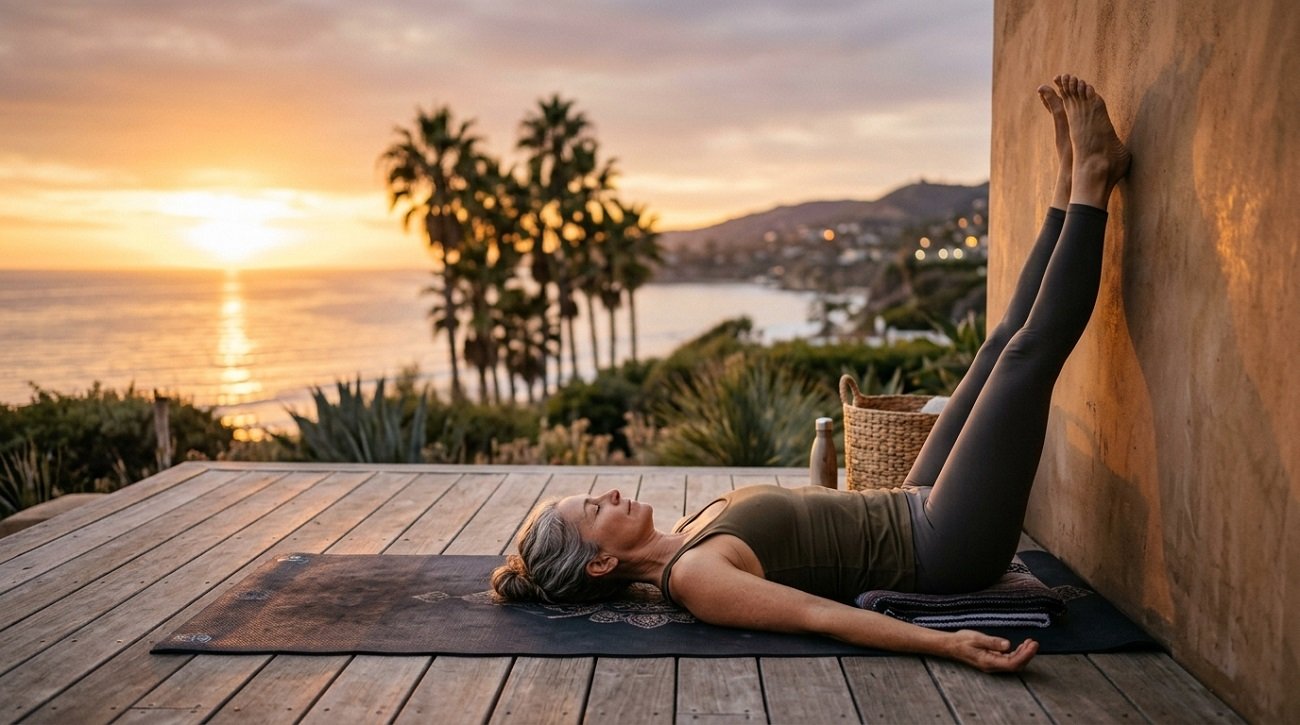
1. Legs Up the Wall (Viparita Karani)
Lie on your back. Scoot your hips close to a wall and extend your legs up it so your body makes an L shape. Arms at your sides, palms up. Eyes closed. Stay there for 5 to 10 minutes.
This one reverses blood flow in your legs, reduces swelling, and flips on your parasympathetic nervous system — the “rest and digest” mode. It’s probably the single most calming thing you can do without a prescription.
One mistake I see: people try to get their hips right against the wall. Don’t. Leave a few inches. More comfortable, same benefit.
2. Child’s Pose (Balasana)
Kneel on the floor. Sit back on your heels. Fold forward until your forehead touches the ground. Arms extended in front or resting alongside your body. Hold for 2 to 3 minutes.
This stretches your lower back, hips, and thighs. The forward fold calms your nervous system. And the pressure on your forehead activates the vagus nerve — the one that promotes relaxation.
Bad knees? Put a folded blanket between your calves and thighs.
3. Supine Spinal Twist (Supta Matsyendrasana)
Lie on your back. Bring your right knee to your chest, then guide it across your body to the left with your left hand. Right arm extends out to the side. Head turns right. Hold 1 to 2 minutes. Switch sides.
Releases tension in the spine and lower back. The twisting motion also massages your internal organs and helps digestion — which matters because eating too close to bedtime disrupts sleep.
4. Cat-Cow (Marjaryasana-Bitilasana)
Hands and knees. Inhale — arch your back, look up. Exhale — round your back, tuck chin to chest. Move slowly. 10 to 15 repetitions.
Loosens the entire spine. The rhythmic movement tied to your breathing calms your nervous system down fast.
5. Reclined Butterfly (Supta Baddha Konasana)
Lie on your back. Press the soles of your feet together, let your knees fall to the sides. Hands on your belly or extended overhead. Stay for 3 to 5 minutes.
Opens your hips and inner thighs — spots where a lot of people hold stress without realizing it. The open-chest position also lets you breathe deeper.
6. Standing Forward Bend (Uttanasana)
Stand with feet hip-width apart. Fold forward from the hips. Let your head and arms hang heavy. Bend your knees a little if your hamstrings are tight. Hold 1 to 2 minutes.
The inversion sends more blood to your brain, which quiets mental chatter. The hamstring and lower back stretch releases physical tension that built up all day.
7. Corpse Pose with Deep Breathing (Savasana)
Lie flat on your back. Arms at your sides, palms up. Legs straight, feet falling naturally outward. Eyes closed. Breathe in for 4 counts, hold for 4, breathe out for 6. Do this for 5 to 10 minutes.
This is the bridge between being awake and being asleep. That extended exhale — longer than the inhale — is one of the fastest ways to activate your relaxation response. A lot of people fall asleep during this pose. That’s fine. That’s kind of the point.
8. Seated Breathing Exercise (Sukhasana with Pranayama)
Sit cross-legged on a cushion. Close your eyes. Breathe in through your nose for 4 counts. Hold for 4. Breathe out through your nose for 8 counts. Repeat for 3 to 5 minutes.
The 4-4-8 pattern — with the exhale twice as long as the inhale — is used by sleep researchers and therapists worldwide. It works fast.
A 15-Minute Bedtime Routine You Can Start Tonight
Do this every night, 30 to 60 minutes before bed:
| Order | Pose | Time | Why |
|---|---|---|---|
| 1 | Cat-Cow | 2 min | Loosen spine, sync breath to movement |
| 2 | Standing Forward Bend | 1 min | Release hamstrings, lower back |
| 3 | Child’s Pose | 2 min | Calm nervous system, stretch back |
| 4 | Supine Spinal Twist | 2 min each side | Release spinal tension, aid digestion |
| 5 | Reclined Butterfly | 3 min | Open hips, deeper breathing |
| 6 | Legs Up the Wall | 3 min | Reverse blood flow, activate rest mode |
| 7 | Corpse Pose + deep breathing | 3 min | Transition into sleep state |
Fifteen minutes. No equipment. Your bedroom floor. Do this consistently for two weeks and you’ll feel the difference.
Our yoga and fitness classes in Los Angeles include both morning active sessions and evening restorative sessions. The morning ones are more vigorous. The evening ones focus on exactly these kinds of poses.
Exercise #3: Strength Training — The Sleep Tool Nobody Mentions
Here’s the one that surprises people. Nobody hears “I want to sleep better” and thinks “you should lift weights.” But the research is pretty clear on this: resistance training is one of the strongest sleep-improvement tools available to adults over 50.
What the Research Shows
A 2020 meta-analysis found resistance training improved sleep quality more effectively than some forms of aerobic exercise in the over-50 crowd. The specific mechanism: strength training increases slow-wave sleep — that’s Stage 3, the deepest, most restorative phase. It also lowers inflammation and helps regulate growth hormone and testosterone, both of which directly affect sleep.
A 2025 American Heart Association position stand confirmed resistance training is safe even for adults with cardiovascular conditions. So even if you’ve got high blood pressure or a heart history, you can still do this.
The Four Ways Strength Training Helps You Sleep
More deep sleep. The physical stress of lifting — followed by recovery — pushes your body to spend more time in Stage 3. That’s where growth hormone gets released, tissues get repaired, and your immune system strengthens.
Better hormone regulation. Regular lifting improves insulin sensitivity, lowers cortisol, and supports healthy testosterone in men. All three of those directly improve sleep quality.
Less pain. Stronger muscles support your joints better. Less joint pain means fewer nighttime awakenings. A 2025 study on sarcopenia confirmed that resistance training reverses age-related muscle loss at any age — even past 80.
Better body composition. Extra weight around the middle is strongly linked to sleep apnea and poor sleep. Muscle burns more calories at rest than fat does. Over time, strength training shifts your body composition in a direction that helps you breathe better at night.
A Complete Strength Routine for Better Sleep
No gym needed. Your body, some resistance bands, 30 minutes, three times a week.
| Exercise | Sets | Reps | Rest | What It Works |
|---|---|---|---|---|
| Bodyweight Squats (or chair squats) | 3 | 12–15 | 60 sec | Legs, glutes, core |
| Wall Push-Ups | 3 | 10–15 | 60 sec | Chest, shoulders, arms |
| Resistance Band Rows | 3 | 12 per arm | 60 sec | Upper back, biceps |
| Step-Ups (low bench) | 3 | 10 per leg | 60 sec | Legs, balance |
| Dead Bugs | 3 | 10 per side | 45 sec | Core, lower back protection |
| Glute Bridges | 3 | 15 | 45 sec | Glutes, hamstrings, lower back |
| Bicep Curls (bands or light weights) | 3 | 12–15 | 45 sec | Arms, grip strength |
Total time: 25 to 30 minutes.
Frequency: 3 times per week. At least one rest day between sessions.
Best time: Morning or early afternoon. Not within 3 hours of bed.
When to progress: When 15 reps feel easy, go to a heavier band or add a set.
Two mistakes I see constantly:
First, people skip legs. Your legs have the biggest muscles in your body. Working them creates the biggest hormonal response and the deepest fatigue. Don’t just do bicep curls and call it a day.
Second, people train too often without resting. Overtraining raises cortisol chronically — which actually makes sleep worse. If you’re wired-tired (exhausted but can’t sleep), you might be doing too much. Back off for a couple days.
For a full bodyweight program you can do anywhere in LA, check out how to build muscle without a gym.
Exercise #4: Aqua Fitness — The Joint-Friendly Sleep Solution
If your knees hurt, your back hurts, your hips hurt — and that’s part of why you can’t sleep — aqua fitness might be your best option. The water removes the impact but keeps the resistance. It’s the closest thing to a free pass for people with joint issues.
What the Research Says
A 2025 study found regular swimmers over 60 report significantly better sleep quality than sedentary people — even after researchers controlled for diet, medication, and other lifestyle factors. The effect held for both men and women.
Separate research showed water-based exercise lowers cortisol more effectively than equivalent land-based exercise. Probably because the hydrostatic pressure of the water on your body creates a mild compression effect — kind of like a weighted blanket. That compression activates your parasympathetic nervous system.
Why Pool Exercise Helps You Sleep
The compression thing. Water pressure on your body promotes relaxation similar to a weighted blanket. It calms your nervous system down.
Temperature regulation. When you get out of a pool, your body temperature drops. That mimics the natural evening temperature decline that signals your brain: “sleep is coming.”
Joint relief. Water supports your body weight. You can move freely without pain. For people with arthritis, hip replacements, chronic back pain — this is often the only exercise that doesn’t hurt.
Full-body workout. Water resists movement in every direction. Every step, every push, every pull works against that resistance. You get a complete workout without the joint stress.
The social piece. Pool classes are social by nature. You’re in the water with other people, following an instructor, laughing when someone splashes. That matters — people who exercise with others stick with it longer.
Best Pool Exercises for Sleep
| Exercise | Duration | What It Does for Sleep | Difficulty |
|---|---|---|---|
| Water Walking | 10–15 min | Low-impact cardio, full-body | Easy |
| Aqua Jogging (flotation belt) | 10–15 min | High calorie burn, deep fatigue | Moderate |
| Leg Swings (holding wall) | 5 min | Hip flexibility, lower body | Easy |
| Water Arm Circles | 5 min | Shoulder mobility, upper body | Easy |
| Pool Wall Push-Ups | 3 × 10 | Chest, shoulders, triceps | Moderate |
| Flutter Kicks (holding wall) | 5 min | Core, leg endurance | Moderate |
| Treading Water | 5–10 min | Full-body cardio, mental focus | Moderate–Hard |
Best time: Mid-morning to early afternoon. If you swim in the evening, take a warm shower after and do some gentle stretching to help your body cool down gradually.
More on this in our aqua fitness vs. gym comparison.
Exercise #5: Tai Chi — Ancient Practice, Modern Science Backing It Up
I’ll be straight with you: a few years back, I would’ve put tai chi much lower on this list. The research that’s come out since 2024 changed my mind.
The Numbers
The 2025 BMJ analysis found tai chi cut poor sleep quality scores by more than 4 points, added over 50 minutes of total sleep time, and reduced nighttime wakefulness by 30+ minutes. It also shortened the time to fall asleep by about 25 minutes.
But here’s the kicker: tai chi benefits lasted up to two years. Two years. Every other exercise type showed benefits that faded within weeks of stopping. Tai chi kept working.
A January 2025 study in JAMA Network Open confirmed that long-term tai chi practice improves sleep in older adults and may even reduce dementia risk.
Why It Works
Three things at once:
Slow, flowing movement. The gentle pace doesn’t spike cortisol or body temperature. Safe for evening. But the continuous motion builds fatigue and improves circulation.
Breath control. Every tai chi movement syncs with breathing. Slow, deep breaths activate your parasympathetic nervous system and quiet the mental chatter.
Mindfulness. You have to focus — posture, weight distribution, breathing. That focus crowds out the anxious, spinning thoughts that keep people awake.
The researchers described it as “decreasing sympathetic nervous system activity, dampening down hyperarousal” and “promoting emotional regulation, deactivating mental chatter.” It also “curbs production of inflammatory chemicals over longer periods.”
How to Practice
Frequency: 3 times a week, 30 to 45 minutes per session.
Best time: Morning for circadian benefits, or early evening for relaxation.
Where: Any flat, quiet outdoor space. A park, a beach, your backyard.
Getting started: Beginner classes are widely available, or follow along with a video. The basic movements are simple enough to pick up in a few sessions.
The key: Don’t rush. Slower is better. Speed defeats the purpose.
Exercise #6: Pilates — The Surprise Winner
Nobody saw this coming. The largest exercise-and-sleep study ever conducted — 86 clinical trials — ranked Pilates number one for sleep improvement. Above aerobics. Above yoga. Above everything.
Why Pilates Helps You Sleep
Three things:
Core strength. A strong core supports your spine, cuts back pain, and improves posture during the day — all of which reduce the physical discomfort that keeps people up at night.
Controlled breathing. Pilates breathing is specific: inhale through the nose, exhale through the mouth, engaging deep abdominal muscles. That pattern activates your parasympathetic nervous system.
Mind-body focus. Every movement requires concentration — alignment, breath, muscle engagement. That focused attention is basically mindfulness, and mindfulness is one of the most effective tools for quieting a racing mind at bedtime.
Best Pilates Moves for Sleep
| Move | How | Duration | Sleep Benefit |
|---|---|---|---|
| The Hundred (modified) | Lie back, lift head/shoulders, pump arms while breathing | 50–100 pumps | Core activation, breath regulation |
| Roll-Up | Lie flat, slowly roll up to seated, slowly roll back | 6–8 reps | Spine mobility, core strength |
| Spine Stretch Forward | Sit tall, legs extended, fold forward toward toes | 5 breaths | Hamstring stretch, back release |
| Pelvic Clock | Lie back, gently tilt pelvis in all directions | 2 min | Lower back release, body awareness |
| Side-Lying Leg Series | Lie on side, lift/lower top leg with control | 10 per side | Hip strength, stability |
Frequency: 2 to 3 times per week.
Best time: Morning or early afternoon.
What you need: A mat. A quiet space. That’s it.
Exercise #7: Outdoor Group Exercise — The Compound Effect
This is where everything stacks together. And honestly, it’s what we built Focus Camp to do.
The Research
A 2025 meta-analysis found that “green exercise” — physical activity in natural settings — reduces anxiety, stress, and fatigue more than the same workout indoors. Same exercise, better results, just because you’re outside.
Group exercise adds another layer. People who work out with others maintain their routine longer, push harder during sessions, and report better mental health than solo exercisers.
And consistency is the variable that matters most. The people sleeping best aren’t doing the hardest workouts. They’re the ones showing up week after week.
Why the Combination Hits So Hard
The exercise creates physical fatigue and hormonal benefits.
The sunlight regulates your circadian rhythm.
Fresh air drops cortisol and lifts mood.
Community keeps you accountable and makes it fun.
Coaching keeps you safe and helps you progress.
Put those five things together and you get a multiplier effect. That’s what our outdoor group training sessions are designed around — not just a workout, but a sleep-optimized fitness routine that you’ll actually stick with.
Your Complete Weekly Sleep-Exercise Plan
Here’s a realistic week for an adult over 50 in LA who’s exercising specifically for better sleep:
| Day | Morning (7–10 a.m.) | Evening (7–9 p.m.) | Notes |
|---|---|---|---|
| Mon | Brisk outdoor walk, 35 min | Bedtime yoga routine, 15 min | Start the week right |
| Tue | Resistance training, 30 min | Gentle stretching, 10 min | Strength day — builds deep sleep |
| Wed | Outdoor group workout, 45 min | Bedtime yoga routine, 15 min | Community + sunlight + movement |
| Thu | Aqua fitness, 40 min | Gentle stretching, 10 min | Joint-friendly cardio |
| Fri | Brisk outdoor walk, 35 min | Bedtime yoga routine, 15 min | Don’t skip — consistency is everything |
| Sat | Tai chi or Pilates, 30 min | Legs Up the Wall, 10 min | Active recovery + mindfulness |
| Sun | Rest or easy walk | Full bedtime yoga, 15 min | Let your body recover |
Weekly totals: 6 active days, 1 rest day. About 3.5 to 4 hours of total exercise. 3 moderate-intensity sessions, 2 low-intensity sessions. Daily evening yoga. Daily sunlight exposure.
This isn’t extreme. It’s not a fitness competitor’s schedule. It’s what the research says works — and what real people over 50 can sustain long-term.
8 Mistakes That Ruin Your Sleep-Exercise Efforts
I’ve watched people make these hundreds of times. All of them are fixable.
1. Exercising Hard Within 3 Hours of Bed
Vigorous exercise raises cortisol, adrenaline, and core temperature. All three fight sleep. A hard run at 9 p.m. is a recipe for staring at the ceiling at midnight.
Fix: Hard stuff in the morning. Evening = gentle only.
2. Only Doing Cardio
Walking and swimming are great. But skipping resistance training means you’re missing one of the most powerful sleep tools available. Cardio alone doesn’t create the same deep physical fatigue or hormonal benefits.
Fix: Add 2 to 3 strength sessions per week. Bodyweight is enough.
3. Being Inconsistent
One great workout followed by six days on the couch won’t fix your sleep. The research says 3+ sessions per week, maintained over time. That’s the threshold.
Fix: Put exercise in your calendar like a doctor’s appointment. Non-negotiable.
4. Exercising Indoors Only
If you never exercise outside, you’re missing the circadian rhythm benefits of sunlight. Morning light is one of the strongest sleep regulators available. And it’s free.
Fix: Move at least one session outdoors every day.
5. Ignoring Pain
“Push through the pain” is garbage advice for anyone over 50. If something genuinely hurts — not just muscle soreness — you’re risking an injury that could sideline you for weeks. Weeks without exercise means weeks of bad sleep.
Fix: Modify. Chair squats instead of full squats. Wall push-ups instead of floor. Aqua fitness instead of running. There’s always a way to move that doesn’t hurt. Our soft workouts for older adults are built for this.
6. Overtraining
More isn’t always better. Excessive exercise without recovery raises cortisol chronically — which makes sleep worse. If you’re exhausted but wired, you might be doing too much.
Fix: One full rest day per week. Minimum. Listen to your body.
7. Relying on Supplements Instead of Moving
Melatonin, magnesium, CBD, valerian root. The supplement industry wants you to think these are the answer. Some help at the edges. None come close to what regular exercise does.
Fix: Supplements are supporting actors. Exercise is the lead.
8. No Bedtime Routine
Exercise during the day sets you up for good sleep at night. But you still need a wind-down routine. Without one, your body doesn’t know it’s time to switch from “on” to “off.”
Fix: A simple 15 to 30 minute sequence you do every night. Dim lights. Screens away. The yoga routine above. A book. Herbal tea. What you do matters less than doing it consistently — your brain learns the pattern.
Beyond Exercise: The Full Sleep Toolkit
Exercise is the foundation. These amplify it.
Sleep Hygiene Essentials
| Habit | Why | How |
|---|---|---|
| Same sleep time daily | Reinforces circadian rhythm | Bed and wake at the same time — weekends too |
| Cool bedroom | Body needs to drop temp to sleep | 65–68°F (18–20°C) |
| Dark room | Light suppresses melatonin | Blackout curtains or sleep mask |
| No screens 1 hr before bed | Blue light suppresses melatonin | Charge phone in another room |
| No caffeine after 2 p.m. | Half-life is 5–6 hours | Switch to herbal tea |
| Limit alcohol | Fragments sleep, reduces REM | Stop 3+ hours before bed |
| No big meals late | Digestion raises core temp | Last big meal 3+ hours before bed |
Supplements: What Actually Works (and What Doesn’t)
| Supplement | What Research Says | Dose | Notes |
|---|---|---|---|
| Melatonin | Modest help for falling asleep; best for circadian issues | 0.5–3 mg, 30–60 min before bed | Start low. More isn’t better. High doses cause grogginess. |
| Magnesium Glycinate | Can improve sleep quality, especially if you’re deficient | 200–400 mg before bed | Glycinate form — not oxide or citrate |
| L-Theanine | Promotes relaxation without drowsiness | 200 mg before bed | Naturally found in green tea |
| Glycine | May lower core body temp and improve sleep quality | 3 g before bed | Newer research, very promising |
| Valerian Root | Mixed evidence; some studies show modest benefit | 300–600 mg before bed | Can interact with medications — ask your doctor |
The people sleeping best after 50 exercise regularly, practice good sleep hygiene, and use supplements only as a last resort. In that order.
When to See a Doctor
Exercise is powerful. It’s not everything. If you’ve been at it for 4+ weeks and still struggling, talk to your doctor if:
- You snore loudly and gasp during sleep. Could be sleep apnea — serious condition, needs diagnosis and treatment.
- You can’t fall asleep 3+ nights a week for 3+ months. That’s chronic insomnia. CBT-I (cognitive behavioral therapy for insomnia) is the gold standard treatment — more effective than medication long-term.
- You have an irresistible urge to move your legs at night. Restless legs syndrome. Treatable, but you need a proper diagnosis.
- You’re exhausted despite 7–8 hours in bed. You might not be getting enough deep sleep. Could indicate an underlying disorder.
- Your meds might be the problem. Don’t stop them. But talk to your doctor about timing or alternatives.
Frequently Asked Questions
How long until exercise improves my sleep?
Most people notice changes within 2 to 3 weeks of consistent exercise — at least 3 sessions per week. Some people feel it after just one week. The key is doing it regularly. One-off workouts don’t move the needle.
Can I do yoga right before bed?
Gentle, restorative yoga — yes. Absolutely. Do it 30 to 60 minutes before bed. It’ll help. Just don’t do vigorous yoga (vinyasa, power, hot) anywhere near bedtime.
I have bad knees. What can I do?
Aqua fitness is your best bet. Water supports your body weight, eliminates impact. Swimming, water walking, pool resistance exercises — all excellent. Chair exercises and gentle yoga work too. We design programs specifically for people with joint issues.
Is walking enough by itself?
Walking consistently — brisk pace, 30 to 45 minutes, 5+ days a week — can significantly improve sleep on its own. But adding 2 to 3 strength sessions per week amplifies the effect. The combination beats either one alone every time.
Morning or evening exercise — which is better for sleep?
Morning outdoor exercise wins because it combines physical activity with sunlight exposure, which strengthens your circadian rhythm. If you can only exercise in the evening, keep it gentle and finish 2+ hours before bed.
I’ve been exercising for 3 weeks and still can’t sleep. What now?
Check: Are you exercising consistently (3+ times/week)? At the right intensity? At the right time? Is your sleep hygiene solid (cool room, dark room, consistent schedule, no screens before bed)? If all of that checks out and you’re still struggling after 4 weeks, see a doctor. You might have an underlying sleep disorder.
Does it matter what type of exercise I do?
Yes. The research shows Pilates, aerobic exercise, resistance training, gentle yoga, tai chi, and walking all improve sleep. But high-intensity exercise too close to bedtime can make it worse. Mix different types throughout the week for the best results.
Can exercise replace sleeping pills?
The 2025 BMJ study explicitly said exercise can serve as a “primary treatment” for insomnia — not just a complement. For many people, yes, exercise can replace medication. But don’t stop prescribed medication without talking to your doctor.
Ready to Sleep Better — Starting Tonight?
You don’t need a perfect plan. You just need to take one step. Tonight, try the 15-minute bedtime yoga routine. Tomorrow morning, walk outside for 30 minutes. That’s it. That’s how it starts.
And if you want real coaching, a structured program, and a community that keeps you showing up — that’s what Focus Camp does. Book Your First Session →
3 Responses